
Do Perfume and Music Really Speak the Same Language?
In the ethereal world of perfumes, creators constantly seek to translate emotions and experiences into captivating fragrances. One of the most eloquent and poetic associations of this field is that uniting music to perfumery. Through this olfactory journey, let us explore how music, with its melodies, its harmonies and its frequencies, influences and inspires the art of olfaction, pausing on brands that have made this symbiosis their signature: Art Meets Art, L’Orchestre Parfum, ROOM 1015, Musicology and Jusbox.
The Scientific Convergences Between Music and Perfume
At first sight, olfaction and hearing may seem to be radically different senses, but scientific discoveries reveal fascinating parallels and complex interactions between the world of smells and that of melodies. Researchers are gradually publishing how these two sensory universes are interconnected, offering a captivating glimpse of the internal symphony that plays out within us.
Sensory Synaesthesia

Synaesthesia is a phenomenon where the stimulation of one sense automatically and involuntarily triggers an experience in another. In the case of music and perfume, some individuals report being able to “smell” melodies or “hear” smells. Although this may seem unusual, synaesthesia illustrates the way our sensory systems are closely linked and can mutually influence our perceptions.
The Brain in Harmony
Studies in neuroscience have shown that listening to music and experiencing smells activate similar regions of the brain, in particular those linked to memory and emotions. Olfactory memories are known to be among the most powerful and the most persistent, and music also has the capacity to trigger deep memories and provoke intense emotions. These two senses seem to have direct access to the most primitive and emotional parts of our brain, creating indelible links between sensory experiences, memories and emotions.
Frequencies and Vibrations
From a physical point of view, both odorous molecules and sound waves propagate through the air in the form of vibrations. Although our senses perceive them differently, they both react to specific frequencies—sound frequencies for hearing and molecular frequencies for olfaction. Some research even suggests that our perception of smells could be influenced by sound frequencies, opening the way to multi-sensory experiences where music and perfume are carefully tuned to enrich and intensify the overall experience.
Learning and Creating Through the Senses
Research continues to explore these fascinating connections, offering new perspectives for perfumers and musicians. By better understanding how music can influence our perception of smells, and vice versa, creators can harness this knowledge to generate richer, more immersive multi-sensory experiences.
The link between music and perfume is far more than metaphorical. Both disciplines call upon our senses and our ability to perceive, feel and recall emotions. Is not the act of composing a perfume similar to that of composing a melody, where each note, whether olfactory or auditory, must harmonise perfectly in a precise accord? Sound frequencies, just like smells, have the power to make our inner being vibrate, awakening memories, images and sensations that often transcend consciousness.
The Echo of Musical Vocabulary in Perfumery
The world of perfume and that of music share a surprising symphony of terminology, illustrating a deep interconnection between these two sensory arts. Not only do they touch our souls in a similar way, but they also use a strikingly similar vocabulary to describe their nuances and their complexities.
Notes and Accords
Just as a melody is composed of individual notes that harmonise to create a song, a perfume is also built around distinct notes.
As the musician’s notes can be high or low, perfumed notes can also give this impression of lightness or depth: one could say that citrus notes give a high sensation of vivacity, while woody notes “sound” lower, and seem deeper.
These notes, when combined, form olfactory “accords,” a term directly borrowed from the musical world. In music, a chord is a harmonious combination of different notes played simultaneously, and in perfumery, it is the union of different essences that creates a unique smell.
Organ
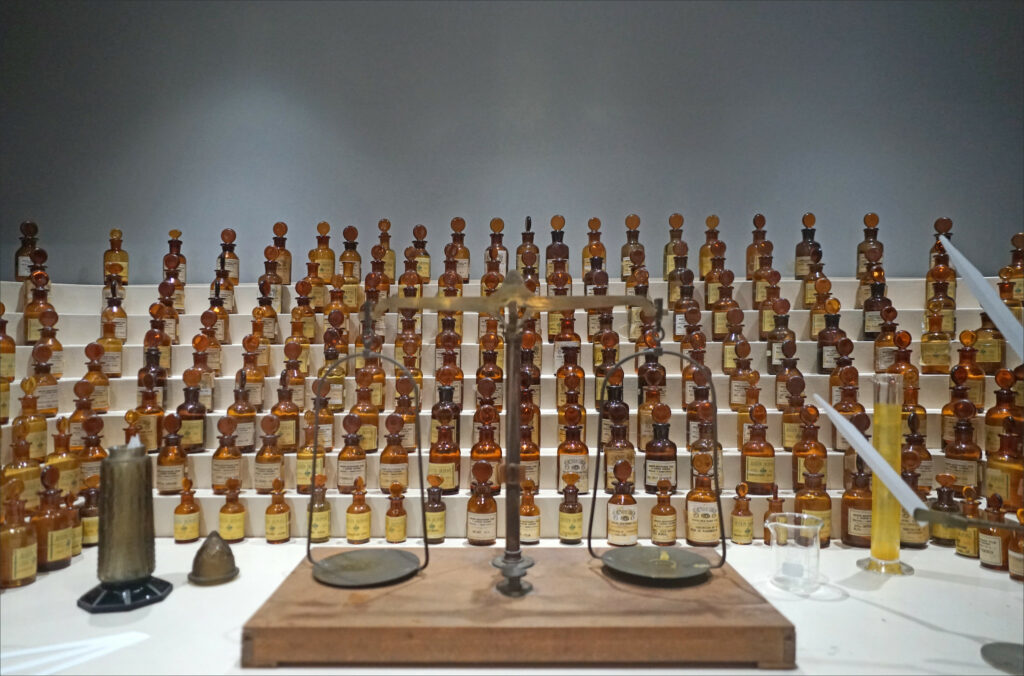
One of the most essential and iconic tools of a perfumer is the “perfume organ.” Just as a musical organ with its multiple pipes and keyboards makes it possible to produce a rich variety of sounds, the perfume organ is a specially designed piece of furniture containing a multitude of niches, each filled with bottles of different essences. The perfumer, like a musician, composes their olfactory symphony using this instrument, a desk essential to optimal organisation.
Symphony
A musical symphony is a grandiose work, generally structured in several movements, where each part contributes to a coherent whole. A perfume can also be considered a symphony, where each note plays its role, intertwining and evolving to create a complex, harmonious olfactory experience.
Composition
The process of creation, whether of a musical piece or a perfume, is often called “composition.” In both fields, this goes through the writing of the score that will bring the composition to life. It refers to the know-how of assembling different elements to create a unique, memorable work of art. Just as the musician who writes their composition mentally before transcribing it onto a score, the perfumer imagines their perfume and its accords first in their head and then materialises it into a formula. Trials will make it possible to refine their creation. As Jean-Claude Ellena emphasises in his Que Sais-je “Le Parfum,” just like the musician’s ear, the perfumer’s nose is nothing other than a tool of control and learning.
This rich exchange of vocabulary between music and perfumery testifies to the way these two worlds, although distinct, come together in their quest to express and evoke emotions. These shared terms remind us that we are touched in a deep, intangible way, transported by the magic of sensory art.
The Perfumery Houses That Draw Inspiration from Music
Art Meets Art: The brand created by Tanguy Le Baud uses the prism of culture and, more precisely, of music to make highly artistic perfumes. The perfumes then become works where the perfumers draw on the refrains of the great musical icons to create essences that tell a story, that of an era, an artist or a musical genre. The result? Perfumes that are so many olfactory tributes to the musical works that inspired them, offering art lovers a new way to explore and appreciate the musical classics.
L’Orchestre Parfum, created by Pierre Guguen, is a perfume house that transcends music into fragrance. The perfumes created here are compositions where each perfumed note is inspired by a musical instrument or a specific melody. The wearer of the perfume is invited to an immersive experience, where olfaction and hearing intertwine in a dazzling sensory dance, generating a third work of art that is none other than the emotion felt.
Room 1015, created by Michael Partouche alias Dr Mike: the echo of rock’n’roll.
With Room 1015, the world of rock’n’roll is sublimated into bottles emanating the rebellious, electric spirit of this music. The perfumes, with their woody, spicy and sometimes flowered notes, transport us into the world of hotels and dressing rooms, where the rock legends left an indelible trace of their passage. It is an olfaction tinged with nostalgia, freedom and non-conformism that unfolds with each waft of the perfume. Each perfume is accompanied by an original piece of music that describes the fragrance and by a specific playlist of the same style.
Musicology, founded by Fabien Boukobza, represents the essence of melodies in a bottle. The Musicology brand invites us to explore our own internal musical library through its perfumes. The idea here is to transcribe the essence of various musical genres into olfactory creations, thus making it possible to explore jazz, blues or rock through the prism of perfume. Musicology thus offers a journey where olfactory memory and auditory memory dialogue, making it possible to rediscover melodies through a new sense.
Jusbox, founded by Chiara and Andrea Valdo, the brand explores the world where musical and olfactory memories overlap, each perfume seeking to immortalise an emblematic moment of musical history. Their perfumes, like encapsulated melodies, offer a nostalgic olfactory experience, where scents trigger reminiscences of past melodies.
L’Oréal Paris collaborated with Ircam Amplify to create an innovative sound experience olfactorily translating the perfume Spicebomb Infrared by Viktor & Rolf, released in 2023. This initiative aims to produce a sound that reproduces the sensations and emotions provoked by the perfume. The perfumers Jean-Christophe Hérault, Nicolas Beaulieu and Carlos Benaïm, at the origin of the fragrance, worked with the Ircam Amplify team, including the sound designer Romain Barthélémy, to translate the olfactory notes of the perfume into a sound lexical field. Using Ircam Amplify’s SpeaK method, they developed and tested various sound drafts with consumers. The final result is a 26-second sound experience, capturing the evolution and the intensity of the fragrance and provoking a tangible increase in body temperature! This unique collaboration merges science, the art of perfume and marketing, offering a new perspective on the perception of perfumes.
Music and perfume, two art forms that transcend words and languages, merge in a surprising, exquisite way within these perfumery houses. Far from being a simple source of inspiration, music becomes an ingredient, a note, that resonates in each olfactory creation. And what if this interweaving of the arts were an open door towards new ways of apprehending and creating perfume? Could the multi-sensory experience be the future of perfumery, offering creations where seeing, touching and tasting will also be an integral part of the creative process and the user experience?
Sources
Nez, la revue olfactive n°14 – Musique et Parfum; Le parfum et la voix – Annick Le Guérer