
Mimosa in Perfumery
On the occasion of the mimosa festival, let’s explore mimosa in perfumery together, from its geographical and botanical environment to its use in the creation of fragrances. Let’s discover its natural smell, the extraction methods used to capture its essence, and analyse the olfactory nuances that make it a note prized by perfumers. Finally, we will highlight a selection of perfumes that embody the richness of mimosa.
The Geographical and Botanical Environment of Mimosa
Mimosa, a symbol of delicacy and resilience, finds its origins in the distant lands of Australia. This shrub, which is now an integral part of the Mediterranean landscape, and in particular on the Côte d’Azur, is known for its winter flowering, offering touches of colour and warmth in the often dark landscape of late winter.
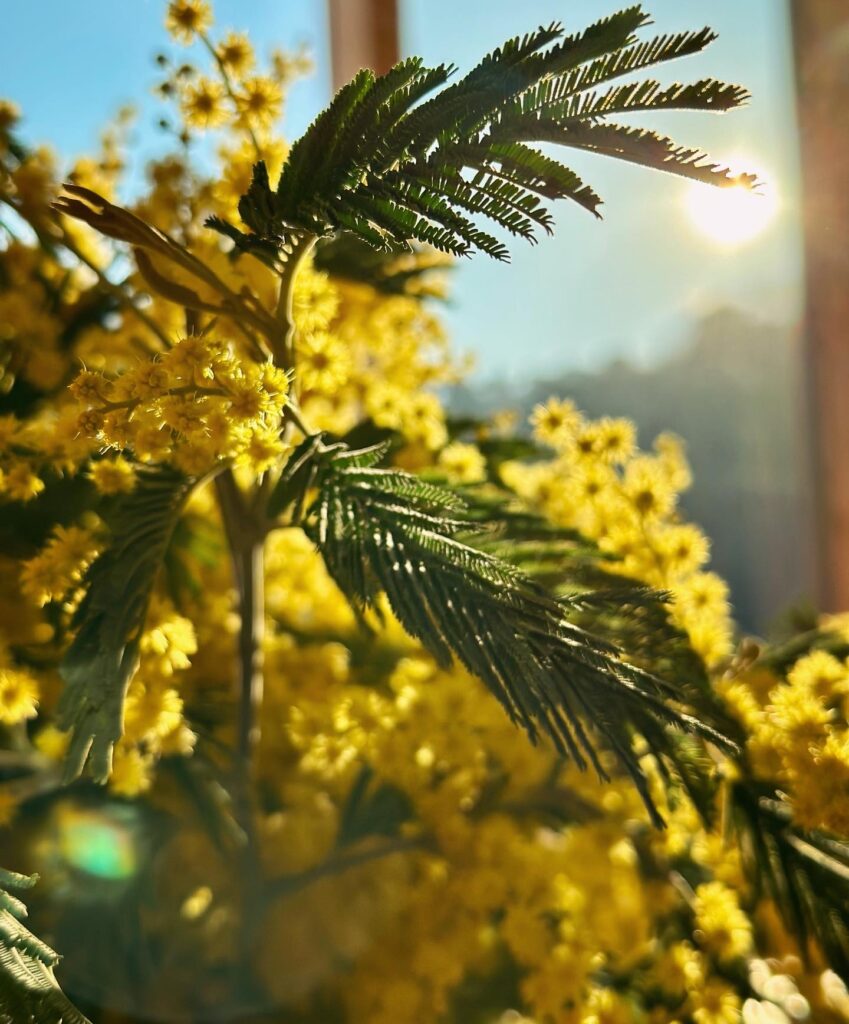
Mimosa, belonging to the Fabaceae family and characterised by its graceful leaves and its bouquets of spherical yellow flowers, blooms from January to March, bringing colour and scent to winter landscapes. Beyond its aesthetics, mimosa plays a crucial ecological role in fixing soils and serving as a habitat for wildlife, while having a cultural importance, notably in the Côte d’Azur region where it is celebrated for its resilience and its beauty that brighten the landscapes in late winter.
The Smell of Mimosa and Its Extraction Method
This scent, at once delicate and complex, makes mimosa an essence prized in perfumery for its ability to bring luminosity and elegance to compositions.
The Smell of Mimosa
Its natural scent stands out for an enveloping softness, where slightly powdery, almondy floral notes blend with a honeyed base and a hint of fresh greenery. This olfactory alchemy evokes springtime softness, gentle sunshine. The smell of mimosa is at once delicate and powerful, luminous and soothing.
In perfumery, mimosa brings a touch of light and warmth to compositions, marrying harmoniously with woody, ambery notes, or with floral and green accords.
The nuances of the smell of mimosa are manifold: at first, it may seem simply sweet and floral, but more sustained attention reveals its richness and its complexity. The green, fresh facets recall the first days of spring, while the powdery, honeyed touches offer a depth and an enveloping warmth, creating a perfect balance between vivacity and softness.
The Extraction Methods
The extraction of mimosa essence for its use in perfumery is a delicate process that aims to capture all the complexity of its fragrance. Mimosa flowers are particularly fragile, which requires careful extraction methods to preserve their authentic essence.
- Volatile solvent extraction makes it possible to obtain a mimosa absolute. The flowers are plunged into a solvent, most often hexane, which captures the volatile compounds. Once saturated with scent, the solvent is evaporated in order to collect a concrete, a kind of fragrant wax, which will be washed with alcohol to separate the fatty substances and thus obtain the absolute. This very concentrated absolute offers perfumers a high-quality raw material for their creations.
- Supercritical CO2 extraction, applied to mimosa, makes it possible to obtain a pure, high-quality essence of this flower without using chemical solvents. By exploiting CO2 in the supercritical state, which combines the properties of a gas and a liquid, this method extracts, at low temperature, the delicate aromatic compounds of mimosa while preserving their freshness and their integrity. This environmentally friendly process offers a complex extract faithful to its natural scent.
A Few Perfumes Built Around Mimosa
Several olfactory creations showcase mimosa, each interpreting this solar flower in its own way. Among the emblematic perfumes, we can cite:
Farnesiana by Caron, a floral perfume launched in 1947 by Michel Morsetti, interprets mimosa with a rich, nuanced composition. At the top, accords of mimosa blend with wafts of hay, blackcurrant and bergamot, introducing a complex, welcoming opening. The heart unfolds around violet, jasmine and lily of the valley, creating a deep, captivating floral bouquet thanks to iris butter. In the base, vanilla, sandalwood, opoponax and musk bring a warm, resinous base, finishing on a soft, honeyed note.
Mimosa Pour Moi by L’Artisan Parfumeur, by Anne Flipo in 1992. This perfume is a pure, simple celebration of mimosa, offering a fresh, slightly sweet fragrance. The composition opens on green notes that evolve towards a floral, powdery heart, capturing the delicate, sunny essence of mimosa. The base reveals a touch of vanilla, adding a soft, comfortable dimension to the fragrance.
Champs-Élysées by Guerlain, Olivier Cresp, 1996. Inspired by the eponymous Parisian avenue, this floral, fruity perfume blends mimosa with rose, almond and fruity notes of melon and peach. The presence of mimosa brings a unique softness to the composition, making Champs-Élysées a joyful, sophisticated fragrance; the base remains barely gourmand for a luminous fragrance.
Summer by Kenzo, created by Alberto Morillas in 2005, is a perfume that evokes summer with its top notes of citrus and bergamot. The floral heart blends mimosa and almond milk with delicate flowers such as lily of the valley and jasmine, while the base notes combine musk, lemon, amber and wood for a warm, sunny finish. An invitation to summer pleasures, a fragrance that is at once fresh and deep, perfect for evoking the most luminous season of the year.
Le Mimosa by Goutal, by Isabelle Doyen and Camille Goutal, created in 2011. Le Mimosa is an ode to this flower, with a fresh, luminous interpretation. The mimosa notes are accompanied by accords of peach and iris, creating a soft, powdery and slightly fruity fragrance that evokes the first breath of spring.
Mimosa & Cardamom by Jo Malone, created in 2015 by Marie Salamagne. A warm, spicy perfume, where mimosa meets the richness of cardamom. This combination creates a fragrance that is at once comforting and invigorating, with mimosa bringing a floral softness and cardamom adding a spicy, aromatic dimension. The base, carried by tonka bean, wraps the whole to reinforce the softness.
Infusion de Mimosa by Prada, launched in 2016 and created by Alberto Morillas, is an olfactory ode to mimosa, blending delicacy and radiance. Part of the Les Infusions collection, it is imbued with Prada’s sophistication. Floral notes intertwine around mimosa, evoking a breeze fragrant with flowers. The composition, subtle and balanced, is completed by warm base notes that add depth and comfort. This perfume, at once modern and timeless, is ideal for those who want a pure floral essence for everyday.
Mimosa Indigo by Atelier Cologne, created in 2016. A perfume that is part of the Cologne Absolue collection, combining mimosa with rich, deep notes such as leather and sandalwood. The result is a complex, sophisticated fragrance, where the softness of mimosa blends with darker, more enveloping accords, offering a unique interpretation of this flower combined with bergamot and lilac on a distinguished base.
Mimosa Tanneron by Perris Monte Carlo, by Jean-Claude Ellena in 2020. Named after the Tanneron region, famous for its mimosa forests in France, this perfume captures the essence of the flower with exceptional fidelity. The fragrance opens on fresh, green notes, leading to a rich heart of mimosa, before settling on a woody, slightly sweet base, reflecting the complexity and the beauty of the flower.
Mimosa by Le Couvent, created in 2021 by Jean-Claude Ellena. This perfume is probably a celebration of mimosa in its purest, most natural form. One can expect a delicate fragrance, highlighting the softness and luminosity characteristic of mimosa, possibly accompanied by subtle green or woody notes to complete its olfactory profile.
Mimosa Supercritique by Les Eaux Primordiales, created in 2021 by Amélie Bourgeois, is an ode to mimosa, using CO2 extraction to capture the pure essence of the flower. The fragrance begins with invigorating top notes of aldehydes, cyclamen, bergamot and neroli, evolving towards a floral heart of jasmine, tuberose and orange blossom. In the base, mimosa blends with white musks and ambroxan, creating a perfume that marries tradition and innovation, for a rich, modern olfactory signature.
Each of these perfumes offers a distinct interpretation of mimosa, demonstrating the versatility and the richness of this note in perfumery.
Mimosa is an inexhaustible source of inspiration in perfumery, offering a palette of fragrance that goes from powdery softness to honeyed warmth. Its cultivation, its extraction, and its prime place in olfactory compositions make it a true treasure for perfume lovers. The diversity of perfumes built around mimosa testifies to its richness and its universality, inviting a sensory journey with every waft.