
Perfume and War
On the occasion of the commemoration of 11 November, the day marking the end of the First World War, our olfactory reflection leads us to explore an unexpected angle: the relationship between perfumery and war. These two worlds seem far apart, and yet history reveals to us an intimate link, rich in creations and symbolism. It is an olfactory journey between resilience and renewal that we propose you discover.
The Olfactory Correlations Between Perfume and War
War, with its conflicts and its turmoil, seems at first sight antithetical to the finesse and the harmony that perfumery represents. Yet the history of the olfactory art and of the great world confrontations are surprisingly intertwined, weaving deep, complex links that deserve to be explored.
Cross Influences: Raw Materials and Economy
The first correlation between perfume and war is at the level of raw materials. World conflicts have often disrupted trade routes and the availability of certain precious essences. The Second World War forced perfumers to reinvent themselves, because of the shortage of natural raw materials, giving rise to the increased use of synthetic molecules.
The shortages due to the blockade of wars are also at the origin of new ways of creating and wearing perfume: in the United States during the Second World War, faced with the shortage of perfume alcohol needed for making eaux de toilette, American manufacturers adapted by creating innovative alternatives: more concentrated extracts (therefore containing less alcohol), perfumed creams and powders, solid perfumes and bath oils.
In Spain, during the civil war (1936–39) and the years that followed, it was impossible to import raw materials for perfumes. Self-sufficiency was the order of the day. This is how Agua Lavanda, Puig’s first flagship product launched in 1940, was created with local Mediterranean materials: lavandin, sage, rosemary, thyme, lavender, cistus labdanum… An eau de cologne which, moreover, fitted perfectly with the traditional values carried by the Franco regime.
Beyond the economy, there is the symbolism. Perfumes born during or just after periods of war often carry within them the spirit of their era. They become emblems, acts of resilience, conveying that spirit of renewal and optimism, and marking the return to life and reconstruction.
Perfume as Memory: Conservation and Transmission
Perfume has this unique faculty of capturing and preserving memory. The olfactory creations inspired by periods of war are vectors of historical transmission, evoking not only collective memory but also personal stories. They make it possible not to forget, to teach, and to continue telling the story through the senses.
Olfactory Notes: Echoes of War in the Art of Perfumery
At the heart of perfumery, the olfactory notes associated with war evoke powerful, complex memories.
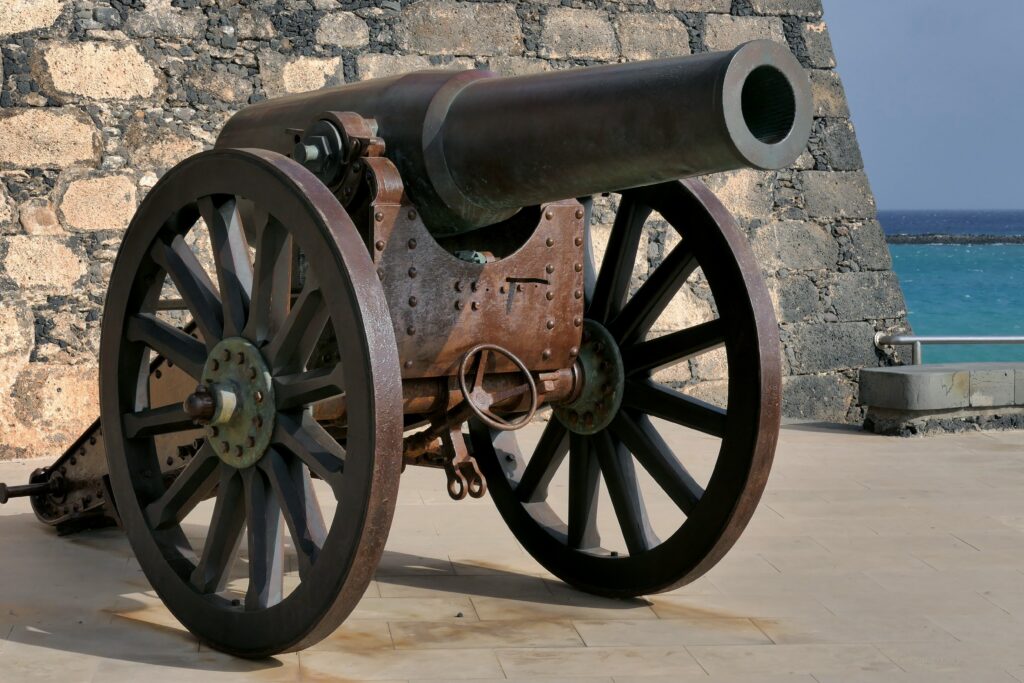
Take the gunpowder note, for example, whose metallic, sulphurous smell instantly recalls battlefields and distant detonations. This note, used sparingly, confers on fragrances a dimension that is both mineral and bold.
Smoke, for its part, evokes campfires and landscapes after the confrontation, its woody, burnt character increasing depth and mystery. When it enters the composition of a perfume, smoke brings a dimension that is both airy and dark, like a phoenix rising from the ashes of devastation.
Leather is another note that finds its roots in military equipment: boots, belts and harnesses. Let us recall that the first leather notes in perfumery were brought by birch wood, with which the Cossacks maintained their boots and which gave leather a very specific smell. This note embodies robustness and strength, but also a form of nobility and refinement. In perfumery, leather often reveals itself as warm and sensual, a subtle allusion to the armour that one dons to face ordeals.
Fog is more abstract but just as evocative: it recalls the unknown and uncertainty, the concealment of movements and strategies. It is often suggested by aqueous or ozonic notes, bringing a freshness that plays with clarity and sharp outlines, evoking the ambiguity of troubled times.
Finally, earth—damp, fertile, turned over by the trenches—is particularly evocative. It speaks of death and of life, of the inescapable cycle that war highlights with brutality. In olfactory compositions, earth reconnects us with nature and with the basis of our existence, with chypre accords or notes of vetiver, oakmoss and patchouli that anchor perfumes and give them a unique resonance.
These olfactory notes do not simply tell a story of war; they also tell a story of human resilience, of adaptability and, ultimately, of hope.
A Few Symbolic Perfumes
Chanel N°5: a Legend in Wartime
N°5 is a pillar of perfumery, a perfume that has defied eras and trends since its creation in 1921 by Ernest Beaux for Gabrielle Chanel. Its composition, a complex alchemy of floral notes with an overdose of aldehydes, brought an olfactory revolution with an exceptionally modern, abstract bouquet. During the Occupation of the Rhineland, when France was marked by war, Chanel N°5 continued to be an emblem of French elegance. Its ability to remain in production offered a form of cultural resistance, a reminder of beauty and refinement in contrast with the dark times. The perfume transcended its era to become a symbol of survival and continuity, offering a touch of luxury and normality in an otherwise chaotic world. A French luxury that was also exported across the Atlantic thanks to the American soldiers who, on returning from the war, brought back to their wives this chic souvenir of Paris…
Vent Vert: an Ode to Freedom
Vent Vert, launched by Balmain in 1947, is often celebrated as the first perfume to capture the essence of post-war renewal. Designed by the legendary nose of Germaine Cellier, this perfume is a true pioneer in the world of perfumery, introducing a wind of freshness into an era dominated by heavy, opulent scents. The name itself, “Vent Vert” (Green Wind), is evocative of the liberation and the breath of freedom so awaited after the dark years of the war. Its top notes are a burst of greenery, an innovative blend of galbanum, basil and lemon that signified a bold departure from the conventions of the time. The floral heart opens on aromas of rose, jasmine and ylang-ylang, evoking the rebirth of nature in spring. The woody base with touches of vetiver and musk anchors the perfume in a sensation of quiet strength. Vent Vert is not simply a perfume, it is a declaration of hope and a hymn to life reclaiming its rights.
L’Air du Temps: a Symphony of Peace
L’Air du Temps by Nina Ricci, created in 1948, is another olfactory treasure that captured the spirit of the post-war era. Designed by the perfumer Francis Fabron, this perfume embodies the universal aspiration to peace and harmony in a world that was barely emerging from the shadow of war. The bottle, topped with two entwined doves, is a powerful symbol of peace and purity. The fragrance itself is a delicate, feminine blend, opening on sparkling notes of spices and bergamot that introduce a flowered heart of rose and jasmine. The addition of iris brings a touch of powder, a reminder of rediscovered softness and innocence. The base blends sandalwood and musk, creating a sillage that speaks of calm and comfort. L’Air du Temps is more than a perfume, it is a message encapsulated in a bottle, a promise of a new era charged with optimism and joy.
L’Art de la Guerre: a Modern Olfactory Reflection
“L’Art de la Guerre” by Jovoy, created by Vanina Muracciole, although more recent in the world of perfumery, establishes a conceptual link with the Chinese strategy of Sun Tzu, whose writings are known for their deep understanding of the dynamics of conflict and peace. Launched in 2014, this perfume is an olfactory interpretation of strategy and tactics, reflecting the complexity and the depth of Sun Tzu’s work. The fragrance opens on citrus and fresh notes, symbolising the clarity of mind necessary for strategy. The spicy heart represents the manoeuvres and the unpredictable movements of battle, while the leathery base evokes the warriors’ armour. The presence of vetiver and patchouli in the sillage brings an earthy, robust dimension, recalling that all strategies are ultimately anchored in the terrain, in the reality of the world. “L’Art de la Guerre” is a tribute to the principles of discipline, patience and tactical intelligence.
Perfumery, like the flowers that grow back on the battlefields, is a resilient art that not only survives dark times but draws inspiration from them to create. These historic perfumes are not only olfactory witnesses of a bygone era, but bridges to the future. On this 11 November, let us remember that each note of these perfumes carries within it the spirit of an era, the memory of a struggle and the hope of a world at peace.