
Gourmet Notes in Perfume
A treat or a trick? Halloween is approaching, and soon the little pumpkin-shaped baskets of the youngest children will be filling up with multicolored candy. Calling all sweet tooths craving treats: Master Parfums invites you to explore the gourmand fragrance family and its most iconic sweet notes, each one more tempting than the last.
Olfactory Families in Perfumery
In 1984, the Société Française des Parfumeurs unveiled a classification of perfumes into different families based on the raw materials used in their composition. Various facets can also be distinguished within these families themselves—facets that add nuance to a fragrance’s identity. For example, a fragrance that highlights sandalwood would undoubtedly be classified as part of the woody family. Is it sprinkled with cardamom, nutmeg, or even pepper? Then we’d call it woody-spicy. Do lavender, rosemary, or thyme make an appearance? Bingo—we’re dealing with a woody-aromatic.
As early as the beginning of the 20th century, certain molecules with vanilla notes (vanillin) or fruity notes such as peach (C14 aldehyde) or plum (De Laire’s prunol) added a new sense of roundness to fragrances, but the term “gourmand” as we know it today had not yet been coined. The term “gourmand” initially referred to an olfactory facet, but with the wave of delightfully sweet fragrances launched in the 1990s, it is now used to designate a distinct fragrance family in its own right.
The gourmand fragrance family
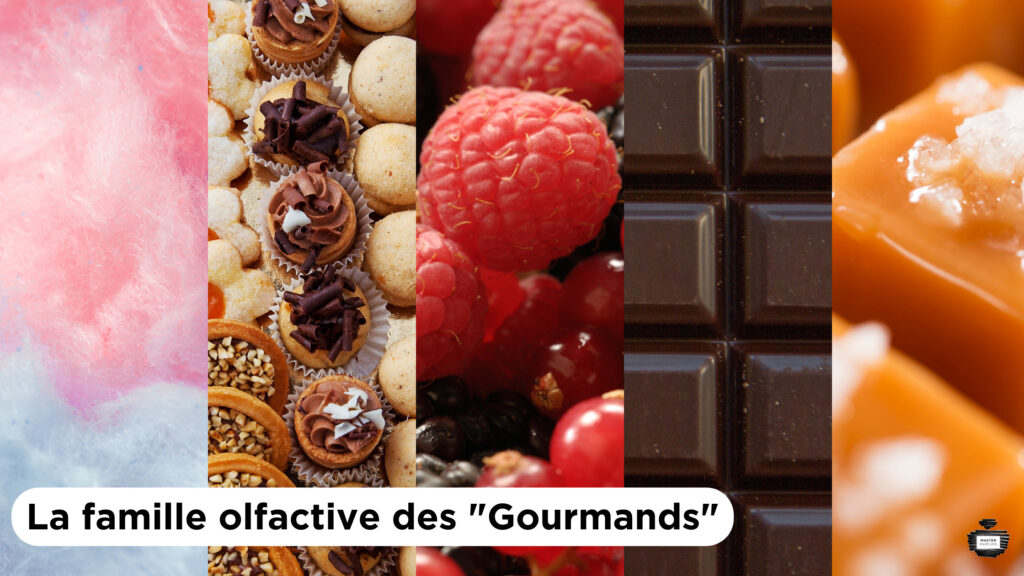
While the 1970s saw a trend toward floral, green, and chypre compositions synonymous with freshness and elegance, vanilla-based fragrances began to quietly breathe a warm breath of renewal into the olfactory landscape of the time. This was particularly true of Guerlain’s creations, as the brand was a pioneer in the creation of gourmand perfumes. It’s impossible not to mention La Guerlinade: this fragrance base, created in 1921 and composed of vanilla, bergamot, iris, rose, tonka bean, and jasmine, would become the signature scent of many of the brand’s perfumes.
The gourmand revolution of the 1990s began with Thierry Mugler’s Angel. When it was released in 1992, this bewildering fragrance—the likes of which had never been smelled before—struggled to find its place. People weren’t used to putting so much “sugar” on their skin.
But these indulgent scents eventually become addictive, and as the new millennium approaches, we love to wrap ourselves in fragrances with nostalgic notes.
Its overdose of patchouli, red berries, and caramelized vanilla—along with its famous ethyl maltol molecule evoking cotton candy and praline—cast a spell, and in its wake, an ever-growing number of sweet fragrances emerged, with notes so tempting you just want to take a bite. And this groundbreaking fragrance, now a classic, has become the leader of a new olfactory family: the gourmand fragrances. A wave of fragrances with mouthwatering notes—both nostalgic and sexy—is sweeping through our perfume shops…
In the gourmand family, I’d like…
Vanilla
If there’s one note that could truly be called timeless, it’s vanilla. There may be over a hundred varieties of vanilla, but nothing changes the fact that perfumers’ favorite remains Bourbon vanilla, because its aromas are both incredibly rich and refined. In perfumery, it can be as creamy and balsamic as it is ethereal and powdery, often coming across as sensual and almost animalic, while other versions are filled with tenderness, like a caress.
While perfumers may use a fine vanilla absolute, the high cost of vanilla beans has made the use of synthetic notes such as vanillin and ethylvanillin more widespread (although vanillin can be obtained naturally). Synthetic vanillin was used for the very first time amid the multitude of aromatic notes in Jicky (1889). Also from Guerlain, the voluptuous Shalimar (1925) marked the beginning of the “Guerlinade”… which, incidentally, is said to have been created after reworking Jicky by adding ethylvanillin! Of course, vanilla also shines in Angel.
Marshmallow
Did you know that before becoming Haribo’s “Chamallows” candy, the marshmallow plant is native to the wetlands of China, Russia, and Europe? It’s not its leaves or flowers that interest us here… it’s its roots! In fact, marshmallow roots are rich in mucilage, a viscous substance used to make the famous confection that looks like a little powdery cloud.
Marshmallow, in both confectionery and perfumery, is light and fluffy, with a hint of vanilla. To capture this scent in a bottle, one can turn to synthetic notes or to a vanilla-orange blossom accord, found notably in Guerlain’s magnificent, powdery L’Heure Bleue (1912). Also worth mentioning is the cozy Mademoiselle Guerlain (2014) with its iris and white musks, Boucheron’s Quatre en Rouge (2019), a fruity fragrance reminiscent of a candy apple, or État Libre d’Orange’s Divin’Enfant (2006), where marshmallow flirts with the bitterness of coffee, leather, and tobacco.
Almond
In perfumery, almond is reminiscent of marzipan and frangipane, and can evoke cherry or amaretto. While it is impossible to extract an essence from the almond itself, hydrodistillation of apricot or plum pits can yield an essential oil containing benzaldehyde, an olfactory component with a bitter almond scent… but be careful: it is a delicate raw material to work with due to the hydrocyanic acid it contains, a highly toxic compound that must be removed.
That’s where the tonka bean comes to the rescue: it’s a small seed whose main aromatic component, coumarin, exhibits notes of tobacco, gingerbread… and almond! When it comes to synthetic molecules, perfumers can rely on synthetic coumarin, of course, but also on benzoic aldehyde, anisic aldehyde, and heliotropin—the latter being naturally present in small quantities in violet flowers.
In 2007, Guerlain’s L’Instant Magic was one of the first fragrances to feature bitter almond essence prominently, blending it with vanilla, musks, and woody notes. The presence of almond lends Christian Dior’s sensual Hypnotic Poison (1998) a touch of sweetness, while in La Petite Robe Noire (2012), it reveals its most elegant cherry facet, already hinted at by the morello cherry in its top notes. It also appears in Yves Saint-Laurent’s scandalous Black Opium (2014), La Vie est Belle (2012) with its gourmand iris, and Serge Lutens’ Un Bois Vanille (2003) in the niche perfume sector. Prada dedicates one of its beautiful infusions to it.
Caramel
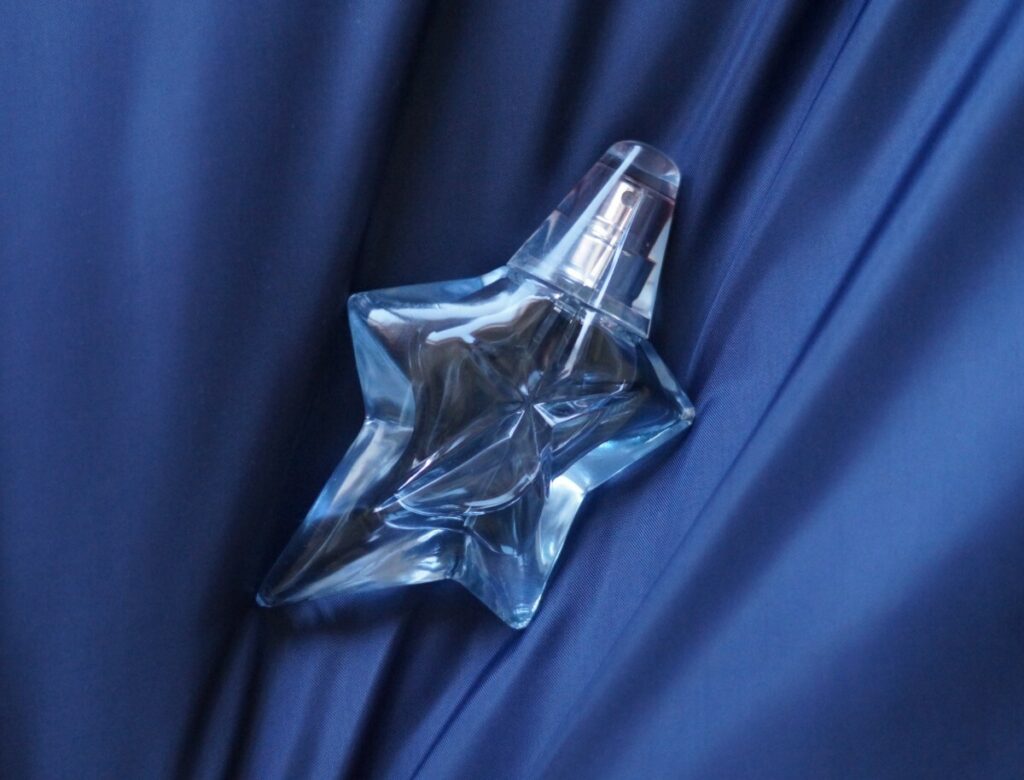
Whether it’s crunchy to the bite or, on the contrary, sticks to our teeth, this iconic treat from Brittany has also made its way into the world of perfumery with the release of Angel. The warm, syrupy scent of caramel must be created synthetically: ethyl maltol, furanol, sacrasol, or coumarin—these molecules jostle to recreate the characteristic aroma of burnt sugar, vanilla, and milk found in golden caramel. Sweet and balsamic, caramel is an incredibly nostalgic note.
To experience it in a bottle, aside from Mugler’s iconic Angel, consider Jean-Paul Gaultier’s Scandal (2017) and its honey-coated salted caramel; Nina Ricci’s Luna (2016), where it weaves its way through red berries and pear; or Thierry Mugler’s Alien Le Goût du Parfum (2011) by Thierry Mugler—a supremely sensual reinterpretation of the 2005 original, where the sweet note reveals a magnificent heart of cashmere wood.
Cocoa
Cacao beans are truly everywhere: we can enjoy them in our chocolate bars, but also on our skin! Highly versatile, cacao can be just as much a comforting, milky note as it is an animalic, sensual one. It’s a staple in base notes, pairing perfectly with vanilla, musks, and woods for guaranteed sensuality. Its rich aromas can be captured naturally with a cocoa powder absolute, but they can also be evoked—for example, through musks, patchouli, and tonka bean—or achieved using synthetic bases such as chocovan and pyrazines.
In Pure Poison Élixir (2006) by Christian Dior, an amber cocoa absolute is blended with jasmine and orange blossom. In L’Instant de Guerlain for men (2015), cocoa is paired with a surprising blend of tea, resin, and spices. Dark (2018) by Akro, the brand of perfumer Olivier Cresp, pairs its cocoa with cinnamon and hazelnut, and in Vanilla Diorama (2021), it is steeped in rum and enhanced with a hint of pink pepper.
The Tonka Bean
We’ve already mentioned it several times in this article: the tonka bean is a small black seed that comes from a South American tree. Once they fall from the tree, the fruits are left to dry for a year, then cracked open to extract the seeds… which are actually the tonka beans. These are then macerated in rum for a full day before being dried. It is during this process that small crystals form on the surface of the tonka bean: this is coumarin, its main component and the substance that gives it its characteristic almond-like scent with hints of hay. Once the beans have been transformed into an absolute, they take on a warmer, balmy quality, reminiscent of tobacco.
One of the very first fragrances to introduce the tonka bean in the form of synthetic coumarin was Jicky—synthetic vanillin alone wasn’t enough for it! It’s also worth noting that the tonka bean is one of the ingredients in the Guerlinade. Over time, it has become a signature note for the House of Guerlain: there’s Shalimar, but also Samsara (1989), Insolence (2006), and the magnetic Tonka Impériale (2010)… Van Cleef & Arpels’ Bois Doré (2017) and Tom Ford’s Tobacco Vanille (2007) combine their tonka bean with the woody aroma of tobacco, and Tonka Blanc (2022) by L’Artisan Parfumeur is surprising to say the least, because amidst an almondy tonka bean refreshed with citrus, what suddenly intrudes is… cauliflower!
A Word on Hunger
It’s impossible to list them all: honey, sugared almonds, dulce de leche, licorice… These indulgent notes continue to tantalize both our taste buds and our sense of smell. Ever since Angel, cotton candy has continued to melt on our skin; this is the case, for example, in Byredo’s Sundazed (2019). Lactones, meanwhile, are a family of molecules capable of recreating the sweet, comforting vanilla scent of warm milk; Issey Miyake’s Le Feu d’Issey was the first fragrance to use them in 1998. Fruity notes, mostly obtained through synthesis, are also abundant in gourmand perfumes.
Speaking of fruit, with Halloween just around the corner, why not dare to try… pumpkin? No need to be scared: its gently fruity and creamy character makes it a perfect match for white flowers, while its woody undertones pair beautifully with spices. Paco Rabanne’s Fabulous Me (2019) eau de parfum pairs pumpkin with rhubarb in a cocoon of almond-vanilla, while État Libre d’Orange complements the velvety pumpkin accord in Like This (2010) with immortelle and spices.
Want to keep feeding your appetite for the world of perfumery? You’re in luck: the Master Parfums game book has prepared 120 questions about perfume, a shower of olfactory challenges, and scented pencils to help you sketch out your own fragrance… perhaps a gourmand fragrance?