
Olfactory Families in Perfumery
Perfumery is a complex art that consists of combining different scent notes to create a unique, harmonious fragrance. One of the main methods used to classify perfumes is categorisation into olfactory families. These families group perfumes according to their olfactory characteristics.
Classification by Olfactory Family
Classification by olfactory family in perfumery was first introduced in 1984 by the Société Française des Parfumeurs. A categorisation of perfumes is established into different olfactory families based on the scent characteristics of the raw materials used in their composition.
This classification has been widely adopted by the perfume industry and is today considered a reference tool for understanding the different types of perfumes available on the market.
Classifying perfumes into olfactory families is a useful way of understanding their olfactory characteristics. In creating this codification, the overall organisation of modern perfumery rests on fundamentals, making it possible to organise the different types of perfume according to their dominant olfactory composition.
Each of these olfactory families has its own distinctive characteristics and can be subdivided into sub-categories according to the dominant smells. These are then called facets.
Here, we present a simplified classification: 5 families decoded in a vivid way, with simple terms to better understand the families and their associated facets.
The Fresh Olfactory Family

The fresh perfume family groups together several facets:
- Hesperidic (citrus): Sparkling facets are carried by compositions based on citrus fruits from which the essential oil has been extracted. Hesperidic perfumes are perfect for hot, sunny days since they provide an immediate, very pleasant refreshment. It is one of the oldest olfactory families (along with the florals), which made the golden age of eaux de Cologne. Eau d’Orange Verte by Hermès, created by JC Ellena, represents this hesperidic family well.
- Green: Here we find green, crunchy notes with the smell of freshly cut grass.
- Aromatic: with notes of aromatic herbs such as basil, sage, or lavender, mint or mugwort. Eau du Sud by Goutal (Annick Goutal) is a very lovely example of a fresh perfume that is at once hesperidic and aromatic.
- Clean: There are also so-called “clean” notes, composed of notes evoking clean laundry (DHMOL, white musk)—this is called a “clean scent.” A perfume that embodies this facet well is Fleur de Peau by Diptyque (Fabrice Pellegrin), composed of pink pepper for freshness, ambrette seed for the crystalline, transparent facet, iris for the powdery facet, and white musk to give texture with cottony, clean, soft and comforting facets. And in a more “mainstream” fragrance, we can cite Cool Water by Davidoff or CK One by Calvin Klein.
- Aquatic/marine: a facet with notes evoking the sea spray of seaside holidays (calone) or the fresh water of a lake, a waterfall or a stream. Emblematic perfumes such as Kenzo pour Homme, where the marine note mingles with woods; L’Eau d’Issey, a soft water bathed in flowers; or Acqua di Giò, whose citrus and marine note transport us to an Italian island.
The Floral Olfactory Family

The floral family is the most common in perfumery. These perfumes stand out for the predominance of flowers. Jasmine, rose, lily of the valley, iris, orange blossom or violet. Floral perfumes are often paired with fruity or woody notes to create more complex fragrances.
We speak of a Soliflore perfume when it is a variation on the theme of one material/flower. For example, Diorissimo by Dior, a variation on the theme of lily of the valley, Christian Dior’s favourite flower.
“Bouquet” accords are also much appreciated: white flowers, powdery flowers, compositions built around the different roses, or so-called exotic or solar flowers give an infinity of possibilities, and are easily paired with other olfactory families.
The floral facet in our Master Parfums game is a romantic floral bouquet (rose, peony, raspberry), but florals can also be more sensual, narcotic, more springlike or more solar, depending on the materials chosen.
The eau de toilette Insolence by Guerlain is a beautiful fruity floral in which we find violet, orange blossom, iris and red-fruit notes.
The Woody Olfactory Family

This olfactory family is composed of notes built around woods such as cedar, sandalwood, vetiver, rosewood or oud wood. Woody perfumes have a warm, comforting smell, long evoking masculinity because of their powerful, sensual character. But it is a family that can also be chosen to create perfumes for women.
Woody notes can be used to create warm, captivating perfumes, but also to warm up fresh, aromatic perfumes.
At the beginning of the 20th century, the woody family began to gain importance in the perfume industry. One of the first modern woody perfumes, and considered as such, is Bois des Îles by Chanel, followed by Pino Silvestre by Vidal. These perfumes were the first to incorporate wood notes into their modern compositions, thus creating a new category of perfume.
Long perceived as reserved for men, woody perfumes gradually opened up to women thanks to the audacity of certain brands. In 1992, Serge Lutens created Féminité du Bois for Shiseido, which is considered a pioneer in the use of woody notes in perfumes for women.
The Amber Olfactory Family

Amber, or oriental, perfumes are rich and sensual, frequently enhanced with spicy notes such as cinnamon, clove or vanilla. Their main particularity is that they are ambery, balmy: resins such as benzoin or myrrh give them a hyper-sensual, attractive character. Ambers are often categorised as captivating seduction perfumes, thanks to the rich, warm, sensual notes that make them up.
Shalimar by Guerlain, or Opium by Yves Saint Laurent (Jean Amic and JL Sieuzac) are convincing examples.
An oriental perfume is an accord of ambery notes (ambergris, labdanum/cistus, etc.) paired with balsamic notes (incense, benzoin, myrrh, etc.), mystical. These warm, sensual notes are dressed in citrus and/or animalic, gourmand, floral, fruity, powdery or spicy facets.
The Gourmand Olfactory Family
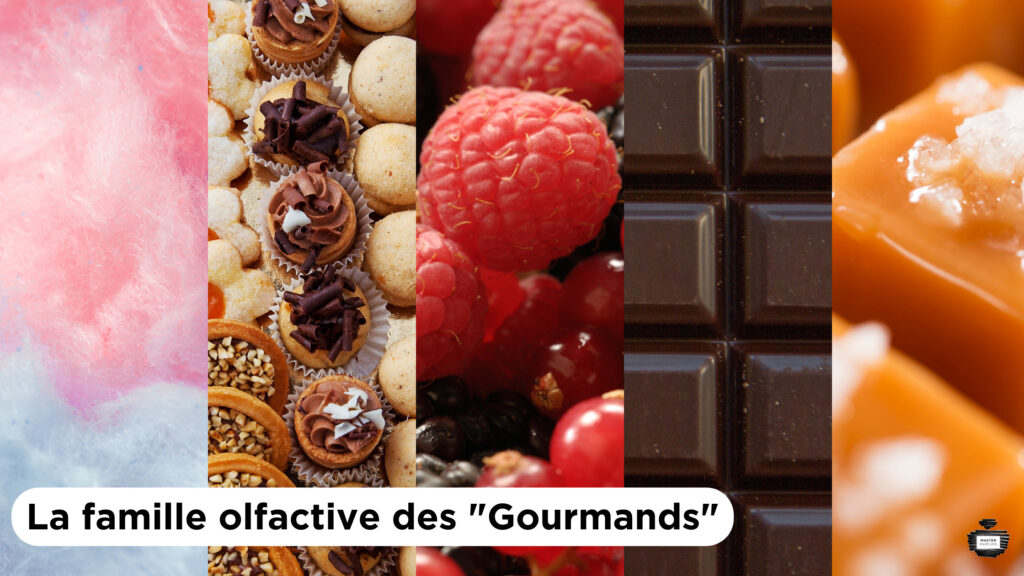
The gourmand olfactory family is relatively new in the world of perfumery. It emerged in the 1990s, with the creation of the perfume Angel by Thierry Mugler, considered the forerunner of gourmand perfumes with the incorporation of the ethyl maltol molecule, whose characteristic smell evokes that of candyfloss, praline and candied fruits. This innovative perfume shook up the world of perfumery by introducing food notes, such as chocolate, caramel and vanilla, into its composition.
Gourmand perfumes were named thus because they evoke smells linked to pastries and delicious desserts, often soft and sweet. They tend to be rich, enveloping and comforting.
We can include in this gourmand family the fruity facet, just as appetising but more “juicy,” tangy, with joyful notes evoking colourful cocktails.
As the gourmand olfactory family evolved, it began to encompass a wider variety of notes. Beyond the traditional sweet notes of facets such as honey, or the creamy and buttery notes, dried or candied fruits and even certain salty notes such as popcorn began to appear.
Other Types of Families
There are other olfactory categories, which are also references for perfumers.

Leather
The leather olfactory category represents perfumes that have an intense, charismatic smell, associated with notes of leather, tobacco, wood and musk.
Cold leather, warmer and velvety suede-style leather, animalic leather or floral leather—the variations and facets are many.
This olfactory family is relatively recent, even though it references the historic trade of the glover-perfumers of Grasse who, as early as the 18th century, in order to camouflage the animalic smell of the leather used, perfected their skills in perfumery by applying floral essences to scent the gloves destined for the court.
When perfumers began to use synthetic—and vegan—raw materials to create innovative perfumes reconstituting the smell of leather, this olfactory family established itself.
Classic examples of leather perfumes include “Cuir de Russie” by Chanel (Ernest Beaux) or Traversée du Bosphore by L’Artisan Parfumeur (B. Duchaufour).
Chypre
Chypres are known for their sophistication and elegance. This olfactory family takes its name from the famous perfume Chypre created by François Coty in 1917. It was, at the time, a revolution in the world of perfumery. Chypre perfumes are historically composed of citrus notes such as bergamot, flowers such as rose and jasmine, oakmoss, patchouli and labdanum (cistus): an unprecedented and particularly seductive accord.
This family is characterised by sophisticated, complex perfumes that present a combination of fresh top notes, floral heart notes and rich, woody base notes.
When it is a feminine chypre, we can evoke the glamour of the Femmes Fatales of the ’50s.
When it is masculine, the flowers become more discreet and the spotlight here goes to the base of oakmoss and patchouli, deep and powerful.
Fougère
The fougère olfactory family is one of the oldest and most respected in the perfume industry.
The history of this perfume family dates back to the end of the 19th century, when the French perfumer Paul Parquet created Fougère Royale in 1882 for the house of Houbigant. This creation was a revolution in the world of perfumery, because it was the first to use synthetic ingredients such as coumarin, which was then still very rare.
Let us note that this is not an olfactory family that refers directly to the smell of the fern plant, but rather to an accord—in the same way as the chypres—traditionally composed of notes of lavender, geranium, coumarin and oakmoss, often evoking the smell of shaving soap.
In the 1900s and 1910s, many other perfumes of the fougère family were created, such as Jicky by Guerlain. Fougère perfumes quickly became popular and are, in the vast majority, perfumes for men.
Classifying perfumes into olfactory families revolutionised the world of perfumery. This categorisation helps us understand and appreciate the complexity of perfumes. It offers clear guidance to perfumers for creating new fragrances, and to consumers for finding the perfume that best matches their personal tastes.
It also makes it possible to catalogue and organise the different smells, whether from natural or synthetic raw materials. It is a true map of exploration for the nose—those artists of perfumery—who can thus navigate this infinite universe of scents and create new harmonies. It is also what will allow sales advisors to guide you towards the perfume choices that will suit you best. (see Mother’s Day article)
The Master Parfums game is your ally for learning about the world of perfumery in a fun and playful way!