
Olfactotherapy: Definition and Uses
“Smell, the mysterious aide-mémoire, had just brought a whole world back to life within him.” You have very probably already experienced this wonderful sentence by Victor Hugo: our fifth sense indeed has the power to bring to the surface a flood of emotions and memories—memories, some of which had sometimes begun to gather dust… It is precisely on the close links between our nose and our emotions that olfactotherapy is based, a practice that Master Parfums invites you to discover today.
Smell and Emotions: A Privileged Relationship
Did you know that smell was the only one of our senses to be anatomically linked to our emotions and our memories? To better understand this relationship, we must retrace the path a smell takes when it comes to tickle our nose.
The chemical components of a smell come into contact with our olfactory mucous membrane, located right at the top of our nasal cavity. This mucous membrane, made up of millions of olfactory neurons, has the mission of transforming these components into a nervous message that can then be deciphered by our brain. The mucous membrane is in direct communication with the olfactory bulb, which receives this message, then—off to two different systems.
On one side, there is the conscious system thanks to which we are able to identify smells, name them and differentiate them. On the other, there is the limbic system, the area of our brain managing our emotions (through the amygdala) and our memories (through the hippocampus).
Taking into account this physical and neurological proximity between smell and emotions, it is not surprising that our olfactory memory is the most resilient of all. Our limbic system does not merely generate passing emotions; it also keeps a trace of the associations of smells and emotions we experience throughout our life. An incredible faculty, but a double-edged one: if the wafts of vanilla instantly bring a smile to your lips, reminding you of that ice cream you savoured every summer, carefree and knee-high to a grasshopper, other scents could send you back to far less pleasant memories. A union for better and for worse!
Before defining olfactotherapy more precisely, it is important to distinguish it from other smell-related disciplines with which it is sometimes confused.
Olfactotherapy vs Aromatherapy and Aromachology
Aromatherapy aims to treat physical problems—for example, a persistent headache or muscle pain—and relies for this on the pharmacological virtues of different essential oils. For its part, aromachology is the science examining the way smells affect our mood and our actions.
But while there is indeed a difference between olfactotherapy and aromatherapy, they are nonetheless not so far apart: olfactotherapy is in fact a branch of aromatherapy, the one that helps to heal psychological rather than physical ailments—ailments that are no less real.
Olfactotherapy—What’s It All About?
Olfactotherapy came into being in 1992 when it was developed by the therapist and somatologist Gilles Fournil, before he began to teach it three years later. It is a psycho-emotional therapy consisting of stimulating our sense of smell and exploiting its relationship with our memory in order to free us from certain emotional barriers: one may want to unleash a repressed emotion or, on the contrary, curb another, revive a distant memory or make sure that another no longer weighs on us so much.
Gilles Fournil’s Method
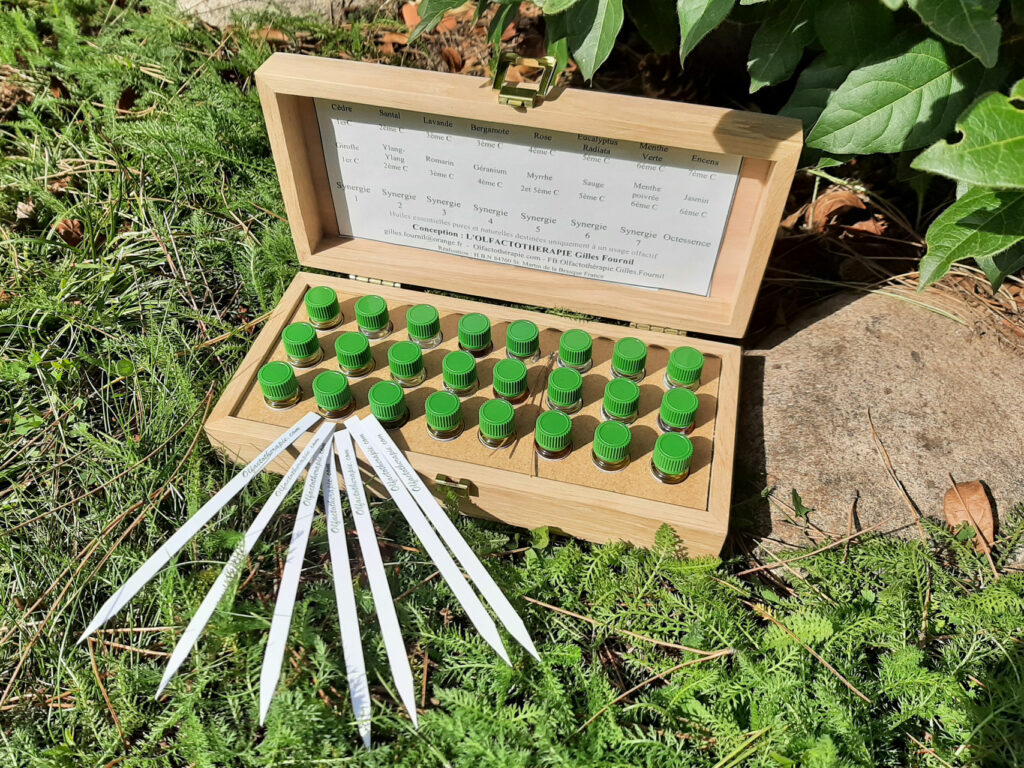
Fournil’s method is based on a kit composed of sixteen essential oils carefully selected by the therapist, among which are Atlas cedar, myrrh or jasmine. After smelling these oils one by one, the patient is asked to rank them from the one they preferred to the one they liked least. The olfactotherapist’s work is then done around the essential oil at the top of the list and at the bottom of the list, the latter often being revealing of a psychological blockage. The objective? “The work is successful when the smell no longer disturbs the client. And 7 times out of 10 at the end of a session, the smell that was disliked becomes pacified. It’s all a question of perception,” Gilles Fournil himself explains.
The aim is therefore to transform the negative charge revealed by the smells the patient rejects into a charge that is not necessarily positive, but in any case neutral—sometimes over the course of several sessions. Beyond a smell, it is above all an emotion or a negative belief that one tames.
With the growing success of olfactotherapy, more and more therapists decide to train in its practice.
Applications of Olfactotherapy
The applications of olfactotherapy are numerous: whether it is helping patients in palliative care, coming out of a coma or gripped by trauma, olfactotherapy can be beneficial wherever it is a question of soothing our mind.
At the Raymond-Poincaré hospital in Garches and at the Pitié-Salpêtrière, the aromachologist and olfactotherapist Patty Canac aims to stimulate patients’ language after a head trauma or a stroke. We owe to her an olfactory-therapy method named Olfarom including natural essential oils, but also synthetic perfumes whose objective is to remind patients of everyday-life scents such as those of chocolate, gas or the pencil.
Olfactotherapy and Memory
For people living with Alzheimer’s disease and other memory disorders, olfactotherapy opens up a fabulous field of possibilities. One can stimulate a patient’s memory through once-familiar smells, linked to their life journey. Let us imagine a patient who lived in Provence: work around lavender essential oil can potentially bring back previously forgotten images and moments of their experience. The famous concept of the “Proustian madeleine” that we use so often in the world of perfume has never made so much sense!
Olfactotherapy and Anosmia
Owing to the Covid-19 pandemic, another purpose of olfactotherapy that has gained popularity in recent years is that aimed at the olfactory rehabilitation of people who have lost their sense of smell (anosmia) and taste (ageusia). Being deprived of the pleasures generated by these senses can be hard to live with… And what about the risk of accidents, which is multiplied tenfold when our nose no longer sounds the alarm in the face of a spoiled ingredient or a burning smell?
Good news: repeated exposure to smells could promote the regeneration of the olfactory mucous membrane and restore the connections between neurons, allowing us to smell the world in which we live. A promising avenue, and all the more precious given that it is not always possible to treat anosmia with medication. At the University of Nice, work is under way to establish protocols to rehabilitate the noses of people who have retained after-effects of Covid.
In France, under the impetus of Mrs Véronique Le Lan, speech therapist and trainer, an expert in olfactory-gustatory disorders, many speech therapists today treat their patients suffering from olfactory-gustatory disorders, notably post-Covid, by integrating the scented pencils and cards of the Master Parfums Olfactory Game-Book into their protocol.
A Foretaste of Olfactotherapy… at Home!
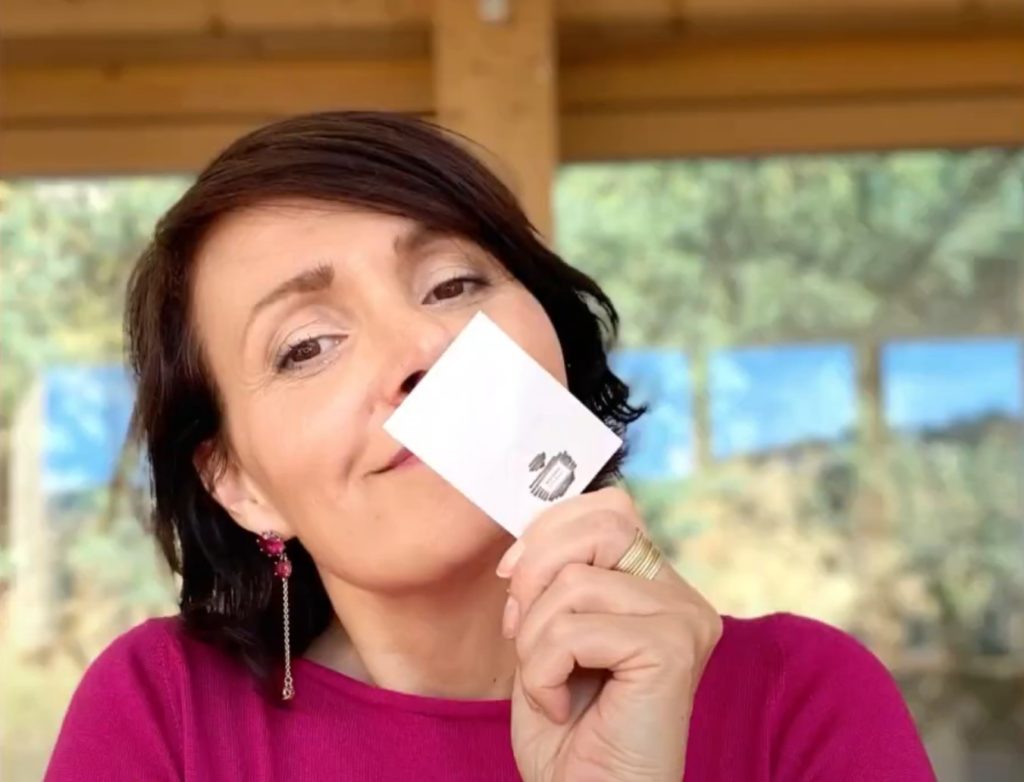
One can train one’s sense of smell at home, by smelling blind the odours that surround us—so, to your drawers! Want to go further? Stimulate your fifth sense with the Master Parfums olfactory game and its scented pencils, a game that has been recognised by speech therapists as beneficial within the framework of olfactory-gustatory therapy.