The mocha note in perfumery first calls to mind gourmand, roasted accords of coffee and cocoa, with a hint of whipped milk. Flavours of pastries or comforting drinks. But where does the term “mocha” come from? How is this note used in perfumes, and which facets are brought to the fore?
Mocha, a Coffee of Origin
Mocha coffee is the variety derived from the coffee tree that is at the origin of Arabica coffee in Ethiopia. It grows on the high plateaus, since coffee trees are cultivated at altitude, between 1,500 and 2,200 metres, in this region. This particular cultivation gives it a unique, rich and fruity taste.
Its name also refers to the port of Mocha in Yemen, a hub of the coffee trade since the 18th century.
In the collective unconscious, with Ethiopia referring to the notion of coffee excellence, mocha coffee is considered a superior, richly flavoured coffee.
The plantations are spread across 4 regions of the country: Sidamo, Kaffa, Wallaga, Harrar.
In these regions, hundreds of thousands of hectares are dedicated to coffee cultivation. Depending on the origin and terroir of the coffee beans, the characteristics of the coffee vary slightly.
Furthermore, “crème de moka” is a liqueur created from the distillation of coffee beans, a liqueur used both in drinks and in pastries of the same name.
Mocha in Perfumery
Coffee in Perfumes
Coffee is one of the most difficult notes to reproduce in perfumery, since many molecules are responsible for the smell, and since no one drinks their coffee the same way: espresso, filter, instant, Turkish… The taste also varies according to the coffee’s terroir: fruity, acidic, full-bodied… and the perception of its aromas is also highly variable: grilled, roasted, smoky, gourmand, slightly spicy, chocolatey.
Coffee absolute is obtained by volatile solvent extraction from the roasted beans of the coffee tree. It is found in leathery, tobacco, vanilla and chypre perfumes.
The Mocha Note
Unlike the coffee accord, which is generally a coffee note with frank, sometimes bitter facets, the mocha accord will denote a softer coffee note, likely with slightly cocoa or even hazelnut facets. There is no defined rule as such.
In perfumery, evoking the mocha note or accord implies a “coffee/cocoa/cream accord.”
If the brand wants to create a perfume based on Ethiopian mocha coffee, this is expressly specified during the briefing with the perfumer.
In all cases, a coffee/mocha accord will be reproduced in the laboratory by the perfumer.

According to the story, the mocha note refers to mocha cake, a pastry created in the 17th century in Paris, with a sponge base and a buttercream flavoured with coffee essence. This gives a creamy, cocoa-tinged coffee accord, sometimes with a hint of roasted almond.
Mocha is also the name of a hot drink based on coffee, milk, cocoa, whipped cream and sometimes chocolate shavings on top. This comforting drink is appreciated for its gourmand, milky wafts, with that little touch of bitterness from the coffee—also known as a mocaccino.
The Mocha Note, a Neo-Gourmand
In perfumery, the mocha accord more often evokes the comforting softness of a mocaccino.
For a long time, the notion of gourmandise in perfumery was synonymous with sweet, fruity, vanilla-tinged, honeyed and sticky accords. This trend has been changing gently over the past few years, and the gourmand tends to be less comforting-childlike, less sweet, in favour of being creamier, cosier and more cocooning.
The coffee note gathers all the facets ideal for this new way of wearing perfume, making the fragrance sensual and warm while being addictive. The roasted coffee note gives body, a singularity tending towards a slight, assumed bitterness. It is characterful, sometimes even offhand. This coffee note is often used with imposing raw materials, from rose to tonka bean, for example.
First used for masculine perfumes, the coffee note is now paired with gourmand notes such as vanilla, almond, caramel, as well as milky notes of whipped cream that give it that mocha facet, but also sandalwood or even tuberose to give another kind of roundness and a delectable, generous side.
TEST YOUR NOSE
And you, can you recognise raw materials?
Identifying a raw material, recognising its facets, memorising a smell…
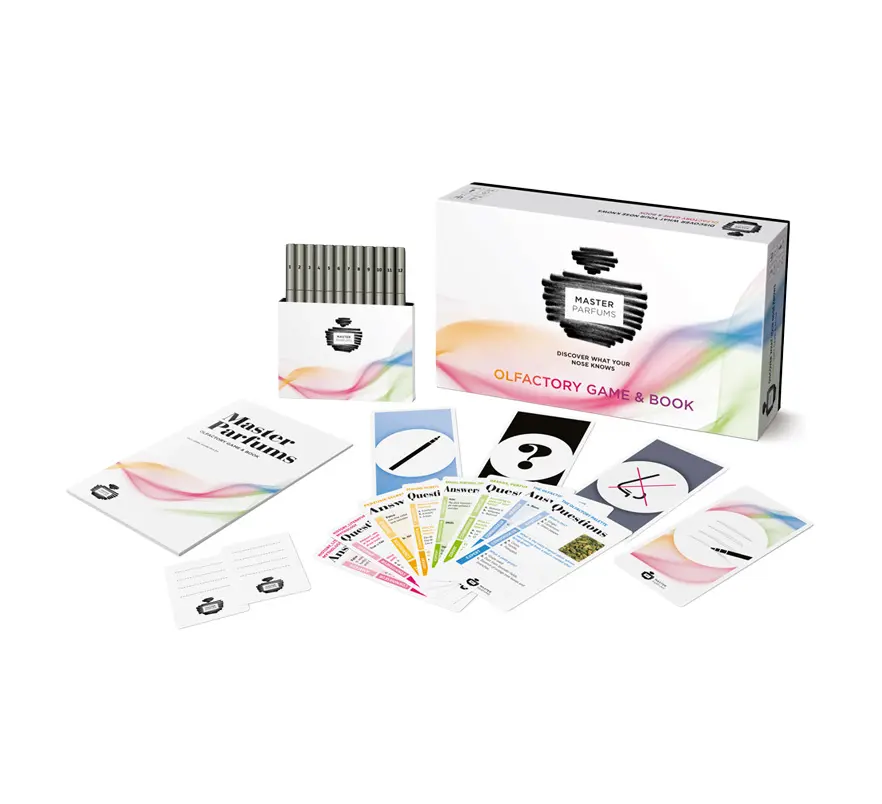
With the Master Parfums Olfactory Game, train your sense of smell in a fun way and develop your perfume culture.
A Few Examples of Perfumes with Coffee and Mocha Notes…
The coffee note was first reserved for masculine fragrances, in ambery perfumes such as Valentino Uomo, blending coffee and leather; A*Men by Mugler (by Jacques Huclier), displaying an overdose of a mocaccino note; or Yohji Homme by Yamamoto (by Olivier Pescheux).
Then the coffee accord became unisex with softer notes—milky, chocolate, cinnamon, caramel or marron glacé—mocha in the dessert sense of the term. Bitterness gives way to velvety softness, as if to envelop you in a reassuring, addictive warmth.
One thinks of a Moka by Micallef (by Martine Micallef), with here a coffee float dusted with cocoa and caramel.
In Noir Exquis by L’Artisan Parfumeur (by Bertrand Duchaufour), coffee wraps itself in orange blossom, maple syrup and marron glacé.
For Café Cabanel (by Cécile Zarokian), Téo Cabanel invites us to a sensual, captivating cappuccino, where coffee soaks up vanilla, caramel, sandalwood and tonka.
With its Coffee Break collection, Xerjoff draws us into the twists and turns of the international coffee trade: Golden Dallah, the most gourmand, blending cocoa, hazelnut and tonka with rose and oud; Golden Moka, where coffee surrounds itself with citrus and incense; and Golden Green, celebrating the raw coffee bean not yet roasted.
Hugo Boss The Scent Private Accord (by Bruno Jovanovic), for its part, dresses its mocha accord in ginger and cocoa absolute.
Of course, we cannot forget the blockbuster, Black Opium by Saint Laurent (by Nathalie Lorson) and its hyper-addictive shot of fruity, floral coffee.
Vanille Café by Comptoir Sud Pacifique (by Vanina Muracciole) takes us to Costa Rica for a journey through the coffee-tree fields, with notes of green almond and a sensation of the smell of freshly ground coffee beans. Then quickly the soft, gourmand vanilla and the suave benzoin give an ambery, sensual and languorous accord.
For Mumbai Noise by Byredo (Jérôme Epinette), it is a relaxing smell of spicy, herbaceous davana accompanied by a smoky, gourmand coffee-tonka and a creamy, velvety sandalwood.
And for those who prefer to stay with the bitterness and power of a full-bodied coffee, we find, in two different registers: L’Eau Corsée from the Do Not Drink collection by Sephora (by Maïa Lernout), where freshly roasted coffee is powdered with iris; and Akro, the brand of perfumer Olivier Cresp, which revisits the touch of madness of coffee with Awake, a veritable concentrate of energy blending cardamom, lemon and vetiver.
Often associated with winter fragrances, perfumes with mocha accords envelop us sensually. It is warm, often powerful and still uncommon! So, ready to stand out by wearing a singular, addictive perfume?
You can find these references in our video quiz that covered this subject!
YOU MAY ALSO LIKE …
Electronic noses are increasingly present in the industry of the 21st century. Major advances in the world of artificial intelligence today make it possible to use electronic noses in the fields of health, safety and beauty. How do these intelligent machines work? How are they used in modern perfumery? Will perfumers eventually be replaced by electronic noses? Master Parfums tells you everything!
The Electronic Nose, a Futuristic Machine?
What Is an Electronic Nose?

The electronic nose is a biomimetic system designed to imitate the function of the human olfactory system. An electronic nose is a device used to detect and analyse smells and tastes, in addition to, or as a replacement for, the sense of smell of a human or an auxiliary dog (for example, for the detection of drugs or explosives).
Since the beginning of the 2010s, electronic sensor technology has undergone major developments, from both a technical and a commercial point of view. The English expression “electronic sensing” refers to the ability to reproduce the human senses thanks to a set of sensors and recognition systems.
How an Electronic Nose Works
The electronic nose imitates the process by which humans recognise smells. Once inhaled, the odorant molecules attach to a sensor, a little like olfactory receptors that analyse chemical fingerprints. This information is initially encoded as a unique reference. Then this code is sent to a database for analytical processing.
The architecture of an electronic nose depends on the use that will be made of it and the reasons for which it is designed. Generally speaking, it is created with a gas aspiration or inhalation sensor system, and an analytical and information-processing subsystem via algorithms.
In practice, most of these algorithms work by comparing descriptions of new data with descriptions of previously evaluated samples. This functionality requires a learning phase, before the development phase.
At the end of this learning phase, it will be possible to correctly classify and catalogue most of the smells that are presented.
These noses are widely used in the fields of food processing to check the freshness of foods, of defence to detect explosives for example, in the fields of the environment to recognise possible pollutants, and increasingly in medicine thanks to a process that analyses patients’ breath in search of possible diseases. For a few years now, they have also been used in the world of perfumery.
The Electronic Nose in Perfumery
Until now, the creation of perfumes was still very artisanal. How is the electronic nose used in perfumery, and will it eventually supplant humans?
The Electronic Nose
Obviously, all the technical qualities a human possesses are available via the machine. A few years ago, an AAP (Augmented Assistant Perfumer) named Philyra was born.
IBM Research conducted a study by collecting data concerning consumer tastes on the basis of several measures. Composed of nearly 2 million perfume formulas, the algorithm can create fragrances based on past successes.
Richard Goodwin, an IBM researcher, said: “This system behaves like an apprentice; in the same way that a human would learn from a master which combinations of ingredients work, the machine learns to create based on the formulas that work best.”
Algorithms are important accelerators of innovation, and the perfume industry needs them to evolve its offerings. Consumers want to be seduced by inventive, creative novelty.
Is a Perfume Made Entirely by Artificial Intelligence Possible?

Yes, technically it is achievable, but the electronic nose is not designed to replace perfumers and their evaluators. The final composition will be validated by the professional.
Electronic noses are an aid in this respect, a way to save time and energy wisely. Some ultra-high-performance electronic noses have a smell library of 99,000 molecules. (The human nose is said to be capable of deciphering 1,000 billion!)
But from an emotional point of view, it does not replace the hedonic, subjective evaluation particular to humans. Unlike the human nose, the electronic nose can precisely remember each odorant molecule for months or years. Our olfactory memory is not as high-performing.
For Claire Viola, vice-president of digital strategy at Symrise: “Creation will always need humans, because fragrances are developed from emotions, from intuitions. It is better to consider artificial intelligence as an assistant perfumer, a tool at the service of an ‘augmented’ professional.”
The aim of using an electronic nose is to be able to propose other viable formulations, and to use new raw materials, while being supervised and validated by a master perfumer.
The interest of artificial intelligence would therefore be to offer another point of view and to generate the use of new ingredients. AI can then offer wonderful opportunities, provided that the emotional aspect is respected.
The legendary perfume Opium by Yves Saint Laurent resonates like an ode to the emancipation of the woman of the late 1970s and heralded a new generation of perfumes throughout the decade of the 1980s. A provocative perfume in the image of its creator.
Yves Saint Laurent, Provocative Designer

Born in Oran, Algeria, in 1936, Yves Saint Laurent took an interest in couture fairly quickly. At 18, he arrived in Paris to take drawing courses at the Chambre Syndicale de la Haute Couture, where his talent made him famous in only 3 months. Christian Dior noticed him and appointed him a pattern designer. After the latter’s death, Saint Laurent continued the work of his mentor, thus taking over the direction of the House of Dior.
An undisputed genius, Yves Saint Laurent opened his own fashion house in 1962 with the help of his friend Pierre Bergé. Determined, the couturier then lived the apogee of his early hours, and the name Yves Saint Laurent became an essential of fashion.
A provocateur at heart, he broke the codes and made his know-how an artistic expression of feminism by launching a collection drawn from the men’s clothing world. The trouser suit now gave women the opportunity to wear trousers to work. The Saharienne jacket was diverted from the hunting wardrobe to make it an essential of his collection. Avant-garde, he dared to make the tuxedo a garment for women, cementing his aura in the world of fashion.
However, as early as the end of 1976, the press spoke of his excessive disappearance from the media, and magazines were already preparing retrospectives about him, as if he were soon going to die.
But Mr Saint Laurent was only writing his legend, and in response to this relentlessness, he launched with unprecedented success this narcotic juice with a transgressive name: Opium.
Opium by Yves Saint Laurent
Context of Its Release
In 1977, under the artistic direction of Chantal Roos, Yves Saint Laurent offered a modernised version of the oriental perfumes neglected since the 1940s. Opium was an olfactory and marketing coup advocating the emancipation of women, increasingly asserting their femininity.
The couturier wished to create a luxurious fragrance and imagined a bottle that went against the grain of what had been done until then.
For the bottle, Pierre Dinand innovated by slipping a glass flask into a sheath of amber plastic, inspired by the inrō cases that samurai used to store spices, medicinal herbs and opium.¹ He adorned it with a black silk tassel of Napoléon III inspiration, showcased in Yves Saint Laurent’s collection of the moment.

“It was a completely revolutionary object, a thousand miles from traditional glass bottles,” “It’s a period when Yves Saint Laurent is truly in the richest, most complete, most intense expression of his art,” notes Yann Andrea (International Marketing Director YSL Fragrances 2010–2014).
Opium concretised the fascination Yves Saint Laurent had with the Orient.
Sold on average 30% more expensively than its competitors, the perfume was such a success that French retailers quickly found themselves out of stock. It was the marketing tour de force aimed at reinforcing its prestige and its attractiveness.
In 1978, the advertising slogan was reworked for the American market. “Opium, pour celles qui s’adonnent à Yves Saint Laurent” (“Opium, for those who give themselves over to Yves Saint Laurent”) became tamer—some would say too prudish—”Opium, for those to whom Saint Laurent is a habit.”
Opium was immediately noticed, making the perfume the beginning of a myth. Indeed, the launch party took place on a boat moored in South Street harbour in Manhattan. Precisely where the ships coming from Asia loaded with opium arrived. The message was provocative, just like the couturier.
Opium, the Modernised Oriental
“If I chose Opium as the name for this perfume, it is because I intensely hoped that it could, through all its incandescent powers, release the divine fluids, the magnetic waves, the kiss-curls and the charms of seduction that give birth to mad love, love at first sight, fatal ecstasy…,” wrote Yves Saint Laurent. Transgressive, he wanted a sensual, hyper-opulent, extravagant, provocative, enigmatic and liberating perfume.
Olfactorily, Opium is largely inspired by Youth Dew (1953) by Estée Lauder (by Josephine Catapano) and the carnation-patchouli accords of Tabu (1932) by Dana (by Jean Carles). Its longevity is excellent; Opium opened the way to a lineage of sensual, sophisticated perfumes for glamorous femmes fatales, heralding an uninhibited, exuberant perfume industry for more than a decade.
Moreover, Estée Lauder replied to Yves Saint Laurent in 1978 (the year of Opium’s American launch) by creating Cinnabar (by Bernard Chant)… a revisited version of Youth Dew, very close to Opium.
Under the artistic direction of Jean Amic, Jean-Louis Sieuzac, Raymond Chaillan and Françoise Marin composed this dense, powerful perfume that nonetheless keeps an accuracy throughout its evolution.
It joins the oriental olfactory family, a powerful, heady spicy floral amber.
The Olfactory Notes of Opium
A fruity start of mandarin, peach and plum combines with aldehydes to give a certain brilliance and volume to this opulent heart.
The carnation accord studded with clove is the star of this composition. Dusted with cinnamon, it surrounds itself with rose, jasmine and ylang-ylang. These spicy floral facets nestle in an ambery, mysterious base adorned with myrrh, patchouli, vanilla, labdanum, cedar and sandalwood.
It is dense and captivating, addictive and enveloping. Musks and castoreum make this voluptuous, sensual fragrance wild.
It is a carnal perfume with much elegance. The carnation-patchouli accord is sublimated by a characterful, imposing ensemble.
However, the reformulations of the fragrance failed to keep the very essence of the original perfume, making it smoother and more conventional and perhaps less impactful, less provocative.
After Opium, the Story Continues with the Re-editions
No fewer than 25 flankers (reinterpretations) have come into being since the creation of Opium in 1977.
Variations on the concentration of the perfume—eau de toilette, eau de parfum, extrait or elixir—but also on their compositions have come into being; here are a few examples:
- Opium pour Homme (1995)
- Opium Fraîcheur d’Orient (1998)
- Opium Fleur de Shanghaï (2005)
- Opium Fleur Impériale (2006)
- Opium Légende de Chine (2007)
- Opium Elixir Voluptueux (2008)
Let us also note the creation in 2016 of Black Opium, nearly 40 years after the release of Opium, by 4 perfumers—Honorine Blanc, Marie Salamagne, Nathalie Lorson, Olivier Cresp—propelled to the rank of commercial blockbuster.
Black Opium represents, according to the brand, the new generation of Opium, provocative and rock & roll with a falsely relaxed style since it is perfectly mastered. Meaning to be rebellious and avant-garde in the image of the original Opium perfume, Black Opium—whose addiction is breathed in by the coffee note—is described as magnetic and sulphurous.
And you, do you prefer the initial version of Opium or its reinterpretation Black Opium, hewing to modern standards of what represents exuberance?
Watch our Master Parfums video on the question of the Opium perfume by Yves Saint Laurent.
References
- Les 111 parfums qu’il faut sentir avant de mourir, page 101. Y. Cervi
Banner photo credits: https://www.flickr.com/photos/wvfonseca/23827977442