Raw materials are key ingredients in the composition of perfumes, whether natural—obtained by various extraction methods—or synthetic. The composer-perfumer selects them for their olfactory qualities and combines them to create unique, lasting fragrances.
Natural Plant Raw Materials
Natural raw materials in perfumery are ingredients obtained from plants.
Plants are the first source of the natural raw materials used in the composition of perfumes: flowers, stems, wood, fruits, leaves, roots, seeds… everything is usable, and the extraction methods vary.
The Different Extraction Processes for Natural Raw Materials
Various techniques are used to best capture the essence of each material.
- Distillation is the most common method for extracting essential oils from plants. Distillation uses steam to separate the oils from the plants. By decanting, one obtains on one side the essential oil or essence, and on the other plant water that can be used in cosmetics or for cooking (example: rose water, orange blossom water…).
- Cold expression, called “Pelatrice,” consists of cold-pressing fruit zests to extract the essential oil/essence. It is the most common method for extracting oil from citrus fruits. The so-called Sfuma Torchio expression presses whole fruits and makes it possible to obtain an essential oil/essence that is just as zesty but a little more gourmand.
- Enfleurage is an ancestral technique that consists of spreading flower petals on a plate of animal or plant fat that will absorb their odorant molecules. Once saturated with smell, it is filtered to obtain a pomade that can be used as is or else washed with alcohol and filtered to obtain a pure essence called an absolute. As this method is long and very costly, it is practically no longer used. It has been replaced by…
- Volatile solvent extraction. Solvents such as benzene, ethanol or hexane have, like fat, the property of absorbing odorous materials. Depending on the fragility of the ingredients, it can be done hot or cold. This technique is often used to extract raw materials that are difficult to process by distillation, such as flowers and leaves. The plants are placed in an extractor containing a solvent that circulates several times. Once saturated with smell, it is evaporated in order to obtain a highly fragrant paste, called a concrete (for flowers) or a resinoid (for dry materials such as roots or mosses). This paste is then melted and cleaned with alcohol to obtain one waxy phase and one alcoholic phase. The alcoholic phase is distilled to remove the alcohol, and one thus obtains an absolute.
- Infusion, another ancestral technique, consists of leaving plants to macerate in an oil or alcohol for a prolonged period in order to dissolve the odorous principles and recover a tincture. This method is often used to extract raw materials from roots, resins and woods.
- Headspace and Nature Print make it possible to capture the volatile smell of a material. Indeed, a flower cut to be distilled or extracted by solvent will not have the smell it can give off when it is still alive (the scent of a rose essence is very different from that of a fresh rose into which one might plunge one’s nose). This is what this technology sets out to reproduce. A glass bell is placed above the material, through which a gas current is passed. The gas impregnated with odorous material is absorbed by a carbon filter. This filter is analysed thanks to a chromatograph and a mass spectrometer, which will deliver the composition in odorant molecules. Once the list of molecules is identified, they can be reproduced in order to obtain an ACCORD reconstituting the smell of the fresh extracted material. For Nature Print, instead of a bell, a syringe is used to capture the odorous substances.
- Supercritical CO2 extraction, also called Softact, is the most recent technique. The principle is to replace volatile solvents with CO2. The latter has the particularity of transforming from the gaseous state to the “supercritical” state (dense like a liquid but fluid like a gas) when put under pressure (70 bars) and at a temperature of 30°C. It then has the same properties as a solvent without using high temperatures that can denature the materials. In addition to being ecological (the CO2 is recycled) and respectful of the material, this innovative process makes it possible to obtain extracts of exceptional quality and purity.
Each of these techniques has its advantages and disadvantages in terms of cost, quality and quantity of oil produced.
Raw Material Sourcers
The job of a sourcer in perfumery consists of finding and supplying quality raw materials for perfumers.
This involves establishing relationships with raw material suppliers, assessing the quality and stability of raw materials, negotiating prices and guaranteeing the regulatory compliance of raw materials. Sourcers must also be able to find rare and hard-to-find raw materials for perfumers.
Sourcers have a thorough knowledge of raw materials in perfumery, as well as of the processes of extraction and transformation of raw materials. They must also be familiar with quality and safety regulations for the raw materials used in perfumery.
A sourcer is able to work closely with perfumers to understand their raw-material needs and to help them find the most suitable ingredients for their project.
In summary, the job of a sourcer in perfumery is a key role for perfumers and perfume manufacturers.
Natural Animal Raw Materials
Raw materials of animal origin have been used for their odorous characteristics for hundreds of years. They are generally used as a fixative, found in the base notes of perfume compositions.
Animal musk comes from a sexual secretion produced by the male musk deer of the Himalayas during the rutting season. It is found in a pouch hidden under the animal’s belly. Generally obtained by killing the animal, the use of this raw material has been banned since 1979.
Civet adds an animalic, musky note to a perfume. It is obtained from the perianal gland of the animal, a small mammal, a kind of small wild cat, found in Africa (Ethiopia) and Asia. The production of this civet musk often involves confining civets in captivity and regularly harvesting their glands, which can cause pain and discomfort for the animals.
Castoreum is an oily, odorous secretion from the perianal glands of the beaver, serving it to mark its territory and waterproof its coat. Its smell, strong at first, can be soft, leathery and suave when treated. This highly prized raw material often involves hunting the beaver to obtain this substance, which causes, like musk and civet, ethical concerns.
Ambergris is used in perfumery to add a marine, animalic, ambery and tobacco note to a perfume. It is an intestinal concretion due to an irritation caused by the molluscs poorly digested by the animal. The whale naturally expels this substance through its digestive system. This raw material floats on the sea and, in contact with the sun and salt, dries and finally washes up on the beaches where this kind of waxy stone is collected. It is generally subjected to a cleaning and purification process to remove impurities and obtain a pure substance usable in perfumery. Owing to its rarity and the complexity of its formation, ambergris is precious and therefore very costly.
Beeswax, also used as a fixative, brings to the perfume its warm, round, honeyed notes, which can also exhale leather or tobacco facets.
Most of these raw materials are today controversial owing to ethical and environmental concerns. Synthetic alternatives are often used to replace these ingredients.
Synthetic Raw Materials

Synthetic products, for their part, are made in the laboratory from molecules of natural or synthetic origin. They are used to reinforce natural fragrances, give them relief, and to imitate natural aromas that are difficult to obtain.
The history of synthetic raw materials in perfumery dates back to the end of the 19th century, when, during the Industrial Revolution, the French scientists Paul Parquet and Georges Darzens began to synthesise odorant molecules in the laboratory. Before that, perfumers used exclusively natural raw materials to create fragrances. However, these raw materials were costly, rare and sometimes difficult to obtain in sufficient quantity.
The choice to create synthetic raw materials is also part of a dynamic of innovation. It is not only about reproducing already-existing natural smells, but also about creating new smells that make perfumes unique.
To cite a few examples, this is the case of aldehydes, which give a metallic, soapy smell to the perfume’s composition and make it possible to illuminate a bouquet. Ernest Beaux dared to use them for the first time in overdose in Chanel N°5, a feat that made the perfume unique and recognisable above all others.
Vanillin, used by Jacques Guerlain, an emblematic component of Shalimar and of his Guerlinade, gives gourmand vanilla scents.
Kenzo pour Homme, created by Christian Mathieu, has the characteristic of incorporating calone, giving that scent of marine, slightly aqueous freshness to the perfume.
Of course, one thinks of Angel by Mugler, created by Olivier Cresp, who had the wonderful idea of adding ethyl maltol to the perfume, with its addictive notes of candyfloss, caramel and praline.
Over time, synthetic raw materials have become increasingly popular in perfumery, since they offer greater stability and greater consistency in perfumes, as well as a more affordable cost compared to natural raw materials—even though some can sometimes be very expensive to develop.
They also make it possible to reproduce the scents of mute flowers (which do not give up their essence: e.g. lily of the valley, lilac, peony…), of materials that have become banned (animal materials and allergenic substances).
They also avoid the overexploitation of soils and remedy production problems caused by ecological disasters (fires, floods, drought…). And above all, they enrich the perfumer’s palette.
TEST YOUR NOSE
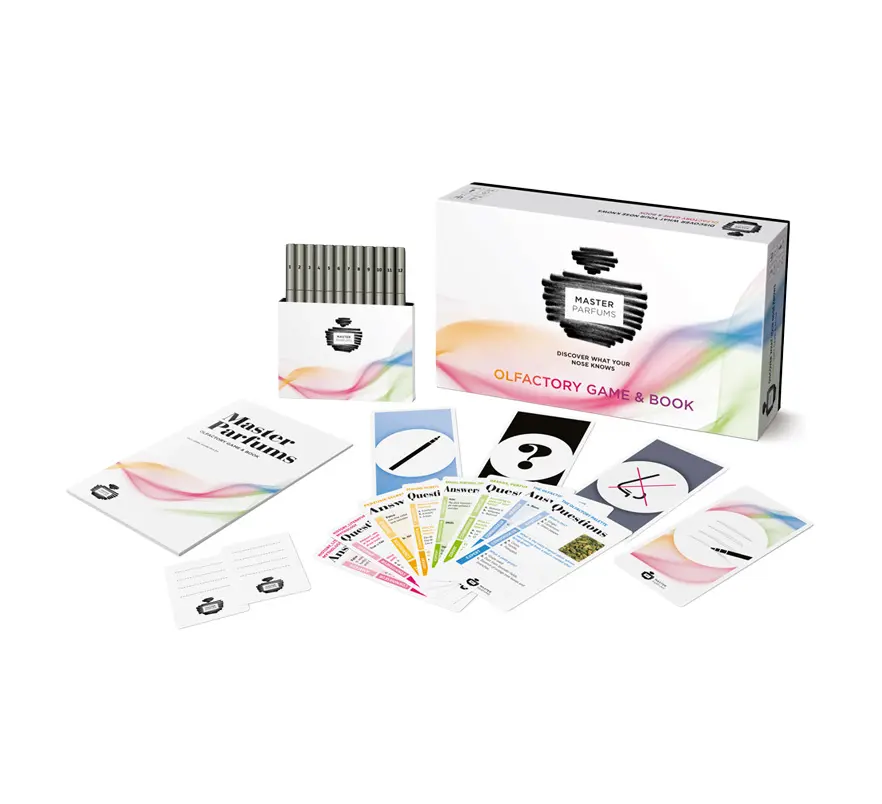
Will you be able to recognise raw materials? 👃
Woody, floral, spicy… Some smells seem familiar. But could you really identify them?
With the Master Parfums Olfactory Game, train your sense of smell, recognise raw materials and test your perfume culture.
IFRA Safety Standards
IFRA (the International Fragrance Association) is a global organisation that defines safety standards for raw materials in perfumery. IFRA establishes restrictions on the use of certain raw materials owing to their potential harmfulness to health or to the environment.
These restrictions can include limits on the quantity of raw material that can be used in a product, specific conditions of use, or a total ban on the use of certain raw materials. Perfumers must follow IFRA standards to guarantee the safety of their products and their regulatory compliance.
It is important to note that IFRA restrictions are not mandatory, but perfumers are encouraged to follow them to guarantee the safety of their products and their compliance with the regulations in force. Perfumers can also choose to follow stricter standards than those of IFRA to guarantee the safety of their products.
Natural or synthetic, each raw material adds a distinct note to the final perfume and can influence the fragrance according to the quantity used. Depending on trends, some raw materials are more prized than others. The advent of synthetic raw materials gives an infinity of possibilities for olfactory compositions, to our great delight!
YOU MAY ALSO LIKE …
The profession of composer-perfumer is above all that of an artist of great sensitivity, but not only. It is also a technician mastering the chemistry of the molecules that make up a fragrance.
It is the alliance between creativity, science and emotion in the service of a noble profession.
How does one become a perfumer? What is the necessary training path?
Master Parfums tells you all about it!
Artist and Technician of Fragrances
The composer-perfumer is an artist, a creator who designs fragrances both to develop skin perfumes and interior perfumes, food flavourings or household products.
They will first reflect on the structure of the perfume’s composition and on the choice of raw materials that will be used in it. The composer-perfumer masters the art of the symbiosis of the molecules that make up each raw material. This expertise is inevitably accompanied by a creative spirit whose sensitivity leads to a unique alchemy.
Note that the perfumer is commonly called a Nose. A rather simplistic and reductive term, since the profession does not boil down to a sensory function but rather to the symbiosis of multiple qualities and skills that are intrinsically inseparable. In fact, just like the musician’s ear, their nose is above all a tool of control and learning. To learn more about the composer-perfumer profession, don’t hesitate to take a look at our dedicated video!
The Skills of the Composer-Perfumer
A Developed Sense of Smell and an Outstanding Olfactory Memory
Having a developed sense of smell is an asset, and the ability to memorise smells is fundamental and indispensable to be a perfumer. There are hundreds of basic raw materials that a perfumer must know by heart, and therefore be able to identify by smelling them. The seasoned perfumer can recognise not only a raw material, but can also identify its origin, its place of production, and the type of equipment used for its extraction!
The greatest perfumers can memorise up to 3,000 smells! To become an expert, long years of experience and training are necessary; nevertheless, the perfumer must practise continually throughout their professional life to maintain their olfactory memory.
Intensive training of perfumers results in an increase in the brain areas linked to olfaction (piriform cortex and orbitofrontal cortex). With expertise, perfumers develop a high capacity to mentally manipulate smells. They can smell them mentally and imagine what different compositions might smell like. It is then the trials that will allow the perfumer to corroborate their intuition and refine their creation.
An Artistic Sense and Creativity
For a perfume to touch the client’s sensitivity, it is imperative to know how to develop an emotional intelligence in order to offer a relevant olfactory experience. Sometimes the objective is to create novelty, originality, to go and seek unusual or never-used raw materials making it possible to offer a unique perfume, while being universal.
The challenge is delicate, since the perfumer must not limit themselves to their personal tastes. Developing one’s artistic sense makes it possible to constantly seek new ideas, sometimes far from the perfumer’s preferences.
Becoming a perfumer is a profession that takes time, and patience is another indispensable asset. They must constantly keep watch from a socio-cultural point of view to ensure they always present fragrances in symbiosis with consumers’ expectations.
The Technical Skills of the Perfumer

In general, solid knowledge of chemistry is necessary to master and handle the molecules of the essences and other absolutes that make up the raw materials, whether natural or synthetic.
For perfumers who work in the creation houses (see paragraph below), knowing how to work in a team is also a necessary qualification. Indeed, in these companies, the perfumer does not develop the perfume alone in front of their perfume organ. A whole team composed of marketing, the evaluator, the assistants, gravitates around, and it is indispensable to be comfortable with this spirit of sharing. Many perfumes are also the fruit of the alliance of several perfumers.
Studies and Training to Become a Perfumer
There are very few perfumery schools leading strictly to this profession. A few creation houses have their own internal school (Givaudan, IFF, Firmenich) but the entries are limited and very selective.
One can also become a perfumer through training courses aimed at acquiring solid foundations in chemistry, creativity and marketing.
Besides fine-perfumery perfumers, these schools also train perfumers who will be specialised in functional perfumery (cosmetics, soaps, shower gels, shampoos, detergents), and food flavourings, as well as evaluators.
The ESP (École Supérieure du Parfum) in Paris and Grasse offers admissions in the first year post-baccalaureate on application, as well as in the second year after a two- or three-year degree in chemistry, biology, mathematics…).
The ISIPCA (Institut Supérieur International du Parfum, de la Cosmétique et de l’Aromatique), located in Versailles, offers various training courses around the perfumery professions, post-baccalaureate or higher.
The GIP (Grasse Institute of Perfumery) also offers various training courses in Grasse, and in several other cities around the world and online.
Other perfumery creation and training centres, such as Cinquième Sens, offer complete training courses over several modules.
The Perfumery Art School, created by the perfumer Isabelle Gellé, makes it possible to train online for the profession of independent perfumer, handling only natural raw materials. An artistic approach to perfumery, without the need for expertise in chemistry.
In addition to diplomas and training, experience remains fundamental. It is by practising continually that the perfumer manages to become a recognised expert in the very closed, selective world of perfumery.
Famous Perfumers and Creation Houses
Few are the perfumers who have the advantage of creating perfumes, sometimes entire collections, within the great houses themselves. We can cite Mathilde Laurent for Cartier, Christine Nagel, who took over from Jean-Claude Ellena for Hermès, Olivier Polge, who took over from his father Jacques Polge for Chanel, or Thierry Wasser for Guerlain, Francis Kurkdjian, who took over from François Demachy for Dior.
Most perfume creators are employees in companies that compose and produce natural and synthetic raw materials. It is these companies that, besides sourcing perfumery materials and creating new accords, provide perfume-composition services to the different brands: Givaudan (formerly Roure), IFF, Firmenich, Symrise, Mane, Robertet…
Today we also find companies or agencies dedicated solely to perfume creation, whose perfumers can express their talents for brands (often more confidential ones) such as, for example, Maelström, Flair, or Accord et Parfums.
Let us also note that the promotion of perfumers, who until then were considered shadow workers, was made possible and democratised thanks to Frédéric Malle who, by creating his perfume house Les Editions Frédéric Malle in 2000, not only offers a collection of perfumes of recognised quality, but even goes so far as to write the name of the perfumer on the bottle of the fragrances to give even more cachet to his collection. The recognition of the perfumer is henceforth official vis-à-vis the consumer. The young brand Essential Parfums also highlights the creators of its fragrances on its bottles and cases.
Furthermore, today more and more perfumers free themselves from the creation houses to become independent and offer their creation services directly to brands (often so-called niche brands, more confidential).
Others have even created their own brand where they can express their art without constraint: Jean-Claude Ellena and his daughter Céline, who had launched The Different Company; Akro by Olivier Cresp; Maison Jean-Michel Duriez; Parle-Moi de Parfum by Michel Almairac; Maison Francis Kurkdjian; Voyages Imaginaires by Isabelle Doyen and Camille Goutal; Pierre-Guillaume Parfums; Thierry Bernard and his perfumer friends for Parfumeurs du Monde…
Our Master Parfums olfactory game pays tribute to the great perfumers in a series of questions that plunge you into the heart of perfume history and culture! Discover it right here.
A Few Remarkable Perfumes and Their Creators
- Édouard Fléchier for Dior: Poison (1985)
- Calice Becker for Dior: J’adore (1999)
- Jean-Claude Ellena for Hermès: Terre (2006)
- Olivier Cresp for Mugler: Angel (1992)
- Alberto Morillas for Kenzo: Flower by Kenzo (2000)
- Cécile Zarokian for Amouage: Epic Woman (2009)
- Dominique Ropion for Editions de Parfums Frédéric Malle: Portrait of a Lady (2010)
- Maurice Roucel for Editions de Parfums Frédéric Malle: Musc Ravageur (2000)
- Bertrand Duchaufour for L’Artisan Parfumeur: Séville à l’Aube (2012)
- Isabelle Doyen for Naomi Goodsir: Nuit de Bakélite (2017)
- Patrice Revillard for Jacques Fath: L’Iris de Fath (2018)
- Philippe Paparella-Paris for Memo: Sintra (2020)
Synaesthesia is a fairly rare neurological phenomenon in which the stimulation of one sense simultaneously triggers a connection to another sense. Some people can see colours, or even numbers, associated with sounds or smells. But how does it manifest? What kinds of sensory associations are known to scientists? How is this phenomenon experienced? Master Parfums tells you everything.
Synaesthesia, a Little-Known Phenomenon
Syn [together] – Aesthesis [sensation]
Synaesthesia is a cognitive manifestation by which the stimulation of one sense triggers a simultaneous response from one or more other senses.
While almost all types of sensory association are possible, some forms are more common than others.
For example, some people may see colours when they hear sounds, or feel textures when they perceive colours. Others have a taste experience at the mere mention of a word, and still others associate colours with the letters of the alphabet and even with numbers… For some, sound information can also be perceived through smell, so that music has a certain smell.
As you will have understood, synaesthesia can manifest in different ways for different people and can vary in intensity depending on the situation.
Scientific Research on Synaesthesia
This phenomenon, which remains very mysterious, has attracted the attention of the scientific community since the 19th century. Part of the problem with research on synaesthesia is the way people describe their experiences. What is intense for some may be moderate for others, and the subjective dimension of the description remains difficult to grasp.
Everything we experience exists in the form of a pattern of “chemical-electrical signals” circulating in the brain. As a rule, different areas of the brain represent different types of information.
The occipital lobe, for example, contains information about vision, and part of the temporal lobe contains information about sound. Synaesthesia may be caused by unusual crosstalk* (*a fault in the transmission or reproduction of a signal) between brain regions that are normally separate.
Although scientists do not fully understand the causes of this phenomenon, they think it may come from a particular connection between the brain regions that handle the different senses. Synaesthesia could be hereditary and can vary in intensity in different people.
The discourse around synaesthesia remains nuanced because, unfortunately, few studies address the subject.
Although it is caused by cognitive processes, it is generally not an inconvenience in everyday life.
How Is Synaesthesia Experienced?
People who experience synaesthesia do not realise it immediately, since it most often occurs in childhood, and this continues until they discover that others do not have the same experience of perceptions. This is “developmental synaesthesia.”
Synaesthesia can be a gift for some people, but it can also cause confusion or anxiety for others. Some synaesthetes have described their sensory association as captivating and enriching, adding an extra dimension to their perception of life.
Others, on the contrary, feel so different that they are frightened by it, and their social life can be disrupted as a result.
It is just a different way of perceiving the world, and it would seem that synaesthetes are more creative.
Scientists continue to conduct studies on this phenomenon to understand more about brain functions and human sensory perception.
Smell-Colour-Texture Synaesthesia

Synaesthesia associating smell and colour, and sometimes a texture, is a phenomenon that is still little known but fascinating. This unusual condition allows some people to see and associate colours when they smell odours. For these individuals, of whom I am one, each smell has a particular associated colour, with variations nuanced by intensity and depth, creating a unique and very precise experience of the sensory environment.
As for me, I systematically see a colour when a perfume, a simple or complex smell, is identified. Over time I have noticed that these colours were not only nuanced in intensity but that they sometimes had a texture, making the smell even more concrete and precise.
The smells I see as green do not necessarily come from things that are green.
For example, on smelling a note of vetiver, it is the colour khaki that imposes itself. But on smelling a note of fresh leaf or stem, I see a silver-coloured satin texture… And since I cannot explain it, I only very rarely allude to it.
It is the same principle for perfumes with the standard complexity of an olfactory pyramid.
I will see an overall colour for the whole perfume, and there will be nuances of texture as the fragrance evolves. Obviously, for a few years now I have been trying to separate “my” colours from those provoked by cognitive biases: the colour of the perfume’s juice, that of the bottle, the storytelling, the brand’s logo, etc.—which could modify or influence my own perceptions. I have been aware of this for several years, and it helps me step back and consider the nature of these connections that I have always lived with.
However, the reverse does not hold: I do not perceive a smell when I see a colour, unless I force myself to, but naturally nothing will happen.
Scientists still do not know exactly how smell-colour synaesthesia is triggered, but they think it may be due to an abnormal connection between the brain areas responsible for smell and vision. However, it is important to note that synaesthesia is not an illness or a deficiency. On the contrary, many synaesthetes consider their ability to feel colours with smells as an enriching gift.
Synaesthesia and Memory
Smell-colour synaesthesia can also influence the way synaesthetes perceive and remember smells. For example, a smell that is associated with a particular colour could be more easily memorised and associated with a specific event or person.
Olfactory memory no longer plays on a single front, since other senses come to reinforce and facilitate learning and memorisation thanks to this mnemonic asset.
This experience is obviously very personal and subjective.
Nevertheless, it is important to note that certain colours are often universally associated with basic smells, such as the smell of lavender, which is often associated with its violet colour, while the smell of lemon is often associated with its yellow colour. This is not synaesthesia but rather a tacit consensus of a given society or culture. This is called collective memory.
Synaesthesia in Perfumery
The brand L’Orchestre Parfum has developed a collection of perfumes built around the plurality of the senses, associating a piece of music with each of the fragrances. A playlist is made available, and for each perfume it is proposed to listen to a piece of music composed with inspiration drawn from the fragrance.
To find out more, watch our video on the subject!
The construction of a perfume rests on a structure called the olfactory pyramid. Whatever technique is used, the making of a fragrance is governed by this pyramid. The perfume evolves in several stages according to its composition. How is a perfume conceived? What are the tools the perfumer has to carry out the construction of the perfume?
The Raw Materials of a Perfume
The composer-perfumer will first reflect on the olfactory structure of their creation. This time of reflection makes it possible to write an ordered, coherent formula, with raw materials chosen according to their chemical specificity, which will have to harmonise together to arrive at the desired result.
The selection of raw materials is a decisive step. The selected ingredients generally come from all over the world. Perfumers build their collection by choosing from a large number of raw materials from the plant world, as well as synthetic materials.
For natural raw materials, they call on sourcers, those smell-hunters who travel the world to find the best producers and unearth new materials that can enrich the perfumer’s collection.
In the case of synthetic materials, it is perfumer-chemists who offer them synthetic compositions that will bring new nuances to their palette. The knowledge and know-how of these perfumer-chemists make it possible to create new, unprecedented and original notes, sought after by perfumers.
On average, the composer-perfumer has at their disposal about 500 natural materials (flowers, leaves, barks or resins, spices, zest…) and 2,500 synthetic materials, some of which can be very costly.
The whole of the perfumer’s collection of raw materials is called their perfume organ, because they generally arrange the vials on the shelves of a desk-cabinet, in a semicircle, recalling this musical instrument.
The Olfactory Pyramid
The formulation of a perfume is organised according to the volatility of its ingredients, following the pyramid scheme. It was Jean Carles, a talented perfumer and great teacher who created the perfumery school at Roure in the 1940s, who developed the concept of the olfactory pyramid, illustrating the development of the perfume in 3 stages: the top, the heart, and the base.

His empirical method has since been used by perfumers to organise the creation of the perfume.
Top notes, heart notes and base notes together form the olfactory pyramid.
While the 3 notes are present when a perfume is sprayed, the top notes correspond to the smells we perceive first. They are lighter and evaporate after a few minutes to give way to the heart notes, which give the perfume its texture.
The base notes are the foundation on which the fragrance will evolve.
Just as the painter will use lighter colours to give light, and darker ones to bring shadow and depth, the perfumer will use the different intensities and the persistence of these materials to give relief to their perfumes.
Top Notes
It is the top that gives the first impression of the perfume.
The top notes are the most volatile and the lightest, which does not mean they cannot be intense! They diffuse from the moment the perfume is sprayed, thanks to the alcohol that allows the diffusion of the perfume, and they fade after five to fifteen minutes.
The top is often made up of fresh, tonic notes such as citrus essences, lavender and aromatic herbs, or more modern notes such as tea, or aquatic notes.
Heart Notes
We perceive these facets from the very first moments and for up to 3 to 5 hours or more depending on the materials used. These are the notes that constitute the body of the perfume, its signature, and structure the sillage of the perfume. They also determine the olfactory family of perfumes: woody, floral, ambery, etc.
The heart note gives the style of the perfume and determines its character. Here we find white, rosy, powdery flowers, fruity, spicy notes, and sometimes certain woody notes.
Base Notes
These are the most persistent and the warmest of the pyramid. They intensify and fix the heart note, allowing the perfume to last over time. Some base notes can last a whole day on the skin, and days or even weeks on clothes.
Deep and intense, they represent the base of the perfume on which the whole structure rests. With the heart notes, they form the very essence of the olfactory signature. Here we find woody notes, gourmand notes (such as the mocha note), ambery, balsamic (resins), powdery musky notes, and still sometimes animalic notes.
The Construction of the Perfume
Ultimately, we do not determine the olfactory position of the raw materials in the olfactory pyramid; it is the properties and the weight of the olfactory molecules of these materials that determine the speed at which they evaporate.
When the top notes are prominent, the perfume will be fresher and more ephemeral, which is the case with eaux de Cologne. Conversely, if the perfumer decides to emphasise the heart and base notes, the perfume will be deeper, more opulent and more persistent.
The composition of a perfume rests on the harmony that the perfumer manages to create, thanks to a meticulous know-how, by finding the balance between all these molecules.
Becoming a perfumer cannot be improvised, and ideas are not enough to create a good perfume. It takes genius and talent to create an olfactory masterpiece that will touch the hearts of those who choose it.
To learn more, and above all to immerse yourself in the world of perfume, the Master Parfums game combines playful learning and olfactory discoveries to notably better understand how a perfume is constructed and created.
Collaborative article written by Elfa Jouini & Anne-Laure Hennequin