It is rare for a fragrance to transcend time to remain engraved in the collective memory. Such is the case of Youth Dew, the precious pearl of Estée Lauder. Since its introduction on the market, it has seduced generations with its complexity and its captivating charm.
This article invites you to rediscover this elixir, the remarkable marketing management that Estée Lauder implemented, and to understand why, after so many years, it remains one of the jewels of world perfumery.
Estée Lauder: A Brand, a Creator

The world of beauty is imbued with inspiring stories, but that of Estée Lauder is exceptional. Born in 1908, Estée Lauder, whose real name was Josephine Esther Mentzer, grew up in New York in a modest environment.
With her Hungarian and Czech roots, she immersed herself very young in the world of cosmetics thanks to her chemist uncle, who passed on to her his passion for beauty formulations.
In 1946, the dream became reality. With an unshakeable faith in her vision, Estée, accompanied by her husband Joseph, founded the Estée Lauder brand. She did not merely sell products, she sold an experience. Her personal demonstrations, where she advised women on their skincare routines, quickly caused a sensation.
She firmly believed that “every woman can be beautiful,” and it is this conviction that was the pillar of her brand.
Estée Lauder introduced perfumes that not only reflected the olfactory trends of their time, but that also, in many respects, defined those to come. Her visionary approach to perfumery cemented the brand’s reputation as an innovative, influential force, making Estée Lauder not only a cosmetics icon, but also a legend of the perfume world.
Historical Context of the Perfume Youth Dew
The middle of the 20th century was an era of innovations, social transformations and individual expression. It was also a period of revolution in the world of perfumery, where perfumes were becoming statements of identity and symbols of femininity.
When Estée Lauder introduced Youth Dew in 1953, the perfumed landscape was dominated by the traditional idea that perfume was a luxury offered by men to women as a sign of affection or admiration. Estée Lauder, with her strong perspicacity, spotted a unique opportunity. She realised that if perfume were reformulated and marketed differently, it could become a good that women would choose and buy themselves for themselves.
Thus was born the Youth Dew bath oil. More than a simple perfumed oil, it was designed as an act of female emancipation. Instead of waiting for a perfume to be offered to her, a woman could now pamper herself with this rich, sensual oil, giving herself a luxurious experience affordable at 8 dollars a bottle. Its concentrated formulation made it possible to use it both as a bath oil and as a perfume, which made it a versatile product.
The cultural impact of Youth Dew cannot be underestimated. It not only overturned the marketing conventions of the perfume industry, but also reflected and amplified a growing trend towards female independence and autonomy of that era. By redefining what a perfume could be and how it could be worn, Youth Dew became not only an emblematic perfume, but also a symbol of an era in full transformation.
Josephine Catapano, the Perfumer Behind Youth Dew
Born in 1918, Josephine Catapano is recognised as one of the most talented perfumers of the 20th century. After beginning her career at Elizabeth Arden, she then worked for prestigious houses, making her a respected figure in the industry.
Her collaboration with Estée Lauder in the 1950s remains one of the most memorable of her career. Together, they conceptualised Youth Dew.
At a time when, generally, only French perfume was worn, Estée Lauder aspired to create a perfumed bath oil that women could afford to buy for themselves.
Josephine Catapano knew how to transform this idea into an emblematic perfume, thus illustrating Lauder’s revolutionary vision and her creative genius.
Josephine Catapano left an indelible imprint on the world of perfumery, and Youth Dew remains one of the cornerstones of her rich legacy.
Youth Dew, or Timeless Sensuality

For more than fifty years, Youth Dew has made the hearts of perfume lovers beat. This elixir has managed to cross the decades with a timeless grace.
From the very first wafts, the opulence of rose blends with the freshness of jonquil, evoking the image of a garden bathed in morning dew. Narcissus gives a slightly green, peppery floral touch, in perfect harmony with the camphoraceous freshness of lavender which, like a light breeze, adds an aromatic dimension that perfectly balances the richness of the flowers. Orange and peach add a fruity sweetness, but the most surprising is that almost effervescent nuance of liqueur-like caramel recalling Coca-Cola, which brings a gourmand, almost childlike originality to the whole.
At the heart of the perfume, jasmine deploys its sensuality, enveloping the senses in a white, intense veil. It dances delicately with lily of the valley, that fragile flower that evokes the tenderness of the first spring days. Then, instantly, a spicy touch of cinnamon and clove comes to warm and twist the whole, breathing a captivating warmth into the composition.
But it is truly the base of the fragrance that reveals all its complexity. Oakmoss evokes a dense forest, adding a dark undergrowth depth. This base is reinforced by vetiver, whose earthy, woody and slightly smoky nuances intertwine with the balsamic richness of patchouli. Incense and balms give off an aura enveloping the senses in a resinous, slightly vanillic softness.
It is a perfume categorised by the brand in the olfactory family of spicy ambers. But one also perceives a chypre structure in filigree.
The result? A memorable sillage, at once powerful, subtle and captivating.
It is an olfactory story, an epic that, with each spray, invites a magnetic, opulent sensory journey.
Each note plays its role, creating a story that evolves beautifully on the skin, leaving behind it an indelible impression of elegance and mystery. An opulent fragrance whose sillage is a sign of affirmation, emancipation, even nonchalance, in an era where woman, constantly seeking to assert herself, finds in it a weapon of irresistible charm.
A Word from Anne-Laure, Creator of Master Parfums
This amber-coloured fragrance nestles in an extremely feminine bottle: a draped dress cinched at the waist, not unlike the New Look models of Christian Dior.
For the advertising, Estée Lauder innovated and provoked with a rather daring visual for the time: a naked woman from behind, prettily blurred, ready to take her bath.
To discover the perfume at the point of sale, no blotter or ceramic.
Estée Lauder wanted her product to be accessible to all: the bottle should not be sealed, as other brands did. Thus customers could smell it freely. She knew they would put some on their hands and that they could thus smell it several hours later on their skin.
Faced with the incredible success of this oil, she decided to also launch the perfume at the same time as a complete range of products such as powders, soap, and lotions…
A success that was exported to Europe a little later. A French department store manager is said to have expressed doubts about the success of an American perfume in France. Which only reinforced the creator’s determination. It is even said that she intentionally dropped a bottle of Youth Dew in the store, thus attracting the attention of a crowd of onlookers!
Youth Dew is a celebration of female independence, a symbol of eternal beauty and an olfactory masterpiece. Each drop tells the story of a woman who dared to defy the norms and changed the perfumery world’s vision forever, even going so far as to be an inspiration for Opium by Yves Saint Laurent, which would arrive a few years later.
“Smell, the mysterious aide-mémoire, had just brought a whole world back to life within him.” You have very probably already experienced this wonderful sentence by Victor Hugo: our fifth sense indeed has the power to bring to the surface a flood of emotions and memories—memories, some of which had sometimes begun to gather dust… It is precisely on the close links between our nose and our emotions that olfactotherapy is based, a practice that Master Parfums invites you to discover today.
Smell and Emotions: A Privileged Relationship
Did you know that smell was the only one of our senses to be anatomically linked to our emotions and our memories? To better understand this relationship, we must retrace the path a smell takes when it comes to tickle our nose.
The chemical components of a smell come into contact with our olfactory mucous membrane, located right at the top of our nasal cavity. This mucous membrane, made up of millions of olfactory neurons, has the mission of transforming these components into a nervous message that can then be deciphered by our brain. The mucous membrane is in direct communication with the olfactory bulb, which receives this message, then—off to two different systems.
On one side, there is the conscious system thanks to which we are able to identify smells, name them and differentiate them. On the other, there is the limbic system, the area of our brain managing our emotions (through the amygdala) and our memories (through the hippocampus).
Taking into account this physical and neurological proximity between smell and emotions, it is not surprising that our olfactory memory is the most resilient of all. Our limbic system does not merely generate passing emotions; it also keeps a trace of the associations of smells and emotions we experience throughout our life. An incredible faculty, but a double-edged one: if the wafts of vanilla instantly bring a smile to your lips, reminding you of that ice cream you savoured every summer, carefree and knee-high to a grasshopper, other scents could send you back to far less pleasant memories. A union for better and for worse!
Before defining olfactotherapy more precisely, it is important to distinguish it from other smell-related disciplines with which it is sometimes confused.
Olfactotherapy vs Aromatherapy and Aromachology
Aromatherapy aims to treat physical problems—for example, a persistent headache or muscle pain—and relies for this on the pharmacological virtues of different essential oils. For its part, aromachology is the science examining the way smells affect our mood and our actions.
But while there is indeed a difference between olfactotherapy and aromatherapy, they are nonetheless not so far apart: olfactotherapy is in fact a branch of aromatherapy, the one that helps to heal psychological rather than physical ailments—ailments that are no less real.
Olfactotherapy—What’s It All About?
Olfactotherapy came into being in 1992 when it was developed by the therapist and somatologist Gilles Fournil, before he began to teach it three years later. It is a psycho-emotional therapy consisting of stimulating our sense of smell and exploiting its relationship with our memory in order to free us from certain emotional barriers: one may want to unleash a repressed emotion or, on the contrary, curb another, revive a distant memory or make sure that another no longer weighs on us so much.
Gilles Fournil’s Method
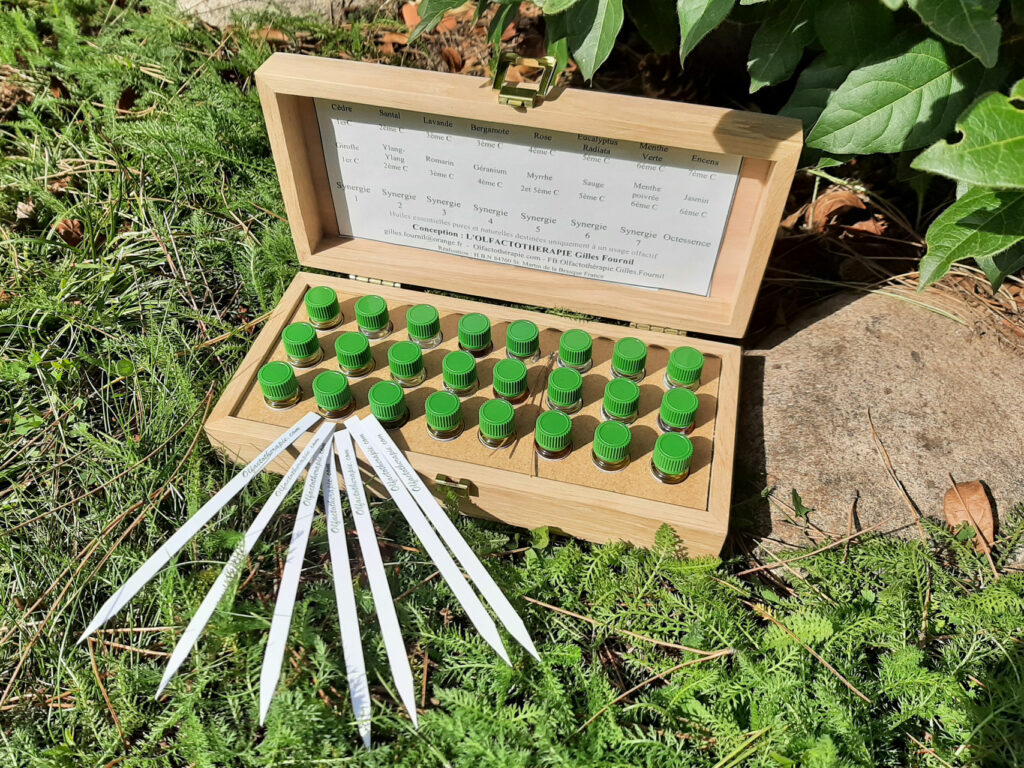
Fournil’s method is based on a kit composed of sixteen essential oils carefully selected by the therapist, among which are Atlas cedar, myrrh or jasmine. After smelling these oils one by one, the patient is asked to rank them from the one they preferred to the one they liked least. The olfactotherapist’s work is then done around the essential oil at the top of the list and at the bottom of the list, the latter often being revealing of a psychological blockage. The objective? “The work is successful when the smell no longer disturbs the client. And 7 times out of 10 at the end of a session, the smell that was disliked becomes pacified. It’s all a question of perception,” Gilles Fournil himself explains.
The aim is therefore to transform the negative charge revealed by the smells the patient rejects into a charge that is not necessarily positive, but in any case neutral—sometimes over the course of several sessions. Beyond a smell, it is above all an emotion or a negative belief that one tames.
With the growing success of olfactotherapy, more and more therapists decide to train in its practice.
Applications of Olfactotherapy
The applications of olfactotherapy are numerous: whether it is helping patients in palliative care, coming out of a coma or gripped by trauma, olfactotherapy can be beneficial wherever it is a question of soothing our mind.
At the Raymond-Poincaré hospital in Garches and at the Pitié-Salpêtrière, the aromachologist and olfactotherapist Patty Canac aims to stimulate patients’ language after a head trauma or a stroke. We owe to her an olfactory-therapy method named Olfarom including natural essential oils, but also synthetic perfumes whose objective is to remind patients of everyday-life scents such as those of chocolate, gas or the pencil.
Olfactotherapy and Memory
For people living with Alzheimer’s disease and other memory disorders, olfactotherapy opens up a fabulous field of possibilities. One can stimulate a patient’s memory through once-familiar smells, linked to their life journey. Let us imagine a patient who lived in Provence: work around lavender essential oil can potentially bring back previously forgotten images and moments of their experience. The famous concept of the “Proustian madeleine” that we use so often in the world of perfume has never made so much sense!
Olfactotherapy and Anosmia
Owing to the Covid-19 pandemic, another purpose of olfactotherapy that has gained popularity in recent years is that aimed at the olfactory rehabilitation of people who have lost their sense of smell (anosmia) and taste (ageusia). Being deprived of the pleasures generated by these senses can be hard to live with… And what about the risk of accidents, which is multiplied tenfold when our nose no longer sounds the alarm in the face of a spoiled ingredient or a burning smell?
Good news: repeated exposure to smells could promote the regeneration of the olfactory mucous membrane and restore the connections between neurons, allowing us to smell the world in which we live. A promising avenue, and all the more precious given that it is not always possible to treat anosmia with medication. At the University of Nice, work is under way to establish protocols to rehabilitate the noses of people who have retained after-effects of Covid.
In France, under the impetus of Mrs Véronique Le Lan, speech therapist and trainer, an expert in olfactory-gustatory disorders, many speech therapists today treat their patients suffering from olfactory-gustatory disorders, notably post-Covid, by integrating the scented pencils and cards of the Master Parfums Olfactory Game-Book into their protocol.
A Foretaste of Olfactotherapy… at Home!

One can train one’s sense of smell at home, by smelling blind the odours that surround us—so, to your drawers! Want to go further? Stimulate your fifth sense with the Master Parfums olfactory game and its scented pencils, a game that has been recognised by speech therapists as beneficial within the framework of olfactory-gustatory therapy.
Ah, the fig! This fleshy, sweet fruit, with its soft and subtle nuances, evokes not only culinary delights but also a rich and varied olfactory experience. Let’s delve into the heart of the fig and its environment, explore its fascinating role, and discover some classics from the world of perfumery.
Fig Varieties, Cultivation, and History
The fig is known as the fruit of the fig tree, a tree belonging to the Moraceae family. In reality, the fig is an inverted flower, containing many small flowers that, once pollinated, produce fruit—those little seeds that crunch between our teeth!
The fig tree is one of the oldest fruit trees cultivated by humans. It is estimated that its domestication dates back more than 11,000 years. Archaeological evidence of domesticated figs dating to around 9,400 B.C. has been discovered at Gilgal I.
This discovery suggests that the fig tree may have been the very first fruit tree to be domesticated, even before the domestication of grains such as barley and wheat.
Traditional figs are primarily grown in areas with a Mediterranean climate. Their cultivation has its roots in the Near East, specifically in Turkey and Syria. The Mediterranean basin—encompassing Europe and the Maghreb—is at the heart of the fig-growing tradition. The Middle East, particularly Iran, is also well established as a fig-producing region. California has become a major producer since Spanish missionaries introduced the fig there.
The world of figs is vast and diverse, with more than 750 varieties spread across the globe. Among them, the black Bourjassotte fig, the Solliès fig, and the white fig are must-tries, each offering unique flavors and aromas.
As for the prickly pear, it is a fruit that grows on the Opuntia cactus, found in the arid regions of the Americas, the Mediterranean, and North Africa. Despite its name, it has no direct connection to the traditional fig.
Extraction of the Fig’s Scent
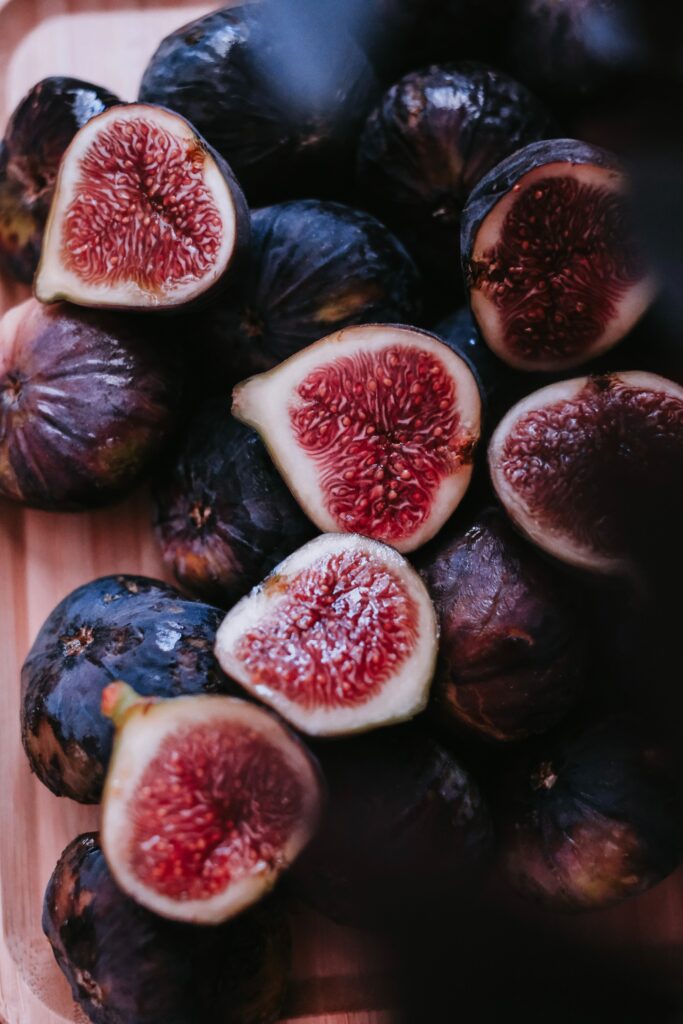
Fig Perfumery
Extracting scents is a delicate art that combines traditional and modern methods to capture the essence of the raw material. In the case of the fig, the process is particularly complex. Although the fruit is richly fragrant, its delicacy means it does not emit a scent strong enough to be extracted using traditional techniques such as distillation or enfleurage, as one would do with flowers or resins.
Chemistry in the Service of Perfumery
The magic of perfumes lies not only in natural ingredients but also in the ability of experts to manipulate chemistry to reproduce specific scents. If we tried to capture the scent of the fig directly from nature, the result might differ from our expectations. But thanks to modern techniques, perfumers have the tools to recreate the very essence of the fig, from the green freshness of its leaves to its sweet, sugary flavor.
These tools are actually specific chemical compounds—molecules—that, when combined, can evoke a precise image, sensation, or memory.
For the fig, it’s not simply a matter of reproducing its juicy fruit, but also the sensation of the sun warming its skin, the cooling shade of its leaves, and even the woody warmth of its trunk.
Thanks to these innovations, we have access to fragrances that not only evoke the fig more faithfully and in a wider variety of ways, but can also go beyond our perceptions by offering entirely new combinations.
These molecules are blended in varying proportions to achieve the desired nuance of the fig, whether it’s the green leaf of the fig tree, the sweet fruit, or the wood of the tree. It’s worth noting that creating a realistic and multifaceted fig note often requires a complex combination of several of these components.
The Importance of Natural and Synthetic Ingredients
Although synthetic methods are often used to recreate the scent of fig, this does not mean that their qualities are inferior. In fact, they can offer greater longevity and better sillage for a fragrance. However, the use of natural ingredients, when possible, can bring unmatched depth and complexity.
Capturing the scent of fig in perfumery is a fusion of science and art—a quest to capture the ephemeral and translate it into a lasting olfactory experience.
Multifaceted Fragrances: The Fig in All Its Forms
The fig tree is an olfactory treasure, not only through its fruit but also through its leaves and wood. Together, they form a triptych of scents that has inspired many perfumers.
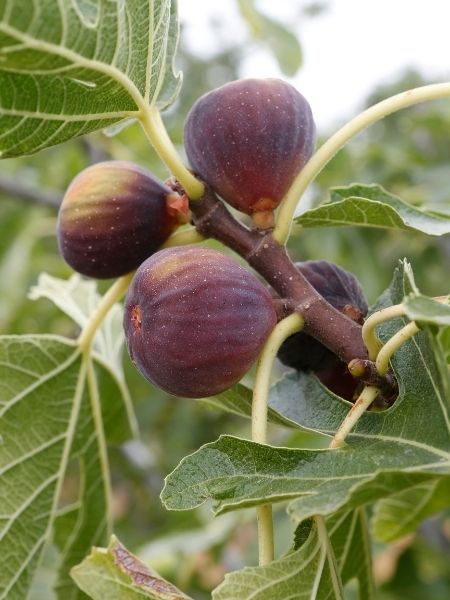
The fruit—the fig itself: Its juicy, fleshy pulp offers a soft, sensual bouquet that is slightly sweet, with a creamy, almost lactic nuance. In a fragrance, it can evoke a sense of nostalgia, recalling summers spent under the Mediterranean sun. Its scent is both subtle and enveloping, making the fig a favorite choice for fruity fragrances that aren’t overly sweet.
The fig leaf: If you’ve ever crumpled a fig leaf between your fingers, you’ll recognize its green, fresh, and almost raw scent. It evokes the shade beneath the tree on hot summer days—an instant escape to places of relaxation. In perfumery, the fig leaf note adds a green, slightly bitter, and crisp dimension that can counterbalance the sweetness of other ingredients.
Fig wood: Less common than the first two, fig wood offers a soft, creamy woody essence. It adds depth and warmth to a fragrance, evoking the sensation of bark warmed by the sun. When combined with other woods, such as cedar or sandalwood, it can enhance a woody accord or soften more powerful notes.
Complementary Combinations: Fig pairs wonderfully with many other ingredients. It can be combined with citrus notes for a more sparkling sensation, with white flowers for a more opulent dimension, or with resins and musks for a more sensual trail.
Iconic Fragrances: The Essence of the Traditional Fig
The fig, with its Mediterranean aura, has been used as an iconic note in many fragrances. Its delicate, sweet, and green scent evokes the warmth of summers past, the freshness of a fig tree’s lush leaves, and the indulgent sweetness of a roasted fig tart. Let’s explore some iconic fragrances where the traditional fig takes center stage.
Premier Figuier by L’Artisan Parfumeur: created in 1994 by Olivia Giacobetti. It was the very first fragrance to feature fig as the star ingredient, and it remains one of the most iconic to this day. What makes it unique is that the fig note did not yet exist in the perfumer’s repertoire.
It is an ode to the fig tree in its entirety, evoking the crispness of green leaves, the milky sweetness of fig milk, and the woody warmth of the tree. It is a fragrance that recalls a summer day in the Mediterranean, both fresh and creamy.
Ten years after the release of Premier Figuier, Olivia Giacobetti introduced the “Extrême” version, which builds on the original theme while intensifying it. The fig notes are deeper and more lush, enriched with indulgent touches such as almond cream. Sandalwood in the base note adds a creamy, warm dimension, making this version more opulent.
Philosykos by Diptyque: In 1996, Olivia Giacobetti repeated this exercise for Diptyque. Undoubtedly one of the most iconic fig fragrances, Philosykos Eau de Toilette beautifully captures the essence of the entire tree—from its lush green leaves to its fleshy fruit. The result is a woody, green fragrance that evokes a summer day spent under a fig tree. Then, in 2012, the perfumer created the eau de parfum, which accentuates the fig tree’s woody character with a touch of white cedar, slightly overshadowing the fruit’s sweetness. Philosykos evokes a summer on Mount Pelion, wandering through an orchard of wild fig trees, capturing the freshness of the leaves, the sweetness of the figs, and the depth of the tree.
Un Jardin en Méditerranée by Hermès: created in 2003 by Jean-Claude Ellena. Fresh, aquatic notes evoke the Mediterranean’s maritime character, followed by woody and green nuances reminiscent of the region’s trees and lush vegetation. Floral and fruity accents reflect the diversity of Mediterranean gardens. A fragrance that is both light and complex, mirroring a seaside garden.
Ninfeo Mio by Goutal, created in 2010 by Camille Goutal and Isabelle Doyen. The dominant note of fig leaf—fresh and green—evokes the garden’s shady trees. The citrus top notes recall the sparkling energy of dawn, while the deeper base notes convey the mystery and depth of ancient ruins. Ninfeo Mio is an ode to nature, history, and beauty, capturing the essence of the Garden of Ninfa in a bottle.
Womanity by Thierry Mugler: created in 2010 by Alexis Dadier and Ralf Schwieger. Although it is not a fragrance centered exclusively on fig, Womanity deserves a mention for its bold use of the fig note in combination with a “caviar” note. This surprising blend creates a sweet-and-salty fragrance that is both intriguing and modern.
Fig Infusion by Essential Parfums: created in 2022 by Nathalie Lorson. Nathalie Lorson has created a fruity fragrance with a realistic fig note, enhanced by Italian mandarin. This fragrance blends with a floral heart of orange blossom and notes of Sri Lankan black tea. The composition is rounded out by a woody blend of Virginia cedar and creamy sandalwood. The balsamic note of benzoin adds a refined, comforting touch.
The fig, with its rich olfactory profile and nuances ranging from the crisp greenness of its leaves to the creamy sweetness of its fruit, has long captivated the imagination of perfumers. Its history, deeply rooted in ancient civilizations, attests to its central place in culture, religion, and gastronomy.
One thing is certain: the fig in perfumery is much more than just a note. It is an invitation to travel, to dream, and to reconnect with nature. And as perfumery continues to evolve, there is no doubt that the fig, with its rich heritage and versatility, will continue to inspire new generations of perfumers in search of the next great classic.
Practice recognizing different scents—and why not try recreating the facets of the fig using the scented pencils from the Master Parfums olfactory activity book!
It’s Indian summer—imagine yourself on the terrace of a Mediterranean beach, a delicate cocktail in hand, electro-groovy music in the background, watching the sun decline on the horizon, its last rays caressing the sea. It is this sensation that Electro Limonade provides, an olfactory creation by L’Orchestre Parfum. It takes us on a memorable journey between perfume and music, thanks to the avant-garde vision of its founder, Pierre Guguen.
L’Orchestre Parfum, an Avant-Garde Brand
At the heart of contemporary perfumery, one name stands out for its singularity and its innovative approach: L’Orchestre Parfum. This brand, born of the ingenuity and passion of Pierre Guguen, transcends the traditional limits of perfumery by creating a captivating fusion between perfume and music.
Pierre Guguen, the architect behind this unique vision, has always believed in the deep interaction between sounds and smells. Captivated by the way certain smells can evoke melodies in the mind, and how certain music can evoke precise olfactory memories. This is what would lay the foundations of what was to become a formidable entrepreneurial adventure.
By founding L’Orchestre Parfum, Pierre Guguen did not simply seek to produce exceptional fragrances; he wanted each perfume to be a composition, a melody, a piece of art. For him, a perfume is not simply a combination of ingredients; it is an olfactory score, where each note, each accord has an emotional resonance.
The approach goes beyond simple marketing or concept. It is a deep conviction that music and perfume, although different in their expression, have the unique power to capture the essence of fleeting moments, memories and emotions. By combining them, he created not only a new way of perceiving perfume, but also an innovative way of experiencing music.
Pierre Guguen’s vision is bold and avant-garde. He has managed to shake up the world of perfumery by introducing a sound dimension to each perfume, thus offering a rich, immersive sensory experience. Through L’Orchestre Parfum, the founder invites each of us to close our eyes, to breathe deeply and to let ourselves be carried away by a symphony of smells and sounds, where each note is a journey, each perfume a melody.
Synaesthesia: The Soul of L’Orchestre Parfum
Synaesthesia is a rare, fascinating neurological phenomenon where the stimulation of one sense automatically triggers an experience in another sense.
L’Orchestre Parfum, with its avant-garde philosophy, is deeply inspired by this notion of synaesthesia. In fact, the brand makes it its creative epicentre. Each perfume is designed not only to evoke a smell, but also to arouse a sound experience, thus creating an olfactory melody that speaks both to our nose and to our ears. This fusion of senses is at once bold and innovative, pushing back the traditional limits of perfumery.
Pierre Guguen has a deep understanding of synaesthesia.
Those moments where a smell evokes a melody or a musical note recalls a specific scent profoundly influence his vision for L’Orchestre Parfum. For him, it was not only about creating a perfume, but a multi-sensory symphony.
The brand has thus partnered with talented musicians to compose pieces specific to each perfume, adding a sound dimension to the olfactory experience. The wearer of the perfume is invited to plunge into a journey where hearing and smell intertwine, each olfactory note being amplified by a musical note, creating a perfect harmony.
L’Orchestre Parfum reminds us that our senses do not function in silos. They are interconnected, weaving together our experiences of the world around us.
Synaesthesia, with its fusion of perceptions, serves as a perfect metaphor for L’Orchestre Parfum’s approach: a dance where music and fragrance blend, inviting us to an immersive, transcendent experience, well beyond what traditional perfumery has been able to offer until now.
NIID’s Musical Approach

What distinguishes L’Orchestre Parfum from other brands is this unique fusion between the olfactory and musical worlds. In collaboration with NIID, an innovative musical duo, L’Orchestre Parfum has managed to define a new kind of experience. Each perfume is accompanied by a musical piece, and together they tell a story, evoke an emotion, transport the listener and the wearer of the perfume into a multi-sensory journey. On hearing NIID’s eclectic melodies, carried by an electro track at 125 BPM, the perfume Electro Limonade takes on another dimension, another depth, and the experience is quite simply transcendent.
Nathalie Feisthauer, the Magician Behind Electro Limonade
It is rare to meet a perfumer with the talent and the trajectory of Nathalie Feisthauer. Her world renown is not usurped. Having worked for prestigious houses such as Hermès and Cartier, Nathalie knows how to capture the very essence of a moment, of a feeling. When she partnered with L’Orchestre Parfum to create Electro Limonade, she brought with her an expertise that transcends simple olfactory creation. Each note, each nuance of the perfume is the fruit of deep reflection, of a search for harmony between perfume and music.
Among her notable distinctions, she won the Russian FIFI Awards 2019 for best perfumer and was also awarded the Russian FIFI Awards 2021 for best niche perfume “Public Choice” for the musical fragrance Electro Limonade.
The Essence of Electro Limonade

Created in 2021, Electro Limonade is a refreshing, sparkling eau de parfum. It is an aromatic hesperidic cologne.
A bold cocktail: Like the unexpected twist of a bursting cocktail, mint joins the party, injecting a mischievous energy into an ultra-sparkling composition of bergamot, clementine and lemon. This “rascally” mint, as the brand expresses it, far from being conventional, recalls the freshness of a chill-out cocktail sipped on a terrace at sunset. Then comes rhubarb, groovy by its bittersweet nature, which creates a fascinating contrast between the citrus and the mint, recalling those innovative lemonades that leave a mark on minds and palates.
The Mediterranean night: As the fragrance develops, it draws us into the intimacy of a Mediterranean night. Orange blossom absolute, soft and opulent, evokes the sensuality of summer nights, when the stars twinkle and the electro-groovy beats take us into a dance between shadow and light, the softness and the intensity of an infinite tempo.
The mystical dawn: As the perfume unfolds, the base notes, like the bass of this electro groove, begin to whisper their secrets. The ambery woods evoke mystery and depth, offering a solid, warm base to the fragrance. Incense, resinous and slightly spicy, adds a mystical aura. Then Haitian vetiver, with its smoky nuances, anchors the perfume, ensuring that it remains engraved in the memory of those who cross its sillage.
The olfactory melody of Electro Limonade that Nathalie Feisthauer offers is a journey to the end of the night, an adventure that begins under the dazzling sun of the Mediterranean and ends at the dawn of a new day. It is at once energetic and vibrant, carried by lively electronic music and evoking memories of infinite nights that NIID has perfectly managed to translate.
Conclusion
Electro Limonade is more than a simple perfume; it is a work of art, rewarded with a Russian FIFI Award in 2021—a journey, a symphony for the senses. By combining the genius of Nathalie Feisthauer with the musical innovation of NIID, Pierre Guguen has once again realised his vision of a perfect fusion between perfume notes and musical accords. Each spray of Electro Limonade is not only the effusion of a fragrance, it is also the beginning of a melody, of a story, of an adventure. Enough to make summer last…
Cover banner photo credits: L’Orchestre Parfum
Ahoy, ahoy, it’s back to school! For many, the holidays are ending. Perhaps you are getting ready to return behind a desk and to take up the responsibilities of the working world again… Not so fast. Master Parfums invites you to fall back into childhood for the length of an article about the smells of school—those that have the power to transport us into a classroom, between dictations and playtimes.
The Pencil
HB, B, 2B—we didn’t always know what it meant, but is there a more classic piece of stationery than the pencil? This essential of our pencil cases, which came into being at the end of the 18th century, was first made of juniper wood, then red cedar. Today, it is incense cedar that is mostly used for its manufacture. At the end of its wooden body, there is of course its grey lead composed of graphite and clay.
To evoke the woody, gently mineral scent of the pencil, there is nothing like cedar, then… but not just any, because not all are equal. Atlas cedar, for example, exhibits a leathery, even animalic facet. Not really the thing to take us back behind a desk. No, the star is Virginia cedar or red cedar, whose wood shavings are distilled in order to extract a rich essential oil. The cedrol molecules this oil contains confer on it a green woody aspect, soft and dry at once.
If cedar has become the darling of many olfactory families thanks to its immense power to fix the notes it rubs shoulders with, place it in a woody perfume, and it truly shines, especially in contact with other woods. Light Blue by Dolce & Gabbana and its bamboo wood, Tam Dao by Diptyque and its sandalwood, or Super Cedar by Byredo where vetiver joins in are a few fragrances built around cedar that have managed to recapture the smell of a freshly sharpened pencil ready to be used… which brings us to paper.
Paper

Whether in a brand-new large-squared exercise book, a novel read reluctantly during the summer or a second-hand textbook, who has never found comfort in the smell of paper? The slightly sweet wafts that emanate from it and strengthen over time are mainly due to two components: cellulose and lignin.
Indeed, trees are mostly composed of cellulose, hemicellulose and lignin. When a wood is treated to make paper pulp, the cellulose is extracted from it, but the other two are shown the door. Lignin can notably make the paper too rigid and difficult to handle. But never mind, it does not have its last word, because the separation is never done completely: some of its essential oils cling to the cellulose, and it is they that make the olfactory signature of the books and exercise books that quickly made our satchels a little too heavy to carry.
Lignin, which previously contented itself with being a residue of paper mills, is today used in perfumery, especially to synthesise vanillin and recreate the sweet smell of vanilla pods more quickly and at lower cost. Paper also contains acetic acid with its vinegary scent, aldehydes recalling dry grass, or benzaldehyde, evoking for its part bitter almond. With the passage of time, these components degrade… to the great delight of our nostrils, because the smell of paper that we love so much is then exacerbated!
The powdery delicacy of Amande Persane by Roger & Gallet, of L’Eau d’Hiver by Editions de Parfums Frédéric Malle, or perhaps of Vanille Exquise by Annick Goutal will thus plunge your nose between white pages. And if you prefer the smell of pages yellowed by time, Old Books by the house The Perfumer’s Story by Azzi recreates the woodier, more resinous side of ageing paper.
The smell of a book will vary according to its age, then, but also according to the type of paper used, the ink that appears on its pages, as well as the glue used to bind them. Speaking of glue, many of them today boast of being fragrance-free; an aberration for former schoolchildren for whom the smell of Cléopâtre glue is an unparalleled Proustian madeleine. Let’s return to the pencil case with this product with the orange cap and its famous almond scent with chemical accents.
Cléopâtre Glue
In 1930, Pierre Chamson founded the Cléopâtre company and made, in his Parisian apartment, a glue of the same name based on potato starch. But faced with sometimes tough competition, one has to reinvent oneself. In no time, the pot armed itself with a little brush and, above all, in 1934, with the almond smell that would make its success. The molecule that delivers the characteristic smell of Cléopâtre glue is the benzaldehyde mentioned above, also called amandol, because it is found in bitter-almond essence. At the time, the aim was not, however, to confer any fragrance on the glue, only to make its texture easier to work with and to be able to preserve it longer.
In the cologne Gentlewoman by Juliette Has A Gun, Cléopâtre glue is brought back to life by an almond intensified by orange blossom and enveloped in ambroxan and musks. Doudou by Jean-Charles de Castelbajac also claims Cléopâtre glue as inspiration. Unsurprisingly, it is the union between a green almond, orange blossom and bitter orange. In the same vein, Serge Lutens delivers with Louve a pared-down, powdery almond.
A Pot-Pourri of School Scents
There are still so many smells of the new school year to rediscover! Perhaps you remember enthusiastically choosing the colour of your exercise-book covers as September approached… The scent that emanates from them comes from residues of vinyl chloride, a toxic gas when present in large quantity, which is fortunately not the case in exercise-book covers—good news for those who liked to inhale their ethereal smell.

Fountain-pen ink, for its part, owes its smell to the small dose of phenol that serves as a preservative in it. Also suspected of having harmful effects at high concentration, it was prudently replaced. Farewell, then, to its slightly leathery smell sometimes evoking mushroom and even tapenade. Le Messager by Courrèges, Téméraire by Givenchy, M/Mink by Byredo, or L’Eau Papier by Diptyque are all fragrances reviving the ink that sometimes ended up more on our fingers than on our sheets. L’Eau Papier also presents an accord of rice steam suggesting, you’ll have guessed, paper. Let us also mention Comme des Garçons 2, a woody perfume showcasing Japanese Sumi ink, accompanying it with a whole host of spices, incense and cedar.
Tempted to recapture the harsh, mineral scent of chalk on a blackboard? Take a look at Royal Bain by Caron or De Bachmakov by The Different Company.
Has this overview of schoolroom notes made you want to learn more about the composition of a perfume? With its 120 questions about the fascinating world of perfumery, the Master Parfums game has the solution, and that’s not all: with its scented pencils, sketching out your own fragrance becomes child’s play!