Ah, perfume, the undethronable classic of gifts of all kinds! Christmas would not say otherwise: in a few weeks, it is a safe bet that many perfume bottles will slip under the trees… About a month before, on 20 November, it is World Children’s Day, a day established to remember the advances made in the rights and well-being of the youngest among us.
Are you thinking of giving a perfume to a little imp this winter, but don’t know how to go about it? You’ve come at just the right time. Did you raise an eyebrow at the previous sentence, because you tell yourself that perfume is for grown-ups? Think again; Master Parfums tells you all about it.
The Genesis of Perfumes for Little Ones
The beginnings of perfumes for babies date back to the 1960s. In 1967, Dior inaugurated its very first Baby Dior boutique on Avenue Montaigne in the French capital. There, one could purchase creations by the label intended exclusively for children! Clothes, toys, dolls, soft toys… No fragrance on the horizon yet. It was not until 1970 that the very first perfume for a young audience made its entrance: it too was called Baby Dior and was designed from an eau de Cologne base, with very little alcohol. Yet, on its release, the gamble did not pay off, perfume still being at the time a product accessible only to the wealthiest.
In 1975, another boutique came into being in Paris, at 67 rue de l’Université: that of Bonpoint, a ready-to-wear brand for children founded by Marie-France and Bernard Cohen. In 1986, the brand launched a perfume for the little ones, the now cult Eau de Bonpoint. This time, this citrus-based, ultra-fresh essence made a splash, and many children’s perfume creations followed in its footsteps. In 1994, it was notably Guerlain’s turn to try its hand at the exercise with Petit Guerlain, the birth of his grandson prompting Jean-Paul Guerlain to compose this water blending citrus, lavender and mimosa.
The popularity of children’s perfumes has never stopped growing, and they have since blossomed more or less everywhere on the market… sometimes making the choice of one of them a little nebulous! Don’t panic, we’ll point you in the right direction.
Scents for Little Ones—What’s the Point?
First of all, you should know that babies are extremely sensitive to smells, even straight out of mum’s belly. Between the eighth and eleventh week of pregnancy, their olfactory receptors and the area of the brain analysing and processing olfactory information are formed. Then, between the fourth and sixth month of pregnancy, their nostrils open up. Foetuses are then already able to “smell” the odorant substances of what mum eats, through the amniotic fluid in which they spend several months!
At birth, the sense of smell gets going without delay: the baby recognises the smell of its mother then, little by little, that of milk, of its environment… Contrary to what one might think, its fifth sense is called upon without further ado, and it will continue to develop throughout its growth! A perfume can therefore constitute an additional marker in this constant olfactory education and help to make baby feel safe through scents that will quickly become familiar to it.
It is recommended to perfume a child only from three months of age, first giving them time to become familiar with the whole host of smells that surround them. From three months and up to three years, perfume is allowed, but be careful: not a drop of alcohol! Let’s look at this a little more closely.
Ingredients to Avoid
Perfumes with Alcohol
Beware of alcohol, then, which can be too aggressive on children’s sensitive skin. Fortunately, although this word is often used to designate them, many baby “perfumes” are in reality what are called scented waters—in other words, alcohol-free perfumes. From three years of age, the embargo on eaux de toilette and eaux de parfum is lifted, but here again, their alcohol content must be low, no more than 30%. In short, it is better to swear by the absence of alcohol or, for children over three years old, a very small dose.
Beware of Endocrine Disruptors
We are also wary of endocrine disruptors, molecules whose effects are complex and still subject to debate, but which scientific studies suggest could affect functions related to the hormonal system. Between its development in its mother’s belly and early childhood, a child will be particularly sensitive to, and therefore vulnerable to, their potential undesirable effects. Here are the main culprits:
- Parabens: methylparaben, ethylparaben, isopropylparaben… Their names all end the same way, which is rather handy for us!
- Phthalates: di-2-ethylhexyl, benzyl butyl and dibutyl are among the most used;
- Phenoxyethanol;
- BHT;
- BHA.
Allergic Reactions
Finally, we anticipate allergic reactions: the chosen perfume is ideally hypoallergenic, and we prefer to diffuse it in moderation at first, and rather on the clothes, until we are sure that the child’s sensitive skin will not turn red! Also be careful that it is not on a zone the child might put in their mouth—the comfort blanket may have to do without its dose of perfume.
Perfumes are subject to rigorous controls, especially when they are intended for the skin of the very young. There is therefore a good chance they tick these boxes, but the further you go up the age range they target, the less this is the case, so keep your eyes open!
AWAKEN YOUR NOSE
Recognising a smell can be learned
Identifying a raw material, memorising a smell, putting words to your perceptions… Your sense of smell can be trained too.
With the Master Parfums Olfactory Game, exercise your nose in a fun way and develop your perfume culture.
And the Smell, in All This?
Beware of overly heady juices! Lightness and subtlety are the watchwords when it comes to perfuming little ones. In these categories, the champions are floral and vegetal notes, as fresh as can be. One thinks notably of honeysuckle, orange blossom or chamomile, true veils of softness on the skin of tots—the latter two are, moreover, frequently used in baby toiletries. Staying in the orange-blossom family, hesperidic notes such as a mandarin, an orange or a discreet neroli are also safe bets.
With age, children begin to want to assert themselves. The older ones may perhaps appreciate sweet, gourmand notes a little more pronounced than their sister notes the flowers and citruses. A creamy caramel, a cloud of candyfloss, a crunchy chocolate, and of course great classics of the gourmand family such as a pretty powdery vanilla will work wonders in a children’s perfume. With almond, softness guaranteed—did you know that benzaldehyde, also called amandol and present in bitter almond essence, often recalls the smell of schoolchildren’s glue? Here’s a fitting note for the next back-to-school season!
Finally, other great favourites of children’s perfumes are fruity notes: apple, strawberry, rhubarb… Mouth-watering scents that tend to please children and parents alike.
An Overview of Emblematic Perfumes
Another avenue to guide you in your search for a perfumed gift can be to turn to creators who have managed to stand out in terms of perfumes for the little ones.
- Eau de Bonpoint, which we mentioned earlier, has become a must-have. It came into being from the nose of the perfumer Annick Goutal, who is none other than the sister of Marie-France Cohen, the co-founder of Bonpoint! Its timeless neroli–orange blossom duo, the house’s olfactory signature, helped to make it an iconic scented water.
- Now itself a cult children’s perfume, Ptisenbon was launched in 1987 by Tartine et Chocolat, the French, elegant children’s fashion brand. The brand collaborated with Givenchy and delivered a pared-down juice in which green notes of mint, citruses and a floral heart of honeysuckle, jasmine and lily of the valley blend. Ptisenbon exists both as a scented water, without a drop of alcohol, and as a low-alcohol eau de toilette for the older ones.
- The latest addition to the Tartine et Chocolat family is the eau de toilette Ptimusc (2023)! Orange blossom, white cocoa and oat milk are brought together in this jewel case of milky softness.
- Jacadi has also managed to establish itself as a reference. Its perfumes are composed of more than 90% ingredients of natural origin, contain thermal water and moisturising agents such as panthenol, and are hypoallergenic: they are what are called care waters!
- The soberly named Le Bébé (2015) combines a burst of bergamot and freesia with a heart of jasmine and orange blossom, before finishing on a soft cloud of musks and sesame.
- Toute Petite and Tout Petit (2008) both open on citruses and rest on a base of musk and cedar. The girls’ perfume offers us a silky heart of lily of the valley and orange blossom, and the boys’ perfume, orange blossom and Granny Smith apple in a greener heart. Two solar perfumes, luminous with freshness.
- For teenagers, you’ll have the choice between the more gourmand Mademoiselle Jacadi and Jeune Homme (2015). Mademoiselle Jacadi is blackcurrant, raspberry and peach, a few flowers, without forgetting the comfort of the vanilla in its base notes. Jeune Homme is rather aromatic, dusted with citrus, combining tea with rhubarb before wrapping itself in ambrette and tonka bean.
- In 2023, the Baby Dior line welcomed a newcomer: Bonne Étoile, a scented water composed of 98% natural ingredients and signed by Francis Kurkdjian. The perfumer describes his inspiration as “that of a round, soft smell, like the lovely cheeks of a chubby baby”! And to bring it to life, he wanted to stray from the beaten path by doing without orange blossom, preferring a juicy pear, a wild rose and cottony musks. Beyond its olfactory notes, the price of Bonne Étoile got people talking… 255 euros, no less!
- Much more economical, Mustela’s baby care water Musti (2012) combines the freshness of lily of the valley and bergamot with extracts of chamomile and honey for a soothing effect.
- With Cabriole (2022), Hermès delivers a velvety osmanthus with accents of peach and apricot, green notes of honeysuckle and an ever-so-soft sandalwood.
- Why not try the gently fruity alcohol-free water Petite Chérie (2019) by Annick Goutal? This variation of the adult perfume of the same name marks the delicate meeting of pear, peach, rose and vanilla, like a garden misted with dew.
So, ready to perfume the gift sack for grown-ups and little ones alike?
On the occasion of the commemoration of 11 November, the day marking the end of the First World War, our olfactory reflection leads us to explore an unexpected angle: the relationship between perfumery and war. These two worlds seem far apart, and yet history reveals to us an intimate link, rich in creations and symbolism. It is an olfactory journey between resilience and renewal that we propose you discover.
The Olfactory Correlations Between Perfume and War
War, with its conflicts and its turmoil, seems at first sight antithetical to the finesse and the harmony that perfumery represents. Yet the history of the olfactory art and of the great world confrontations are surprisingly intertwined, weaving deep, complex links that deserve to be explored.
Cross Influences: Raw Materials and Economy
The first correlation between perfume and war is at the level of raw materials. World conflicts have often disrupted trade routes and the availability of certain precious essences. The Second World War forced perfumers to reinvent themselves, because of the shortage of natural raw materials, giving rise to the increased use of synthetic molecules.
The shortages due to the blockade of wars are also at the origin of new ways of creating and wearing perfume: in the United States during the Second World War, faced with the shortage of perfume alcohol needed for making eaux de toilette, American manufacturers adapted by creating innovative alternatives: more concentrated extracts (therefore containing less alcohol), perfumed creams and powders, solid perfumes and bath oils.
In Spain, during the civil war (1936–39) and the years that followed, it was impossible to import raw materials for perfumes. Self-sufficiency was the order of the day. This is how Agua Lavanda, Puig’s first flagship product launched in 1940, was created with local Mediterranean materials: lavandin, sage, rosemary, thyme, lavender, cistus labdanum… An eau de cologne which, moreover, fitted perfectly with the traditional values carried by the Franco regime.
Beyond the economy, there is the symbolism. Perfumes born during or just after periods of war often carry within them the spirit of their era. They become emblems, acts of resilience, conveying that spirit of renewal and optimism, and marking the return to life and reconstruction.
Perfume as Memory: Conservation and Transmission
Perfume has this unique faculty of capturing and preserving memory. The olfactory creations inspired by periods of war are vectors of historical transmission, evoking not only collective memory but also personal stories. They make it possible not to forget, to teach, and to continue telling the story through the senses.
Olfactory Notes: Echoes of War in the Art of Perfumery
At the heart of perfumery, the olfactory notes associated with war evoke powerful, complex memories.
Take the gunpowder note, for example, whose metallic, sulphurous smell instantly recalls battlefields and distant detonations. This note, used sparingly, confers on fragrances a dimension that is both mineral and bold.

Smoke, for its part, evokes campfires and landscapes after the confrontation, its woody, burnt character increasing depth and mystery. When it enters the composition of a perfume, smoke brings a dimension that is both airy and dark, like a phoenix rising from the ashes of devastation.
Leather is another note that finds its roots in military equipment: boots, belts and harnesses. Let us recall that the first leather notes in perfumery were brought by birch wood, with which the Cossacks maintained their boots and which gave leather a very specific smell. This note embodies robustness and strength, but also a form of nobility and refinement. In perfumery, leather often reveals itself as warm and sensual, a subtle allusion to the armour that one dons to face ordeals.
Fog is more abstract but just as evocative: it recalls the unknown and uncertainty, the concealment of movements and strategies. It is often suggested by aqueous or ozonic notes, bringing a freshness that plays with clarity and sharp outlines, evoking the ambiguity of troubled times.
Finally, earth—damp, fertile, turned over by the trenches—is particularly evocative. It speaks of death and of life, of the inescapable cycle that war highlights with brutality. In olfactory compositions, earth reconnects us with nature and with the basis of our existence, with chypre accords or notes of vetiver, oakmoss and patchouli that anchor perfumes and give them a unique resonance.
These olfactory notes do not simply tell a story of war; they also tell a story of human resilience, of adaptability and, ultimately, of hope.
A Few Symbolic Perfumes
Chanel N°5: a Legend in Wartime
N°5 is a pillar of perfumery, a perfume that has defied eras and trends since its creation in 1921 by Ernest Beaux for Gabrielle Chanel. Its composition, a complex alchemy of floral notes with an overdose of aldehydes, brought an olfactory revolution with an exceptionally modern, abstract bouquet. During the Occupation of the Rhineland, when France was marked by war, Chanel N°5 continued to be an emblem of French elegance. Its ability to remain in production offered a form of cultural resistance, a reminder of beauty and refinement in contrast with the dark times. The perfume transcended its era to become a symbol of survival and continuity, offering a touch of luxury and normality in an otherwise chaotic world. A French luxury that was also exported across the Atlantic thanks to the American soldiers who, on returning from the war, brought back to their wives this chic souvenir of Paris…
Vent Vert: an Ode to Freedom
Vent Vert, launched by Balmain in 1947, is often celebrated as the first perfume to capture the essence of post-war renewal. Designed by the legendary nose of Germaine Cellier, this perfume is a true pioneer in the world of perfumery, introducing a wind of freshness into an era dominated by heavy, opulent scents. The name itself, “Vent Vert” (Green Wind), is evocative of the liberation and the breath of freedom so awaited after the dark years of the war. Its top notes are a burst of greenery, an innovative blend of galbanum, basil and lemon that signified a bold departure from the conventions of the time. The floral heart opens on aromas of rose, jasmine and ylang-ylang, evoking the rebirth of nature in spring. The woody base with touches of vetiver and musk anchors the perfume in a sensation of quiet strength. Vent Vert is not simply a perfume, it is a declaration of hope and a hymn to life reclaiming its rights.
L’Air du Temps: a Symphony of Peace
L’Air du Temps by Nina Ricci, created in 1948, is another olfactory treasure that captured the spirit of the post-war era. Designed by the perfumer Francis Fabron, this perfume embodies the universal aspiration to peace and harmony in a world that was barely emerging from the shadow of war. The bottle, topped with two entwined doves, is a powerful symbol of peace and purity. The fragrance itself is a delicate, feminine blend, opening on sparkling notes of spices and bergamot that introduce a flowered heart of rose and jasmine. The addition of iris brings a touch of powder, a reminder of rediscovered softness and innocence. The base blends sandalwood and musk, creating a sillage that speaks of calm and comfort. L’Air du Temps is more than a perfume, it is a message encapsulated in a bottle, a promise of a new era charged with optimism and joy.
L’Art de la Guerre: a Modern Olfactory Reflection
“L’Art de la Guerre” by Jovoy, created by Vanina Muracciole, although more recent in the world of perfumery, establishes a conceptual link with the Chinese strategy of Sun Tzu, whose writings are known for their deep understanding of the dynamics of conflict and peace. Launched in 2014, this perfume is an olfactory interpretation of strategy and tactics, reflecting the complexity and the depth of Sun Tzu’s work. The fragrance opens on citrus and fresh notes, symbolising the clarity of mind necessary for strategy. The spicy heart represents the manoeuvres and the unpredictable movements of battle, while the leathery base evokes the warriors’ armour. The presence of vetiver and patchouli in the sillage brings an earthy, robust dimension, recalling that all strategies are ultimately anchored in the terrain, in the reality of the world. “L’Art de la Guerre” is a tribute to the principles of discipline, patience and tactical intelligence.
Perfumery, like the flowers that grow back on the battlefields, is a resilient art that not only survives dark times but draws inspiration from them to create. These historic perfumes are not only olfactory witnesses of a bygone era, but bridges to the future. On this 11 November, let us remember that each note of these perfumes carries within it the spirit of an era, the memory of a struggle and the hope of a world at peace.
In the ethereal world of perfumes, creators constantly seek to translate emotions and experiences into captivating fragrances. One of the most eloquent and poetic associations of this field is that uniting music to perfumery. Through this olfactory journey, let us explore how music, with its melodies, its harmonies and its frequencies, influences and inspires the art of olfaction, pausing on brands that have made this symbiosis their signature: Art Meets Art, L’Orchestre Parfum, ROOM 1015, Musicology and Jusbox.
The Scientific Convergences Between Music and Perfume
At first sight, olfaction and hearing may seem to be radically different senses, but scientific discoveries reveal fascinating parallels and complex interactions between the world of smells and that of melodies. Researchers are gradually publishing how these two sensory universes are interconnected, offering a captivating glimpse of the internal symphony that plays out within us.
Sensory Synaesthesia

Synaesthesia is a phenomenon where the stimulation of one sense automatically and involuntarily triggers an experience in another. In the case of music and perfume, some individuals report being able to “smell” melodies or “hear” smells. Although this may seem unusual, synaesthesia illustrates the way our sensory systems are closely linked and can mutually influence our perceptions.
The Brain in Harmony
Studies in neuroscience have shown that listening to music and experiencing smells activate similar regions of the brain, in particular those linked to memory and emotions. Olfactory memories are known to be among the most powerful and the most persistent, and music also has the capacity to trigger deep memories and provoke intense emotions. These two senses seem to have direct access to the most primitive and emotional parts of our brain, creating indelible links between sensory experiences, memories and emotions.
Frequencies and Vibrations
From a physical point of view, both odorous molecules and sound waves propagate through the air in the form of vibrations. Although our senses perceive them differently, they both react to specific frequencies—sound frequencies for hearing and molecular frequencies for olfaction. Some research even suggests that our perception of smells could be influenced by sound frequencies, opening the way to multi-sensory experiences where music and perfume are carefully tuned to enrich and intensify the overall experience.
Learning and Creating Through the Senses
Research continues to explore these fascinating connections, offering new perspectives for perfumers and musicians. By better understanding how music can influence our perception of smells, and vice versa, creators can harness this knowledge to generate richer, more immersive multi-sensory experiences.
The link between music and perfume is far more than metaphorical. Both disciplines call upon our senses and our ability to perceive, feel and recall emotions. Is not the act of composing a perfume similar to that of composing a melody, where each note, whether olfactory or auditory, must harmonise perfectly in a precise accord? Sound frequencies, just like smells, have the power to make our inner being vibrate, awakening memories, images and sensations that often transcend consciousness.
The Echo of Musical Vocabulary in Perfumery
The world of perfume and that of music share a surprising symphony of terminology, illustrating a deep interconnection between these two sensory arts. Not only do they touch our souls in a similar way, but they also use a strikingly similar vocabulary to describe their nuances and their complexities.
Notes and Accords
Just as a melody is composed of individual notes that harmonise to create a song, a perfume is also built around distinct notes.
As the musician’s notes can be high or low, perfumed notes can also give this impression of lightness or depth: one could say that citrus notes give a high sensation of vivacity, while woody notes “sound” lower, and seem deeper.
These notes, when combined, form olfactory “accords,” a term directly borrowed from the musical world. In music, a chord is a harmonious combination of different notes played simultaneously, and in perfumery, it is the union of different essences that creates a unique smell.
Organ
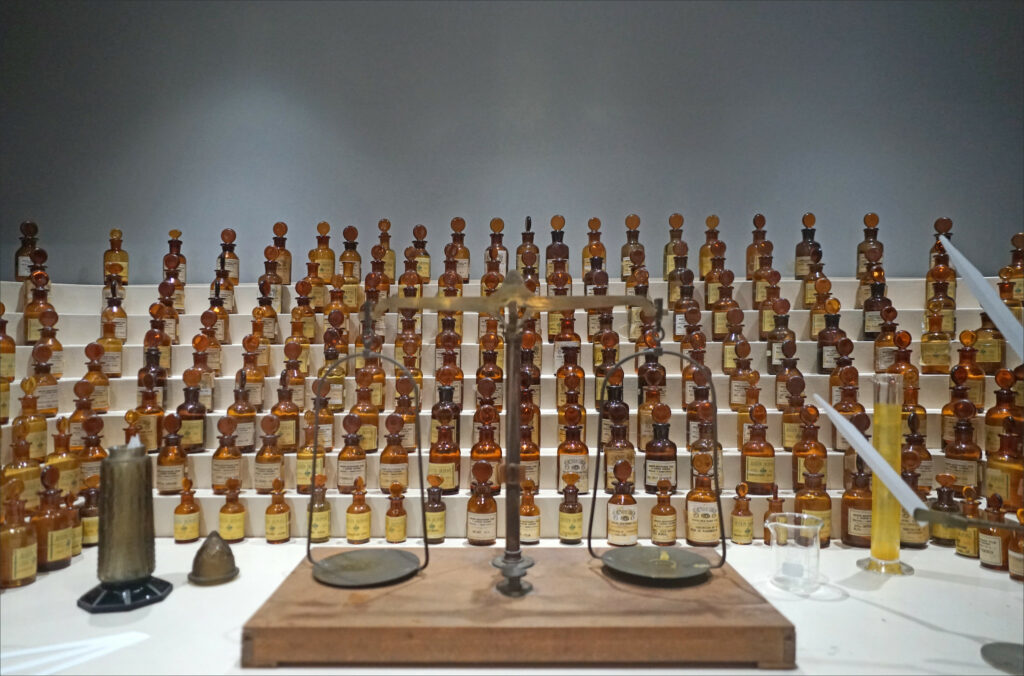
One of the most essential and iconic tools of a perfumer is the “perfume organ.” Just as a musical organ with its multiple pipes and keyboards makes it possible to produce a rich variety of sounds, the perfume organ is a specially designed piece of furniture containing a multitude of niches, each filled with bottles of different essences. The perfumer, like a musician, composes their olfactory symphony using this instrument, a desk essential to optimal organisation.
Symphony
A musical symphony is a grandiose work, generally structured in several movements, where each part contributes to a coherent whole. A perfume can also be considered a symphony, where each note plays its role, intertwining and evolving to create a complex, harmonious olfactory experience.
Composition
The process of creation, whether of a musical piece or a perfume, is often called “composition.” In both fields, this goes through the writing of the score that will bring the composition to life. It refers to the know-how of assembling different elements to create a unique, memorable work of art. Just as the musician who writes their composition mentally before transcribing it onto a score, the perfumer imagines their perfume and its accords first in their head and then materialises it into a formula. Trials will make it possible to refine their creation. As Jean-Claude Ellena emphasises in his Que Sais-je “Le Parfum,” just like the musician’s ear, the perfumer’s nose is nothing other than a tool of control and learning.
This rich exchange of vocabulary between music and perfumery testifies to the way these two worlds, although distinct, come together in their quest to express and evoke emotions. These shared terms remind us that we are touched in a deep, intangible way, transported by the magic of sensory art.
The Perfumery Houses That Draw Inspiration from Music
Art Meets Art: The brand created by Tanguy Le Baud uses the prism of culture and, more precisely, of music to make highly artistic perfumes. The perfumes then become works where the perfumers draw on the refrains of the great musical icons to create essences that tell a story, that of an era, an artist or a musical genre. The result? Perfumes that are so many olfactory tributes to the musical works that inspired them, offering art lovers a new way to explore and appreciate the musical classics.
L’Orchestre Parfum, created by Pierre Guguen, is a perfume house that transcends music into fragrance. The perfumes created here are compositions where each perfumed note is inspired by a musical instrument or a specific melody. The wearer of the perfume is invited to an immersive experience, where olfaction and hearing intertwine in a dazzling sensory dance, generating a third work of art that is none other than the emotion felt.
Room 1015, created by Michael Partouche alias Dr Mike: the echo of rock’n’roll.
With Room 1015, the world of rock’n’roll is sublimated into bottles emanating the rebellious, electric spirit of this music. The perfumes, with their woody, spicy and sometimes flowered notes, transport us into the world of hotels and dressing rooms, where the rock legends left an indelible trace of their passage. It is an olfaction tinged with nostalgia, freedom and non-conformism that unfolds with each waft of the perfume. Each perfume is accompanied by an original piece of music that describes the fragrance and by a specific playlist of the same style.
Musicology, founded by Fabien Boukobza, represents the essence of melodies in a bottle. The Musicology brand invites us to explore our own internal musical library through its perfumes. The idea here is to transcribe the essence of various musical genres into olfactory creations, thus making it possible to explore jazz, blues or rock through the prism of perfume. Musicology thus offers a journey where olfactory memory and auditory memory dialogue, making it possible to rediscover melodies through a new sense.
Jusbox, founded by Chiara and Andrea Valdo, the brand explores the world where musical and olfactory memories overlap, each perfume seeking to immortalise an emblematic moment of musical history. Their perfumes, like encapsulated melodies, offer a nostalgic olfactory experience, where scents trigger reminiscences of past melodies.
L’Oréal Paris collaborated with Ircam Amplify to create an innovative sound experience olfactorily translating the perfume Spicebomb Infrared by Viktor & Rolf, released in 2023. This initiative aims to produce a sound that reproduces the sensations and emotions provoked by the perfume. The perfumers Jean-Christophe Hérault, Nicolas Beaulieu and Carlos Benaïm, at the origin of the fragrance, worked with the Ircam Amplify team, including the sound designer Romain Barthélémy, to translate the olfactory notes of the perfume into a sound lexical field. Using Ircam Amplify’s SpeaK method, they developed and tested various sound drafts with consumers. The final result is a 26-second sound experience, capturing the evolution and the intensity of the fragrance and provoking a tangible increase in body temperature! This unique collaboration merges science, the art of perfume and marketing, offering a new perspective on the perception of perfumes.
Music and perfume, two art forms that transcend words and languages, merge in a surprising, exquisite way within these perfumery houses. Far from being a simple source of inspiration, music becomes an ingredient, a note, that resonates in each olfactory creation. And what if this interweaving of the arts were an open door towards new ways of apprehending and creating perfume? Could the multi-sensory experience be the future of perfumery, offering creations where seeing, touching and tasting will also be an integral part of the creative process and the user experience?
Sources
Nez, la revue olfactive n°14 – Musique et Parfum; Le parfum et la voix – Annick Le Guérer