On the occasion of the mimosa festival, let’s explore mimosa in perfumery together, from its geographical and botanical environment to its use in the creation of fragrances. Let’s discover its natural smell, the extraction methods used to capture its essence, and analyse the olfactory nuances that make it a note prized by perfumers. Finally, we will highlight a selection of perfumes that embody the richness of mimosa.
The Geographical and Botanical Environment of Mimosa
Mimosa, a symbol of delicacy and resilience, finds its origins in the distant lands of Australia. This shrub, which is now an integral part of the Mediterranean landscape, and in particular on the Côte d’Azur, is known for its winter flowering, offering touches of colour and warmth in the often dark landscape of late winter.
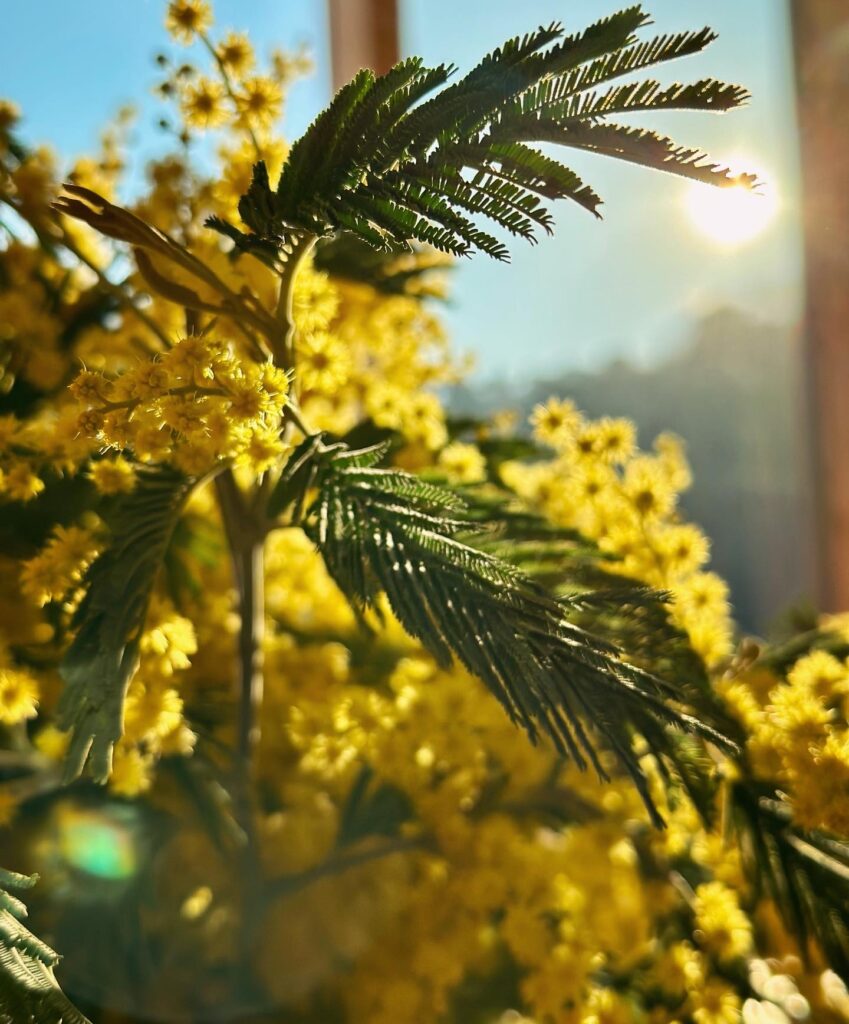
Mimosa, belonging to the Fabaceae family and characterised by its graceful leaves and its bouquets of spherical yellow flowers, blooms from January to March, bringing colour and scent to winter landscapes. Beyond its aesthetics, mimosa plays a crucial ecological role in fixing soils and serving as a habitat for wildlife, while having a cultural importance, notably in the Côte d’Azur region where it is celebrated for its resilience and its beauty that brighten the landscapes in late winter.
The Smell of Mimosa and Its Extraction Method
This scent, at once delicate and complex, makes mimosa an essence prized in perfumery for its ability to bring luminosity and elegance to compositions.
The Smell of Mimosa
Its natural scent stands out for an enveloping softness, where slightly powdery, almondy floral notes blend with a honeyed base and a hint of fresh greenery. This olfactory alchemy evokes springtime softness, gentle sunshine. The smell of mimosa is at once delicate and powerful, luminous and soothing.
In perfumery, mimosa brings a touch of light and warmth to compositions, marrying harmoniously with woody, ambery notes, or with floral and green accords.
The nuances of the smell of mimosa are manifold: at first, it may seem simply sweet and floral, but more sustained attention reveals its richness and its complexity. The green, fresh facets recall the first days of spring, while the powdery, honeyed touches offer a depth and an enveloping warmth, creating a perfect balance between vivacity and softness.
The Extraction Methods
The extraction of mimosa essence for its use in perfumery is a delicate process that aims to capture all the complexity of its fragrance. Mimosa flowers are particularly fragile, which requires careful extraction methods to preserve their authentic essence.
- Volatile solvent extraction makes it possible to obtain a mimosa absolute. The flowers are plunged into a solvent, most often hexane, which captures the volatile compounds. Once saturated with scent, the solvent is evaporated in order to collect a concrete, a kind of fragrant wax, which will be washed with alcohol to separate the fatty substances and thus obtain the absolute. This very concentrated absolute offers perfumers a high-quality raw material for their creations.
- Supercritical CO2 extraction, applied to mimosa, makes it possible to obtain a pure, high-quality essence of this flower without using chemical solvents. By exploiting CO2 in the supercritical state, which combines the properties of a gas and a liquid, this method extracts, at low temperature, the delicate aromatic compounds of mimosa while preserving their freshness and their integrity. This environmentally friendly process offers a complex extract faithful to its natural scent.
A Few Perfumes Built Around Mimosa
Several olfactory creations showcase mimosa, each interpreting this solar flower in its own way. Among the emblematic perfumes, we can cite:
Farnesiana by Caron, a floral perfume launched in 1947 by Michel Morsetti, interprets mimosa with a rich, nuanced composition. At the top, accords of mimosa blend with wafts of hay, blackcurrant and bergamot, introducing a complex, welcoming opening. The heart unfolds around violet, jasmine and lily of the valley, creating a deep, captivating floral bouquet thanks to iris butter. In the base, vanilla, sandalwood, opoponax and musk bring a warm, resinous base, finishing on a soft, honeyed note.
Mimosa Pour Moi by L’Artisan Parfumeur, by Anne Flipo in 1992. This perfume is a pure, simple celebration of mimosa, offering a fresh, slightly sweet fragrance. The composition opens on green notes that evolve towards a floral, powdery heart, capturing the delicate, sunny essence of mimosa. The base reveals a touch of vanilla, adding a soft, comfortable dimension to the fragrance.
Champs-Élysées by Guerlain, Olivier Cresp, 1996. Inspired by the eponymous Parisian avenue, this floral, fruity perfume blends mimosa with rose, almond and fruity notes of melon and peach. The presence of mimosa brings a unique softness to the composition, making Champs-Élysées a joyful, sophisticated fragrance; the base remains barely gourmand for a luminous fragrance.
Summer by Kenzo, created by Alberto Morillas in 2005, is a perfume that evokes summer with its top notes of citrus and bergamot. The floral heart blends mimosa and almond milk with delicate flowers such as lily of the valley and jasmine, while the base notes combine musk, lemon, amber and wood for a warm, sunny finish. An invitation to summer pleasures, a fragrance that is at once fresh and deep, perfect for evoking the most luminous season of the year.
Le Mimosa by Goutal, by Isabelle Doyen and Camille Goutal, created in 2011. Le Mimosa is an ode to this flower, with a fresh, luminous interpretation. The mimosa notes are accompanied by accords of peach and iris, creating a soft, powdery and slightly fruity fragrance that evokes the first breath of spring.
Mimosa & Cardamom by Jo Malone, created in 2015 by Marie Salamagne. A warm, spicy perfume, where mimosa meets the richness of cardamom. This combination creates a fragrance that is at once comforting and invigorating, with mimosa bringing a floral softness and cardamom adding a spicy, aromatic dimension. The base, carried by tonka bean, wraps the whole to reinforce the softness.
Infusion de Mimosa by Prada, launched in 2016 and created by Alberto Morillas, is an olfactory ode to mimosa, blending delicacy and radiance. Part of the Les Infusions collection, it is imbued with Prada’s sophistication. Floral notes intertwine around mimosa, evoking a breeze fragrant with flowers. The composition, subtle and balanced, is completed by warm base notes that add depth and comfort. This perfume, at once modern and timeless, is ideal for those who want a pure floral essence for everyday.
Mimosa Indigo by Atelier Cologne, created in 2016. A perfume that is part of the Cologne Absolue collection, combining mimosa with rich, deep notes such as leather and sandalwood. The result is a complex, sophisticated fragrance, where the softness of mimosa blends with darker, more enveloping accords, offering a unique interpretation of this flower combined with bergamot and lilac on a distinguished base.
Mimosa Tanneron by Perris Monte Carlo, by Jean-Claude Ellena in 2020. Named after the Tanneron region, famous for its mimosa forests in France, this perfume captures the essence of the flower with exceptional fidelity. The fragrance opens on fresh, green notes, leading to a rich heart of mimosa, before settling on a woody, slightly sweet base, reflecting the complexity and the beauty of the flower.
Mimosa by Le Couvent, created in 2021 by Jean-Claude Ellena. This perfume is probably a celebration of mimosa in its purest, most natural form. One can expect a delicate fragrance, highlighting the softness and luminosity characteristic of mimosa, possibly accompanied by subtle green or woody notes to complete its olfactory profile.
Mimosa Supercritique by Les Eaux Primordiales, created in 2021 by Amélie Bourgeois, is an ode to mimosa, using CO2 extraction to capture the pure essence of the flower. The fragrance begins with invigorating top notes of aldehydes, cyclamen, bergamot and neroli, evolving towards a floral heart of jasmine, tuberose and orange blossom. In the base, mimosa blends with white musks and ambroxan, creating a perfume that marries tradition and innovation, for a rich, modern olfactory signature.
Each of these perfumes offers a distinct interpretation of mimosa, demonstrating the versatility and the richness of this note in perfumery.
Mimosa is an inexhaustible source of inspiration in perfumery, offering a palette of fragrance that goes from powdery softness to honeyed warmth. Its cultivation, its extraction, and its prime place in olfactory compositions make it a true treasure for perfume lovers. The diversity of perfumes built around mimosa testifies to its richness and its universality, inviting a sensory journey with every waft.
In February, there is electricity in the air 💕 During this month dedicated to love, Master Parfums takes you on a journey through the deep and fascinating connection between fragrance and romance.
Perfume as a Weapon of Seduction
To trace the earliest links between perfume and seduction, one must go back to the very origins of perfume itself.
Let us travel to Antiquity: the Egyptians were already passionate users of scented products. According to perfume historian Élisabeth de Feydeau, priests in Egyptian temples—considered the first perfumers in history—sought to communicate with the divine. “Burning fragrant woods and resins was a way of seducing the gods in the literal sense: attracting their attention in order to obtain their favour,” she explains.
Perfumed fumigations, ointments, and balms used to anoint the bodies of the deceased were all mystical tools designed to appeal to the gods and secure access to eternal life.
At the same time, scented products also played a role in human seduction—but only among the elite. In ancient times, power was almost equivalent to divinity. The wealthiest classes associated olibanum and myrrh with aphrodisiac properties, while rose and lily were highly prized. Cleopatra herself was said to be inseparable from her perfumed wigs and scented baths.
It was only when perfumes were attributed medicinal and therapeutic properties that ordinary people were allowed to participate in rituals previously reserved for gods and pharaohs.
Over time, perfume’s role shifted depending on the era. With social changes and scientific progress, its medicinal and hygienic function gradually faded—reaching its peak during the Renaissance—while its seductive power slowly re-emerged.
But this return was relatively late. According to Élisabeth de Feydeau, until the 19th century in the West, women who wore perfume were often courtesans—the so-called “cocottes”—wrapped in sensual and narcotic scents such as patchouli, animalic notes (amber, musk, civet), and intoxicating flowers like tuberose, narcissus, and datura.
In the 18th century, even the British Parliament passed a surprising law: a man could annul his marriage if he discovered his wife had used perfume. This shows just how powerful and “bewitching” fragrances were believed to be.
It was only in the 20th century that perfume fully re-emerged as a symbol of pleasure, hedonism, and seduction. During the Belle Époque, the “Art Nouveau woman” became central, associated with floral scents such as lily of the valley, lilac, violet, rose, and jasmine. Orientalist influences then introduced warmer, more mysterious, and sensual notes.
The 20th century ultimately became the era of perfume democratization—and perfume never stopped playing Cupid.
From Cleopatra enchanting Mark Antony with the precious scents of her skin and hair, to modern advertising campaigns built around romantic seduction, perfume has always embraced the language of desire. Who remembers the 1980s slogan: “An unknown man offers you flowers? That’s the magical effect of Impulse!”
Today, even if we no longer take perfume’s enchanting power literally, perfumers continue to play the role of Cupid, creating fragrances that capture the intensity of love and emotion.
Two olfactory families are especially suited to this role…
Cupid’s Favorite Olfactory Families
Every fragrance tells a story through the olfactory pyramid defined by Jean Carles. And love stories are also what bouquets of flowers express—making the floral family one of the most emblematic representations of love itself.
A floral fragrance may highlight a single flower (a soliflore), but most compositions embrace the richness of a full bouquet. The rose—said in legend to have been born from a drop of Venus’ blood and a kiss from Eros—is the ultimate symbol of passion. Jasmine brings seduction, while tuberose expresses intoxicating sensuality.
Depending on its structure, a floral perfume can be opulent and intoxicating, soft and airy (lily of the valley, freesia, lilac), or radiant and solar (frangipani, ylang-ylang).
The oriental family also embodies passion beautifully, with warm and opulent notes: intoxicating musks, animalic oud, sensual amber, captivating patchouli, sweet vanilla, enveloping resins and balms, and spices that enhance the composition. This family expresses love in a more carnal and voluptuous way.
For Valentine’s Day, let us explore some iconic fragrances that celebrate love in all its forms.
Iconic Fragrances of Love
N’Aimez Que Moi – Caron
In 1906, shortly after founding the house of Caron, perfumer Ernest Daltroff met milliner Félicie Wanpouille. She became his collaborator, designing bottles and acting as artistic director. Without initially knowing it, she also became his muse.
Daltroff secretly loved her for years, and this unspoken emotion inspired his creations. During a journey away from her, he conceived the idea of a perfume called N’Aimez Que Moi (“Love Only Me”).
Launched in 1916, it is a floral-woody fragrance built around Turkish rose, violet, iris, cedarwood, patchouli, and vetiver. It became especially meaningful during World War I, when soldiers sent it to their fiancées as a symbol of fidelity and love awaiting their return from the trenches.
Grand Amour – Annick Goutal
“All my perfumes come from an irresistible desire born from those I love,” said perfumer Annick Goutal.
Grand Amour (1997) is inspired by the lilies her husband, cellist Alain Meunier, sent her every week for 18 years. Together with perfumer Isabelle Doyen, she transformed this gesture into a fragrance built around white lilies, hyacinth, honeysuckle, cassis bud, and vanilla.
The result is a soft yet deeply sensual expression of enduring love.
Femme – Rochas
In 1941, Marcel Rochas met Nelly Brignole on the Paris metro. He famously told her: “You look like someone who wears hats.” She would later become his wife and muse.
When they married, Rochas dedicated Femme (1948) to her, created by Edmond Roudnitska. It was a groundbreaking fragrance combining synthetic molecules with natural ingredients, notably prunol, which created a candied plum effect.
With ylang-ylang, rose, cumin, ambergris, patchouli, and oakmoss, it is a deeply sensual chypre and a true olfactory declaration of love.
Capsules of Love
Some fragrances are not tied to a specific love story but still aim to embody passion itself.
L’Amour by Lalique (2013) is a luminous floral bouquet of rose, neroli, and tuberose, celebrating femininity and romance.
Cacharel Amor Amor (2003) blends sparkling fruits like pink grapefruit and mandarin with juicy apricot and cherry, softened by rose, jasmine, lily of the valley, tonka bean, and sandalwood.
Lanvin Marry Me (2010) expresses a fruity-floral love story with Seville orange, jasmine tea, rose, magnolia, white cedar, and peach.
You will have understood: the sense of smell is a powerful language of love, and perfumery has not finished giving us butterflies 💕
The world of perfume in China offers a fascinating journey through time and the senses. From ancient China, where fragrances were deeply rooted in cultural and spiritual traditions, to the modern era, where innovation and global trends are redefining olfactory preferences, Chinese perfumery stands as a living testament to the evolution and richness of scents.
This article delves into the history, practices, and symbols of perfumery in China, revealing how this vast and diverse country has shaped—and continues to shape—the world of fragrances.
Perfumery in Ancient and Modern China
The history of perfumery in China is a fascinating testament to cultural and technical evolution. It illustrates how an ancient art can adapt and thrive in a modern context while remaining true to its roots.
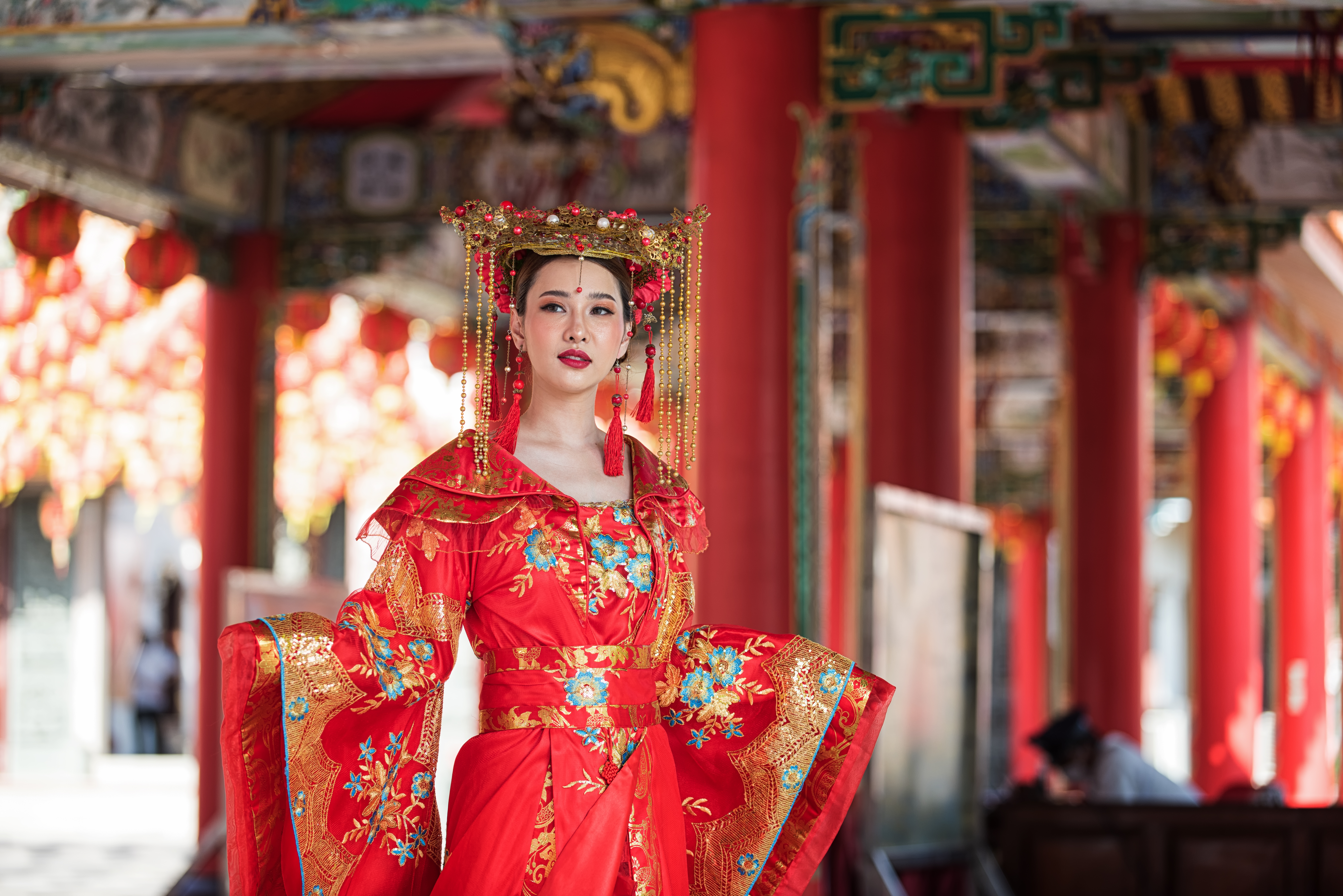
Chinese perfumery, with its ancient origins rooted in rituals and traditional medicine, has endured through the ages, evolving from a sacred practice into a dynamic industry. In the past, natural fragrances such as incense and essential oils were used in both imperial ceremonies and for daily well-being, while “dragon’s saliva” or ambergris embodied rarity and mysticism. These traditions, enriched by foreign influences via the Silk Road, have shaped a unique olfactory identity, blending the gifts of the nature with the contributions of cultural exchange.
With globalization, modern China has embraced international trends, incorporating elements of foreign perfumery while promoting luxury brands. This openness has been accompanied by a quest to preserve the authenticity of local techniques and ingredients, reflecting a desire to fuse the traditional with the modern. Contemporary Chinese perfumery, rooted in its rich past yet focused on innovation, continues to thrive, honoring its heritage while constantly reinventing itself.
The Chinese Relationship with Fragrances and Scents
China’s relationship with perfumes and scents is deeply rooted in its history, philosophy, and traditional medicine. This relationship goes far beyond mere aesthetic appreciation to encompass cultural, spiritual, and therapeutic dimensions.
In Chinese society, fragrances are not only viewed as a means of personal adornment but also as a path to inner and outer balance and harmony.
Historically, the Chinese have used fragrances in various religious rituals and ceremonies to purify the air, ward off evil spirits, or facilitate meditation. Incense, in particular, plays a central role in Buddhist and Taoist practices, symbolizing transformation and the ascent of prayers to the heavens. These uses reflect a holistic approach to life, in which scents are integrated into the pursuit of spiritual and physical well-being.
In traditional Chinese medicine, scents play a crucial role in diagnosing and treating imbalances in the body. Certain fragrances are used for their healing properties, capable of influencing the flow of energy (Qi) in the body, harmonizing Yin and Yang, or treating specific ailments. This medicinal use of scents underscores the belief in an intrinsic connection between scents and health.
Chinese perfumery, with its rich history and traditions, is based on a range of raw materials that reflect both the country’s natural abundance and its philosophy of harmony. These carefully selected ingredients are at the heart of fragrance creation in China, blending ancestral heritage with contemporary aspirations.
In medieval China, the Tang (616–907) and Song (960–1279) dynasties enjoyed immersing themselves in a fragrant atmosphere. In addition to purifying incense, people took baths in scented waters (lemongrass, peach blossoms) and perfumed their clothing using fumigations and scented sachets tucked into the folds of their sleeves (Borneo camphor). They absorbed scented preparations that the skin exuded, which were then transmitted through touch.
Buildings are also scented by incorporating scented wood (sandalwood) and mixing fragrant substances (camphor, musk) into the mortar.
Traditional medicine incorporates numerous aromatic plants with healing properties: jasmine is invigorating, rose aids digestion, and ginger cures everything!
The Chinese Empire also used cinnamon, camphor, basil, lemongrass, styrax, civet, and musk.
While some of these ingredients have stood the test of time, today the key ingredients in perfumes from this region are as follows:
Sandalwood, with its rich, woody, and sweet scent, is a cornerstone of Chinese perfumery. Used in both spiritual practices and as a component in perfumes, it is renowned for its soothing and meditative properties.
Musk, historically prized for its depth and intensity, plays a significant role in the creation of complex and long-lasting fragrances. Although the use of natural musk is now restricted for ethical reasons, synthetic alternatives seek to recreate its warm and enveloping nuances.
Sambac jasmine, with its floral scent featuring exquisite, sweet, and fruity facets, is a prized essence in China, often symbolizing beauty and sensuality. It is frequently used in floral compositions, adding a touch of softness and elegance. It is also used to flavor tea and rice.
Notes of green tea (often reproduced synthetically) bring a vegetal freshness and a slight astringency to fragrances. This characteristic note is appreciated for its ability to evoke tranquility and purity.
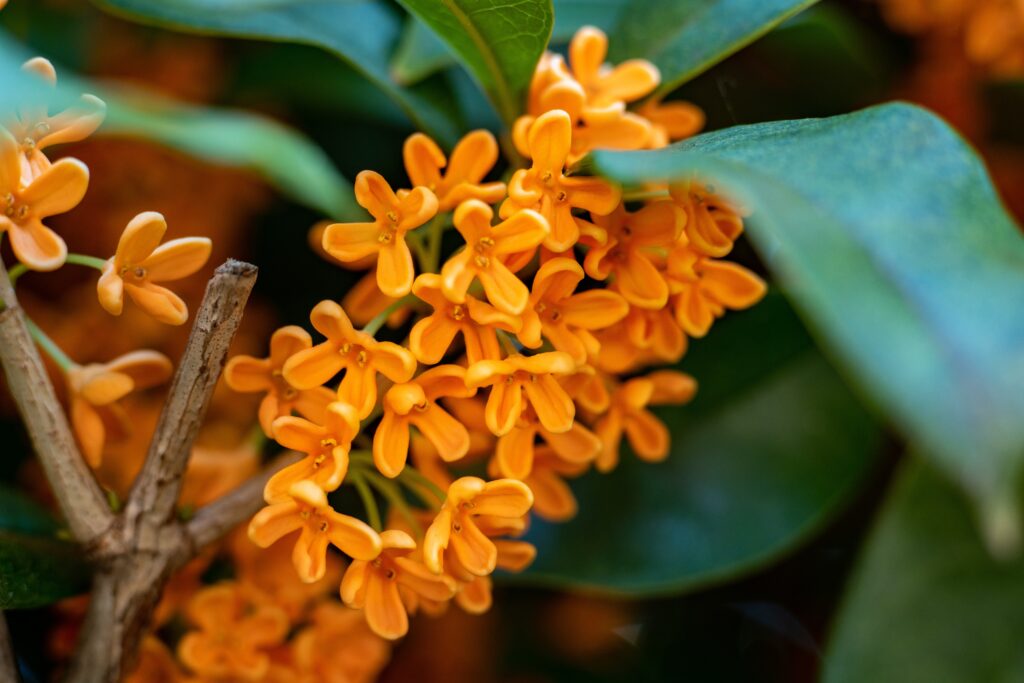
Osmanthus, with its delicate and slightly fruity scent, is a symbol of finesse and sophistication. Its floral, apricot-like, and leathery notes give it a prominent place in many fragrance compositions.
Chinese Perfume Brands
The fragrance industry in China has experienced exponential growth in recent years, with the emergence of local brands that now compete on the international stage. These brands draw on China’s cultural heritage while adopting modern approaches to create unique fragrances that captivate both local and global consumers. Here are some of the most influential and innovative Chinese fragrance brands:
A collaboration between Hermès and Chinese designer Jiang Qiong Er, Shang Xia is a brand that embodies the harmony between tradition and modernity. Although primarily known for its luxury goods and craftsmanship, Shang Xia has also developed a line of fragrances that reflects the brand’s aesthetic and philosophy. Their fragrances celebrate Chinese culture and craftsmanship, offering scent compositions that evoke the landscapes, stories, and emotions of China.
Scent Library is a cutting-edge brand that stands out for its innovative approach to fragrance creation. With uniquely designed boutiques that resemble contemporary libraries, it offers a vast collection of fragrances inspired by unexpected elements, such as childhood memories, abstract concepts, or natural phenomena. Scent Library successfully blends the art of perfumery with pop culture, making fragrance accessible and playful.
Herborist, a brand that draws its essence from traditional Chinese medicine, perfectly illustrates how ancestral knowledge can be applied to the realm of contemporary beauty and perfumery. Its products, including its fragrances, are formulated using natural ingredients from the Chinese pharmacopoeia, aiming to create harmony between body and mind. Herborist, in collaboration with Centdegrés, has launched Mon Instant, a fragrance centered on well-being.
Cha Ling is a brand that embodies the spirit of Yunnan’s tea culture and its connection to nature. Owned by the LVMH Group, Cha Ling specializes in beauty products but has recently expanded its line to include fragrances that capture the delicate and invigorating aromas of Pu’er tea. Cha Ling’s fragrances are an ode to simplicity, purity, and elegance, highlighting the subtle nuances of tea and the botanical riches of Yunnan.
Trending Fragrance Categories in China
Perfume culture in China, much like the country’s culture itself, is a blend of tradition and modernity, reflecting the nation’s preferences and aesthetic values. The popular fragrance categories in China reflect an appreciation for scents that subtly harmonize the senses, evoking both the richness of Chinese heritage and contemporary trends. Here is an overview of the most sought-after fragrance categories in China:
Floral
Floral fragrances hold a prominent place in Chinese fragrance preferences, prized for their ability to evoke natural beauty and delicacy. Notes of jasmine, rose, cherry blossom, and osmanthus are particularly sought after, offering a range of scents that span from subtle sweetness to intoxicating richness. These fragrances are often perceived as an expression of femininity and elegance, establishing a deep connection with the country’s lush and diverse flora.
Woody
Woody fragrances, with their notes of sandalwood, cedar, and vetiver, are also highly prized for their warmth and depth. These fragrances evoke strength, stability, and serenity, reminiscent of ancient forests and traditional Chinese gardens. Woody fragrances are often sought after for their unisex appeal, offering a sophisticated and down-to-earth alternative to lighter floral notes.
Fresh
Fresh fragrance categories—including aquatic, citrus, and green notes—are particularly prized for their ability to revitalize and evoke a sense of purity. Fresh fragrances are often associated with youth and vitality, offering a sensation of cleanliness and renewal. Notes of green tea, mint, bamboo, and lemon are frequently used, reflecting an appreciation for simplicity and harmony with nature.
Spicy
Although perhaps less dominant than other categories, spicy fragrances have their place in the Chinese olfactory landscape, offering warmth and exoticism. Notes of ginger, cinnamon, pepper, and cardamom bring a richness and complexity that can be both invigorating and comforting. These scents evoke spice markets, traditional kitchens, and ancient ceremonies, playing on the contrast between the familiar and the exotic.
Gourmand
Gourmand fragrances, though relatively new to the Chinese market, are gaining popularity, especially among young consumers. These fragrances, with their sweet, almost edible notes—such as vanilla, caramel, and fruit—bring a touch of joy and playfulness. They evoke the delights of Chinese cuisine and traditional festivals, creating a strong, nostalgic emotional connection.
The fragrance industry in China reflects its culture: rich, diverse, and constantly evolving. As the Chinese market continues to open up to global influences, it remains true to its roots, providing fertile ground for innovation and creativity. The future of perfumery in China promises to be as fragrant and vibrant as its past, with new olfactory discoveries and exciting trends on the horizon.
Want to continue this olfactory journey around the world?
The new Pocket Quiz by Master Parfums, “Around the World in Perfumes,” features 120 questions and answers that invite you on a captivating journey through the fragrance traditions and cutting-edge techniques of the world.