
René le Florentin, Perfumer to Catherine de Médicis
A few centuries ago, you would have been looked at with round eyes if you had suggested that perfuming oneself could be anything other than a formality intended to camouflage your body odour. If perfumery is today a noble art, we owe this in large part to Catherine de Médicis and her personal perfumer, René le Florentin. Master Parfums goes back in time and tells you how this Italian master marked the history of perfume in France.
The Convent of Santa Maria Novella
In 1221, a group of Dominican brothers founded the convent of Santa Maria Novella in Florence. There they cultivated an orchard, a vegetable garden and a garden of simples (physic garden) overflowing with herbs and plants used to concoct medicines, balms and ointments that they prescribed in their convent apothecary.
Traces of the production of perfumed waters are found at Santa Maria Novella from 1381: during the Black Death, the monks distilled rose water intended both to purify the rooms and for personal consumption.
Quickly, the convent’s preparations met with real success among the aristocracy, and perfumed products became the preserve of the Italian nobility. And René le Florentin, in all this?
Renato Bianco and Catherine de Médicis
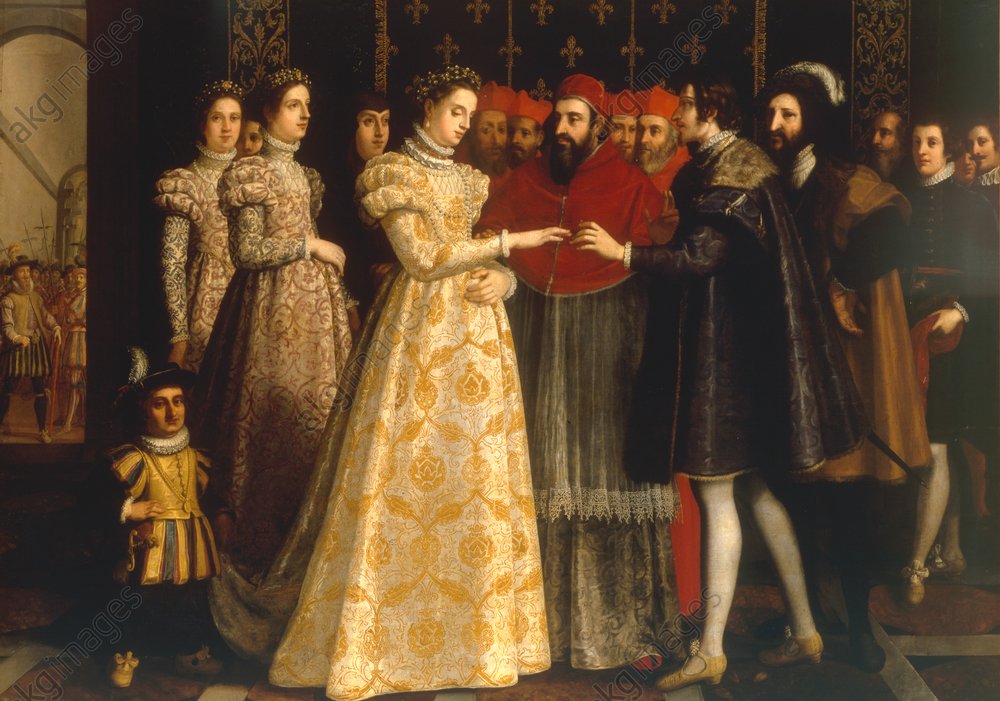
Renato Bianco, by his real name, was abandoned at birth and taken in and raised by the brothers of Santa Maria Novella. It was there that he learned to distil the convent’s herbs alongside the alchemist monks. A good part of the perfumer’s life remains enigmatic; it is above all for his association with Catherine de Médicis that the name René le Florentin still resonates today.
In 1533, the Italian Catherine de Médicis, aged 14, was preparing to join her future husband and the future king of France Henri II. The Italian elites being fond of perfumed products at the time, Catherine de Médicis’s social position naturally turned her towards perfume. She asked the monks of Santa Maria Novella to make her a special fragrance for her forthcoming wedding, but that is not all: as she was going to join the French capital, she demanded that Renato Bianco slip in among her entourage of pages, guards and ladies-in-waiting so that he could continue to supply her with perfumed beauty products.
When they arrived in Paris, Bianco and the future queen witnessed a curious paradox there: while in the Renaissance everyone was outwardly extremely dressed up, hygiene was far from keeping up!
Perfume in the Renaissance, or the “Reign of Perfumed Filth“
On one hand, extreme coquetry was the order of the day. People made use of mirrors, combs, make-up boxes and pomanders made of precious materials. Pomanders were spherical pendants enclosing various odorous substances. In addition to fighting bad smells, they were seen as amulets with the power to protect against illness. Doctors, moreover, considered that odorous materials could cure certain ailments. Besides the pomander, new scent objects flourished, such as the oiselets de Chypre (Cyprus birds—perfumed paste moulded into the shape of a bird) that one threw into the fire and that perfumed and purified the ambient air: rose water, labdanum, civet musk, ambergris, storax, benzoin, cinnamon, clove… so many new odorous materials brought back from Asia by the great explorers of the era.
On the other hand, water frightened people: it was thought to be a vector of illness and contagion. In the 16th century, baths, by opening the pores, were believed to let miasmas into the body. For a real deep wash, the term “se décrasser” (to scrub off the grime) was used. Doctors advocated dry washing, which consisted of rubbing the body with aromatic substances, lotions or vinegars, powdering oneself and dressing in perfumed linen. The word “toilette,” moreover, comes from that little piece of cloth (toile) that was soaked in these vinegars.
Despite everything, the enthusiasm for Greco-Latin Antiquity that characterises the Renaissance, combined with the invention of printing, prepared fertile ground for the dissemination of works containing recipes for odorous waters.
An Italian Master in Paris
In Paris, Catherine de Médicis introduced Renato Bianco to the court of France… and initiated France into the art of perfuming oneself. While in the Italian’s native land the culture of perfume was already in vogue, this was not yet the case in France. In his shop on the Pont-au-Change, he became known under the name René le Florentin and, thanks to his royal connections, the essences he made quickly became indispensable for the city’s nobility.
Perfumed products became a must: wigs, gloves, cushions, fans—everything was perfumed! At a time when hygiene was constantly neglected, perfume played above all a camouflaging role. The fear of water being widespread, it was a matter of masking sometimes nauseating smells; the fragrances therefore had to be as heady as could be. For the nobles who had the means to procure them, musk, amber and tuberose flowed freely.
Perfume certainly continued to be used to conceal the lack of cleanliness, but it gradually earned its credentials and became a symbol of social status. Other Italian perfumers came to settle in Paris, before it was the turn of the French to turn increasingly towards the profession. Whereas it had until then been purely practical, it gradually found itself associated with elegance and luxury. The trade of glover-perfumer had the wind in its sails and little by little replaced that of apothecary for the distribution of perfumes, the Sun King even creating a master glover-perfumer patent in 1651.
Animal materials were highly prized, as were hitherto unknown plant materials brought back by the explorers from their voyages and worked by the Florentine: vanilla and balsam of Peru, cocoa and tobacco, or spices such as cinnamon, ginger and benzoin. With the discovery of new sea routes, it was no longer only Italy that benefited from them!
However, René le Florentin was not famous only for his perfumes…
Sometimes Fatal Fragrances?
It was whispered at the court of France that Catherine de Médicis reputedly charged her personal perfumer with making her poisons concealed in innocent-looking fragrances or fashion accessories…
In 1572, the Protestant Jeanne d’Albret, mother of Henri de Navarre and sworn enemy of Catherine de Médicis, died after being seized by pains and a sudden fever. The rumour incriminating poisoned gloves commissioned by Catherine de Médicis and made by none other than her personal perfumer was not slow to spread.
Let us return to our bottles—in any case, to those that wish us well! So what was this fragrance created specially for the union between Catherine de Médicis and Henri II?
The Acqua della Regina
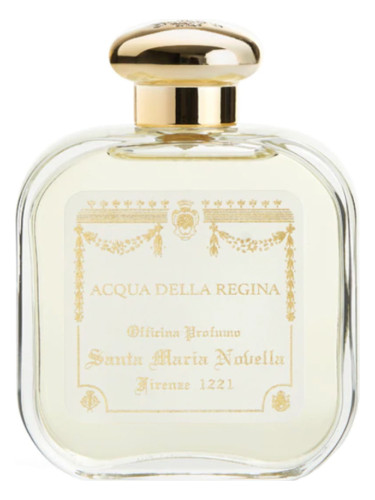
Formulated in 1533, the Acqua della Regina is an essence based on Calabrian bergamot and neroli. One also finds in it clove, rosemary and lavender, all resting on a beautiful musky base. The Santa Maria Novella apothecary still exists in Florence and, to celebrate the brand’s 800th anniversary, it launched the Firenze 1221 edition of the fragrance, today known under the name Acqua di Santa Maria Novella.
It is a hesperidic fragrance, fresh as can be; no wonder that a good number of contemporary colognes fall within its lineage.
- The Aqua Mirabilis (1695) by Giovanni Paolo Feminis could be inspired by the Acqua della Regina.
- With its notes of citrus, lavender and rosemary, the eau de Cologne 4711 (1792) also evokes the fragrance of the one who was called “the black queen.”
- The same goes for the Eau Impériale (1860): Guerlain invites a host of citrus fruits to a meeting with rosemary and cedar.
- Still at Guerlain, one can also name the subtle, tangy Eau de Fleurs de Cédrat (1920).
You will have understood: the passage of René le Florentin through our lands changed the trajectory of perfumery in France, helping it to go beyond its purely functional use and elevating its status, marking in a way the beginning of our modern perfumery.
Want to continue feeding your olfactory culture? Other perfumed anecdotes await you in Master Parfums’ Pocket Quiz game and its 120 questions to learn more about the fascinating history of perfume!