
Which Perfume for Children? Our Advice!
Ah, perfume, the undethronable classic of gifts of all kinds! Christmas would not say otherwise: in a few weeks, it is a safe bet that many perfume bottles will slip under the trees… About a month before, on 20 November, it is World Children’s Day, a day established to remember the advances made in the rights and well-being of the youngest among us.
Are you thinking of giving a perfume to a little imp this winter, but don’t know how to go about it? You’ve come at just the right time. Did you raise an eyebrow at the previous sentence, because you tell yourself that perfume is for grown-ups? Think again; Master Parfums tells you all about it.
The Genesis of Perfumes for Little Ones
The beginnings of perfumes for babies date back to the 1960s. In 1967, Dior inaugurated its very first Baby Dior boutique on Avenue Montaigne in the French capital. There, one could purchase creations by the label intended exclusively for children! Clothes, toys, dolls, soft toys… No fragrance on the horizon yet. It was not until 1970 that the very first perfume for a young audience made its entrance: it too was called Baby Dior and was designed from an eau de Cologne base, with very little alcohol. Yet, on its release, the gamble did not pay off, perfume still being at the time a product accessible only to the wealthiest.
In 1975, another boutique came into being in Paris, at 67 rue de l’Université: that of Bonpoint, a ready-to-wear brand for children founded by Marie-France and Bernard Cohen. In 1986, the brand launched a perfume for the little ones, the now cult Eau de Bonpoint. This time, this citrus-based, ultra-fresh essence made a splash, and many children’s perfume creations followed in its footsteps. In 1994, it was notably Guerlain’s turn to try its hand at the exercise with Petit Guerlain, the birth of his grandson prompting Jean-Paul Guerlain to compose this water blending citrus, lavender and mimosa.
The popularity of children’s perfumes has never stopped growing, and they have since blossomed more or less everywhere on the market… sometimes making the choice of one of them a little nebulous! Don’t panic, we’ll point you in the right direction.
Scents for Little Ones—What’s the Point?
First of all, you should know that babies are extremely sensitive to smells, even straight out of mum’s belly. Between the eighth and eleventh week of pregnancy, their olfactory receptors and the area of the brain analysing and processing olfactory information are formed. Then, between the fourth and sixth month of pregnancy, their nostrils open up. Foetuses are then already able to “smell” the odorant substances of what mum eats, through the amniotic fluid in which they spend several months!
At birth, the sense of smell gets going without delay: the baby recognises the smell of its mother then, little by little, that of milk, of its environment… Contrary to what one might think, its fifth sense is called upon without further ado, and it will continue to develop throughout its growth! A perfume can therefore constitute an additional marker in this constant olfactory education and help to make baby feel safe through scents that will quickly become familiar to it.
It is recommended to perfume a child only from three months of age, first giving them time to become familiar with the whole host of smells that surround them. From three months and up to three years, perfume is allowed, but be careful: not a drop of alcohol! Let’s look at this a little more closely.
Ingredients to Avoid
Perfumes with Alcohol
Beware of alcohol, then, which can be too aggressive on children’s sensitive skin. Fortunately, although this word is often used to designate them, many baby “perfumes” are in reality what are called scented waters—in other words, alcohol-free perfumes. From three years of age, the embargo on eaux de toilette and eaux de parfum is lifted, but here again, their alcohol content must be low, no more than 30%. In short, it is better to swear by the absence of alcohol or, for children over three years old, a very small dose.
Beware of Endocrine Disruptors
We are also wary of endocrine disruptors, molecules whose effects are complex and still subject to debate, but which scientific studies suggest could affect functions related to the hormonal system. Between its development in its mother’s belly and early childhood, a child will be particularly sensitive to, and therefore vulnerable to, their potential undesirable effects. Here are the main culprits:
- Parabens: methylparaben, ethylparaben, isopropylparaben… Their names all end the same way, which is rather handy for us!
- Phthalates: di-2-ethylhexyl, benzyl butyl and dibutyl are among the most used;
- Phenoxyethanol;
- BHT;
- BHA.
Allergic Reactions
Finally, we anticipate allergic reactions: the chosen perfume is ideally hypoallergenic, and we prefer to diffuse it in moderation at first, and rather on the clothes, until we are sure that the child’s sensitive skin will not turn red! Also be careful that it is not on a zone the child might put in their mouth—the comfort blanket may have to do without its dose of perfume.
Perfumes are subject to rigorous controls, especially when they are intended for the skin of the very young. There is therefore a good chance they tick these boxes, but the further you go up the age range they target, the less this is the case, so keep your eyes open!
AWAKEN YOUR NOSE
Recognising a smell can be learned
Identifying a raw material, memorising a smell, putting words to your perceptions… Your sense of smell can be trained too.
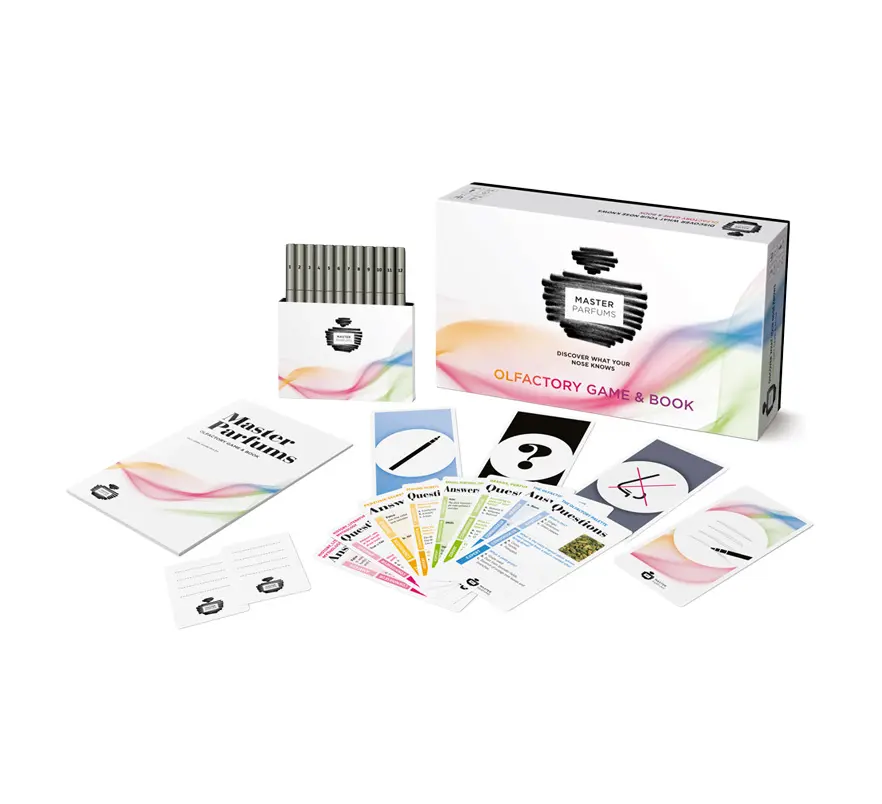
With the Master Parfums Olfactory Game, exercise your nose in a fun way and develop your perfume culture.
And the Smell, in All This?
Beware of overly heady juices! Lightness and subtlety are the watchwords when it comes to perfuming little ones. In these categories, the champions are floral and vegetal notes, as fresh as can be. One thinks notably of honeysuckle, orange blossom or chamomile, true veils of softness on the skin of tots—the latter two are, moreover, frequently used in baby toiletries. Staying in the orange-blossom family, hesperidic notes such as a mandarin, an orange or a discreet neroli are also safe bets.
With age, children begin to want to assert themselves. The older ones may perhaps appreciate sweet, gourmand notes a little more pronounced than their sister notes the flowers and citruses. A creamy caramel, a cloud of candyfloss, a crunchy chocolate, and of course great classics of the gourmand family such as a pretty powdery vanilla will work wonders in a children’s perfume. With almond, softness guaranteed—did you know that benzaldehyde, also called amandol and present in bitter almond essence, often recalls the smell of schoolchildren’s glue? Here’s a fitting note for the next back-to-school season!
Finally, other great favourites of children’s perfumes are fruity notes: apple, strawberry, rhubarb… Mouth-watering scents that tend to please children and parents alike.
An Overview of Emblematic Perfumes
Another avenue to guide you in your search for a perfumed gift can be to turn to creators who have managed to stand out in terms of perfumes for the little ones.
- Eau de Bonpoint, which we mentioned earlier, has become a must-have. It came into being from the nose of the perfumer Annick Goutal, who is none other than the sister of Marie-France Cohen, the co-founder of Bonpoint! Its timeless neroli–orange blossom duo, the house’s olfactory signature, helped to make it an iconic scented water.
- Now itself a cult children’s perfume, Ptisenbon was launched in 1987 by Tartine et Chocolat, the French, elegant children’s fashion brand. The brand collaborated with Givenchy and delivered a pared-down juice in which green notes of mint, citruses and a floral heart of honeysuckle, jasmine and lily of the valley blend. Ptisenbon exists both as a scented water, without a drop of alcohol, and as a low-alcohol eau de toilette for the older ones.
- The latest addition to the Tartine et Chocolat family is the eau de toilette Ptimusc (2023)! Orange blossom, white cocoa and oat milk are brought together in this jewel case of milky softness.
- Jacadi has also managed to establish itself as a reference. Its perfumes are composed of more than 90% ingredients of natural origin, contain thermal water and moisturising agents such as panthenol, and are hypoallergenic: they are what are called care waters!
- The soberly named Le Bébé (2015) combines a burst of bergamot and freesia with a heart of jasmine and orange blossom, before finishing on a soft cloud of musks and sesame.
- Toute Petite and Tout Petit (2008) both open on citruses and rest on a base of musk and cedar. The girls’ perfume offers us a silky heart of lily of the valley and orange blossom, and the boys’ perfume, orange blossom and Granny Smith apple in a greener heart. Two solar perfumes, luminous with freshness.
- For teenagers, you’ll have the choice between the more gourmand Mademoiselle Jacadi and Jeune Homme (2015). Mademoiselle Jacadi is blackcurrant, raspberry and peach, a few flowers, without forgetting the comfort of the vanilla in its base notes. Jeune Homme is rather aromatic, dusted with citrus, combining tea with rhubarb before wrapping itself in ambrette and tonka bean.
- In 2023, the Baby Dior line welcomed a newcomer: Bonne Étoile, a scented water composed of 98% natural ingredients and signed by Francis Kurkdjian. The perfumer describes his inspiration as “that of a round, soft smell, like the lovely cheeks of a chubby baby”! And to bring it to life, he wanted to stray from the beaten path by doing without orange blossom, preferring a juicy pear, a wild rose and cottony musks. Beyond its olfactory notes, the price of Bonne Étoile got people talking… 255 euros, no less!
- Much more economical, Mustela’s baby care water Musti (2012) combines the freshness of lily of the valley and bergamot with extracts of chamomile and honey for a soothing effect.
- With Cabriole (2022), Hermès delivers a velvety osmanthus with accents of peach and apricot, green notes of honeysuckle and an ever-so-soft sandalwood.
- Why not try the gently fruity alcohol-free water Petite Chérie (2019) by Annick Goutal? This variation of the adult perfume of the same name marks the delicate meeting of pear, peach, rose and vanilla, like a garden misted with dew.
So, ready to perfume the gift sack for grown-ups and little ones alike?