In the category of incense, myrrh and frankincense are the best known, both for their medicinal properties and for the legends and religious significance associated with them.
But where do these pieces of resin come from, and what is their spiritual significance? Are they used the same way all over the world?
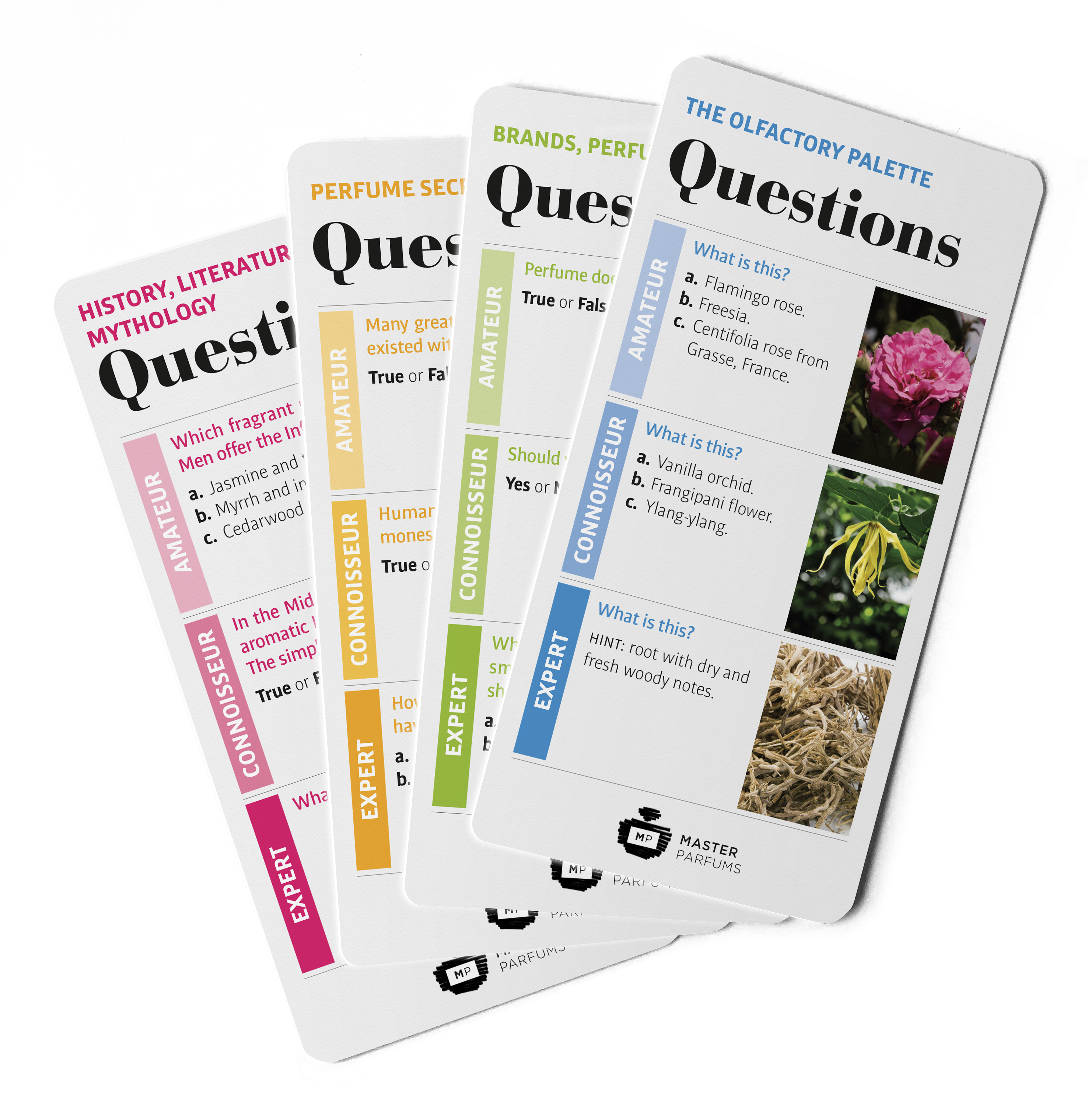
In our Master Parfums game, a quiz card is dedicated to these very special resins. Today, we’re delving into the origins and mysteries of these incenses for you!
Myrrh and Frankincense: Botanical Origins
Olibanum
Olibanum resin, commonly known as “incense,” is derived from Boswellia, a small tree found in northeastern Africa and on the Arabian Peninsula. It is obtained by cutting into the tree’s bark, allowing the sap to flow. As it dries, it turns whitish and opaque, hardening into a solid gum—an exudate. This is frankincense, also known as “Tears of Somalia.”
Frankincense (Boswellia serrata) is native to India but is also found in the Middle East and North Africa. Its resin has been used for thousands of years in India, China, and various African countries for its health benefits and medicinal properties.
The color of this small aromatic gum varies depending on the season in which it is harvested. Boswellia that is incised in the summer and harvested in the fall yields the finest quality incense. Milky in color, it is called white incense, or olibanum, as opposed to red incense.
Olibanum reveals notes that are at once fresh, aromatic, rounded, and warm, with balsamic (resinous, amber), mineral, and dry woody facets. It is a material particularly prized in niche perfumery.
Myrrh

Commiphora myrrha is found primarily in East Africa, particularly in Somalia; it is a tree that does not exceed 3 meters in height, from which myrrh is harvested.
Its large, twisted trunk is covered with gray or brown bark. Highly branched, it bears small leaves and flowers. Swellings form on the trunk, from which a resinous sap naturally exudes. Upon contact with the air, it hardens to form reddish-brown, highly fragrant solidifications: this aromatic oleoresin is known as fragrant myrrh.
Its warm, balsamic scent makes myrrh a prized raw material in the base notes of oriental perfumes. Rich and heady, myrrh lends a warm, sweet, dark, and sensual quality to the fragrance.
History and Religions
What gifts did the Three Wise Men offer?
According to tradition, the three Wise Men came from the East to pay homage to the infant Jesus and offer him gifts: gold, frankincense, and myrrh. These gifts were highly symbolic:

Balthazar offered gold to represent power and kingship, but also because gold symbolizes light and the sun, signs of hope.
Melchior offered frankincense, symbolizing the divine nature of Jesus: incense is a way to honor God.
Gaspard offered myrrh, which is said to have euphoric and analgesic properties. A gift reminding us that despite the divine nature he might have projected, he was nonetheless truly human and, above all, mortal.
Traditional Uses of Myrrh and Frankincense
Frankincense was traditionally used by burning the resin during religious ceremonies, hence the name “Indian incense.” According to tradition, the smoke from the resin induces a state conducive to prayer, meditation, and spiritual experience. Furthermore, the burning of incense is the origin of the word “perfume,” as the rising smoke was believed to facilitate communication with the gods—“Per Fumum” (through smoke) in Latin.
The Egyptians used myrrh daily in their sacred rituals and to embalm their pharaohs. In battle, Greek soldiers always carried it with them because they knew it had antiseptic and anti-inflammatory properties.
Frankincense is a type of incense known as “male incense” or “pure incense.” It was originally considered a powerful anti-inflammatory that also promotes tranquility and calm, which can lead to restful sleep and help relax the body and mind. It also purifies the atmosphere and eliminates negative energy. This is why frankincense is still used as incense for fumigation.
Today, it is often used as an essential oil as well as for fumigation and offers many other benefits: as an antiseptic, it promotes wound healing and stimulates the immune and nervous systems. It is antibacterial, cleanses the mouth, relieves muscle pain and osteoarthritis, and helps combat seasonal depression.
In the Middle East, myrrh has been used in traditional Arab-Islamic medicine for thousands of years. For example, it is used as an anti-inflammatory agent and to relieve rheumatic pain. It is recommended for cleaning wounds and preventing the spread of infection and gangrene once an infection has already set in.
The use of myrrh in traditional medicine also continues in India within Ayurvedic medicine, particularly for the treatment of canker sores, gingivitis, and pharyngitis.
In traditional Chinese medicine, myrrh is often combined with other herbs. When used together, they treat injuries and improve circulation—for example, during menstrual cramps.
Myrrh and frankincense have stood the test of time and crossed continents, not only for their medicinal properties recognized throughout the centuries, but also because of their profound spiritual and religious symbolism, which is imbued with mystical power and a divine aura.
Myrrh and Frankincense: Prized Raw Materials in Perfumery
Furthermore, their use in perfumery is becoming increasingly sophisticated, and some perfumers do not hesitate to showcase them.
Well-Known Fragrances Featuring Frankincense
Frankincense is used to reveal its woody, aromatic, balsamic, mineral, and spicy notes.
Histoires de Parfums created Encens Roi, where olibanum resin is carried by spices, precious woods, and vanilla. The result is majestic and deep.
Guerlain has chosen an oriental fragrance with floral and woody notes that takes on a deeper tone thanks to notes of incense and amber, creating Encens Mythique. It’s a fragrance that many women have embraced.
With Encens Asakusa, L’Orchestre Parfum transports us to a neighborhood in Tokyo, carried along by the sound of a koto. The incense from a sacred temple envelops powdery notes of iris and violet in its swirls, accented by the freshness of pink peppercorns.
In a natural vein, Les Parfumeurs du Monde olfactorily illustrates the incense route in Les Larmes d’Aden. A honeyed, citrusy trail carried by a sirocco of myrrh and incense.
Well-known perfumes featuring myrrh
Its warm, balsamic scent makes myrrh a raw material of choice in the base notes of oriental perfumes. Myrrh, rich and heady, lends a warm, sweet, dark, and sensual quality to the fragrance.
Annick Goutal’s Myrrhe Ardente is a woody amber fragrance that stands out for featuring myrrh alone as its top note. Myrrh reappears in the base notes, alongside benzoin and tonka bean. The blend is voluptuous and captivating.
Myrrhe et Tonka by Jo Malone is an intense amber fragrance where myrrh is paired with tonka bean, vanilla, and almond for a sensual and captivating result.
And a surprising duo from the Hermessences collection (Hermès) with Myrrhe Eglantine
Enough to keep the craze for these resins going for a long time to come!
As with beauty products, we wonder how long it is possible to keep our perfume. What are the factors that make our perfumes more fragile, and how can we prevent our perfumes from deteriorating over time? This is what we are going to see here.
What Is a Perfume Made Of?
To understand how sensitive a product a perfume is, you have to understand how and with what it is made.
The fragility of perfume lies as much in the composition as in its manufacturing process.
A perfumer chooses the raw materials that will go into the composition of a perfume, which is generally made up of the three following elements:
- An oily fragrant concentrate, which is the main scenting ingredient
- A base, usually alcohol (ethyl, or more recently, for perfumes wanting a more natural, plant-based alcohol, wheat or beet alcohol). Alcohol allows the diffusion of the perfume when it is sprayed: by evaporating, it carries the odorous substances with it to create the famous sillage. In the base, one also sometimes finds water and/or oil.
- A fixative, generally used in the base note.
- Various products can also participate in the elaboration of the perfume (anti-UV agents, colorants, or decolorants…).
Note that perfumes can be made from natural and/or synthetic raw materials (such as white musk).
These raw materials are delicate and remain sensitive.
To keep your perfume intact, a few important recommendations should be followed.
Want to learn more about the use of raw materials in perfumery? Discover our Pocket Quiz perfume-culture game, a fun general-knowledge game about perfume.
The Signs of a Perfume That Has Deteriorated
Perfumes sometimes have an indication of a use-by limit, like what you find on the boxes of beauty products, and sometimes this information is not noted. Whatever the case, this does not mean they can be kept indefinitely.
As for the change of colour, it is not a sign of expiry. When the colour of the perfume changes, it is entirely possible that this is the result of a natural maceration, of a chemical reaction between the different raw materials. Some become amber-tinged or darken over time, but this in no way alters the quality of the perfume.
Trust your sense of smell: if, despite a change of colour, the smell of the perfume remains intact, then there is no contraindication to using it. One will nevertheless be very careful not to spray it on light-coloured or delicate clothes, at the risk of staining them.
Another point to take into consideration: if a powerful smell of alcohol (reminiscent of vinegar, for example) takes hold of your nostrils, if the perfume gives off an acrid, irritating smell, or on the contrary if the perfume is no longer as fragrant as it was originally, it is a sign that the perfume has deteriorated.
Recommendations for Optimal Conservation
You should know that fragrances with a high concentration resist time better. Extraits and eaux de parfum, in which the concentration of base notes is predominant, will keep better and longer than fresh waters or eaux de toilette composed essentially of more volatile notes that are more sensitive to oxidation.
As we have seen, the molecules that make up a perfume are fragile. To prolong the shelf life, it is better to follow these few recommendations.
Avoid Direct Light
One might think it would be a shame not to display the magnificent bottle of one’s favourite perfume on a shelf, but in reality, it is better for it to be sheltered from light. Indeed, directly exposing the perfume to natural or artificial lighting (lamps can generate heat, another enemy of perfume) is one of the causes of the fragrance’s deterioration. Choose instead to keep it, as far as possible, in its original box, or in a drawer.
Beware of Temperature Variations

A perfume will not keep its initial freshness with overly fluctuating temperature changes. It is best to preserve it at a constant temperature, in a bedroom far from the window, for example.
Some collectors opt for a cool, dry cellar to store all their perfumed treasures. One can also opt for the bottom compartment of the refrigerator.
In the shop of Editions de Parfums Frédéric Malle, the perfumes are stored on shelves in a refrigerated place.
Banish Humid Places
And the worst place remains the bathroom! As with temperature variations, humidity is to be avoided. Prefer a room that you can ventilate at your convenience, or if possible use a dehumidifier.
Avoid Prolonged Contact with Air
Close the perfume well with its cap. In the event that you use a bottle with a screw closure—practical when you want to refill them with a refill—it is imperative to reseal the perfume bottle hermetically to prevent air from oxidising the fragrance and therefore altering it. Nor do you shake the bottle before perfuming yourself; this serves absolutely no purpose from an olfactory point of view—however, the air contained in the bottle can degrade the perfume more quickly.
Favour Frequent Cleaning
Roll-on bottles or table bottles with a wand are, moreover, exposed to possible contamination by bacteria during direct application on the skin. Remember to clean them regularly with alcohol.
By following these recommendations, the conservation of your perfumes will be optimised and you will be able to keep them for a very long time!
Bergamot is a citrus fruit that is one of the most commonly used raw materials in perfumery. Where does this plant come from? How is it processed, and what are its properties? We explain it all.
A Plant: The Bergamot Tree

Unlike orange and lemon, which are widely used in cooking, bergamot, whose flesh is very bitter, is far less well known.
It is the fruit of the bergamot tree (Citrus bergamia), of the Rutaceae family, growing up to 4 metres in height. This citrus fruit is green in colour but turns yellow when ripe. It has a thick skin and a very bitter pulp that does not taste very good. The bergamot tree is mainly cultivated in Calabria, in the south of Italy, but it is also found in other parts of the world, such as Brazil or the Ivory Coast. Its origin is not very clear; some attribute origins in Asia to it, others in Turkey or Spain… And it is indeed its Mediterranean character and its freshness that come to mind immediately.
There are four species of bergamot tree: the Fantastico, the Castagnaro, the Calabraise and the Femminello. It is the Fantastico variety that is favoured for its superior quality.
Bergamot is a hybrid fruit, a fusion of the lime tree (lime) and the bitter orange tree (bitter orange). The flesh of the fruit is little consumed owing to its acidity and bitterness. If you are a lover of this very particular aroma, you will like Earl Grey tea and the famous bergamotes de Nancy (sweets).
It is said that keeping a few of its leaves in our purse might ward off poverty!
Bergamot Essential Oil

Bergamot is a fruit known for its olfactory properties but also for its essential oil, to which many virtues are attributed.
Bergamot essential oil is extracted from its zest by cold pressing. After harvest, the fresh fruits are kept for 48 to 72 hours to soften the peel.
After this step, the fruits are placed in large machines called “Pelatrices.” These peel the citrus rind, which contains all the benefits and its essence, without altering the flesh. Then comes the filtration step using a centrifuge to extract the essential oils encapsulated in the zest.
This elixir is originally dark green in colour and gives off a rich, intense aroma. But its treatment, which consists of removing the furocoumarins—photosensitising components such as bergapten, which can stain the skin in the sun—changes its colour, making it more transparent and golden. Nowadays, these furocoumarins are removed from all citrus fruits.
It takes on average 200 kg of fresh fruit to obtain 1 litre of bergamot essential oil. Bearing in mind that a kilo of bergamot can cost up to €25!
Depending on the ripeness of the fruit, different results are obtained: when the fruit is still green, it is acidic, invigorating facets that come through. As it ripens, the fruit turns yellow, and it is rather floral notes that emerge. At the end of the season, the fruity aspects of the fruit come out freely.
Bergamot essential oil has medicinal properties: relaxing virtues, helping to lower blood pressure, antiseptic, preventing infections, relieving depression. It is also effective against insomnia. Its benefits are manifold.
The Use of Bergamot in Perfumery
Bergamot is particularly appreciated in perfumery for its soft, sunny, floral and fresh smell. This intense freshness emanating from bergamot is unique. Its flavourful, energising wafts give the perfume a beautiful luminosity.
Calabria’s green gold can also present soft, round facets.
Bergamot is used as a top note in perfumery because of its volatility, similar to that of other citrus fruits. Unfortunately, its intense, fresh scent does not last long, but it is the best opening a perfume can offer, delivering sparkling notes with a sensation of mischievous softness.
The first bergamot in perfumery was used by Jean-Marie Farina to create the famous Eau de Cologne, thanks to the subtle blend of citrus—including bergamot—and aromatic notes such as lavender or rosemary. Eau de Cologne quickly flooded all of Europe… then the world.
Since then, this citrus fruit has reached its peak, since all perfume creators use it without compromise.
In 1925, Guerlain took the initiative of adding an unequalled dose of bergamot (30%) to its Shalimar, the house’s iconic perfume.
Olfactory Category: The Hesperidics
Bergamot belongs to the hesperidic olfactory category, which groups together all the essential oils of citrus zests, such as those of lemon, grapefruit, orange, mandarin and yuzu.
The hesperidic family is the oldest olfactory family. In the olfactory pyramid, they are generally used as the top notes of a perfume because the notes are very volatile and do not persist over time. The opening is generally fresh, light, sometimes very soft, sometimes tangy.
Bergamot is widely used in both feminine and masculine perfumes—a universal freshness that easily pairs with the other olfactory categories!
Want to learn more about the different categories of the olfactory pyramid? Discover our Pocket Quiz perfume-culture game, a fun general-knowledge game about perfume!
Examples of Perfumes Built Around Bergamot
Bergamot is a raw material much appreciated by perfumers because they can use it in all types of perfumes—whether feminine, masculine or unisex—from eaux de Cologne to the most intense orientals, which it brightens.
Some have even given it the leading role, according to its personality:
- In Bergamote 22, Le Labo wanted it flamboyant, hesperidic and floral.
- For Essential Parfums, it is sparkling and solar like the ylang it accompanies in Nice Bergamote.
- It becomes more masculine and aromatic in Velvet Bergamot by Dolce & Gabbana, as in Bergamote Soleil by Atelier Cologne, where it fuses with lavender and is dotted with a few grains of black pepper.
- In its Acqua Allegoria collection, Guerlain gives the leading role to this key material of the famous Guerlinade, and celebrates Calabria’s green gold in Bergamote Calabria.
- Bergamot also asserts its origin in the Blu Mediterraneo collection by Acqua di Parma, with Bergamotto di Calabria, where it becomes effervescent and captivating.
- Finally, while 100BON wraps the rose in its invigorating freshness, Jo Malone lets it irradiate the intense oud with its crisp freshness.
Bergamot, as you will have understood, is a precious citrus fruit, rich in history and benefits, and whose scent—which bewitches us with delight—remains a flagship raw material in the world of perfumery.
Angel has become, over the years, an essential of modern perfumery, a captivating best-seller at the origin of a new lineage of olfactory category.
However, its fame was not achieved immediately. How did Thierry Mugler manage to make Angel one of the most prized perfumes in the world? What makes Angel so addictive and so particular?
Who Is Thierry Mugler?
Thierry Mugler, born on 21 December 1948 and died on 23 January 2022, is a French designer who marked the world of fashion in multiple ways: stylist, couturier, director, photographer and perfume creator.
As a child, he was a dreamer and a loner, tirelessly losing himself in his thoughts while watching the immensity of the starry sky… and one star in particular, blue, shone in his eyes more than the others and seemed to call him. So much so that he would make it his trademark, representing stars in all his artistic projects, and even tattooing on his body the famous, so characteristic Mugler star.
At fourteen, he joined the ballet of the Opéra du Rhin after 5 years of classical dance. From this experience he kept not only a developed talent for bodily expression, but also the sense of the aesthetics of the body that he would constantly want to showcase.
Then he took interior-design courses at the school of Decorative Arts in Strasbourg, which concretised his fervour for staging his fantastical shows.
Then came the moment when Thierry Mugler wanted to give an olfactory dimension to his world: the eau de parfum Angel was born.
Creation of the First Mugler Perfume
An Innovative Composition
Thierry Mugler’s ambitions at the beginning of the 1990s translated into the creation of a perfume, thanks to a famous, totally revolutionary and surprising formula for the time. He would say, “I want to make a fragrance so delicious that you’ll want to eat it.” A perfume that would disconcert at first, consumers being surprised by this gourmand fragrance of a new kind! A success that came into being thanks to a brilliantly conducted marketing method.
Indeed, he created the Cercle Mugler, a loyalty programme integrating customers into the privileged world of Angel. A programme offering advantages and gifts around the Angel perfume as purchases went on; loyalty was therefore rewarded with attentions reserved for members. Customers feeling favoured, pampered and completely under the charm of this new addictive fragrance talked about it around them… Word of mouth worked, and success finally established itself and inscribed Angel in the very restricted list of iconic perfumes.
This gourmand fragrance, which we owe to the great perfumer Olivier Cresp, is composed of sweet, addictive notes, with a base of vanilla and patchouli that is a classic oriental structure, but above all of an ingredient until then reserved for the food-flavouring sector: ethyl maltol. A compound that has a particular scent recalling the smell of funfairs with praline, candyfloss, caramel, which gives this particularity, this singularity to the perfume.
Olivier Cresp told L’Express: “I spent two hours talking with Thierry Mugler. He told me about the afternoon snacks he had at his grandmother’s, the madeleines he dipped in his chocolate, then the funfairs and the candyfloss.”
It took the perfumer nearly 600 trials to manage to develop the perfume as Thierry Mugler had dreamed it.
This completely broke the codes of the time and revolutionised the then still very classic perfume industry, so much so that a new olfactory category came into being thanks to Angel: that of gourmand perfumes.
Angel, a Unique Sensual Gourmand Perfume
Angel, a gourmand amber
The opening is juicy, a puff of citrus freshness. It is, according to Mugler, the celestial facet of the fragrance.
Then quickly come sweet, fruity notes carried by honeyed, milky, childlike, comforting accords. The alliance of praline, red fruits and passion fruit makes the whole gourmand—it is the delicious facet.
Finally, in the base notes, it is a ballet of sensual notes, ambered by vanilla and caramel, where cocoa, honey, heliotrope and patchouli blend. It is the voluptuous facet, giving the perfume this sensation of irresistible delight.
A dense, complex olfactory pyramid, which highlights the characteristics of a warm, sweet, childlike, sensual, mysterious and enveloping perfume.
A powerful perfume, recognisable among a thousand, like the Mugler fashion that strives to give woman the soul of a winner with a tender heart.
An olfactory comfort blanket in an era in search of reassurance—childlike, sexy on a skin you want to eat… and terribly addictive.
TEST YOUR PERFUME KNOWLEDGE
Angel holds no more secrets for you?
Iconic perfumes, great houses, raw materials, the history of perfumery…
Put your knowledge to the test with the Master Parfums Pocket Quizzes.
An Iconic Star-Shaped Bottle
Not only is the composition of its perfume particularly original, but its bottle is a jewel in itself, star-shaped of course, made with an innovative technique in thick glass. Three years of research were necessary to arrive at the creation of this iconic star bottle.
The avant-gardism was pushed even further, since he innovated by creating a refill system called the “Fontaine Mugler” (Mugler Fountain), which consists of fighting against waste.
Thus, each owner of an Angel perfume can refill their bottle and participate, in a certain way, in an ecological responsibility—natural today, but which at the time presented Mugler as a visionary.
A Perfume Rewarded on the International Scene
Particularly well-conducted communication and personalities having collaborated with Mugler to present Angel made the perfume even more desirable. An immense success that translated into Angel’s ranking in the top 3 of the best-selling perfumes in France, and this for more than 20 years. The fragrance also distinguished itself through the prizes received on the international scene:
- Hall of Fame Award of the FiFi Awards of the Fragrance Foundation (2007)
- Feminine Hall of Fame Award at the Canadian Fragrance Awards (2010).
Want to learn more about the iconic perfumes that marked French perfumery? Discover our Pocket Quiz perfume general-knowledge game!