If this year you are going to give your mum a perfume for Mother’s Day, you are in the right place! This gift may well be a great classic, but it is not always easy to find the one that hits the mark. Don’t panic: Master Parfums has cooked up a little guide to help you understand which perfume to choose for your mum.
A Sometimes Thorny Choice
It goes without saying: all mums are different. The good news is that the same is true of perfumes: with a whole host of raw materials, accords and formulations, there are probably as many perfumes out there as there are mums. Hard to know which way to point your nose!
New releases, best-sellers… Lists and rankings blossom relentlessly, and it is not uncommon to drown in this ocean of suggestions that is nonetheless supposed to make our task easier. Rather than buying online, our first piece of advice is to favour a visit to the shop: nothing beats the sharp perfume advice of a sales advisor who knows their products inside out.
Here is what you should keep in mind so that your visit is fruitful.
Tell Me What You Wear…

Try to establish a kind of olfactory history of your mum: which perfumes has she already worn, or does she wear currently? Even without their names, just their smell can guide the person advising you. Is it rather floral? Green? Spicy? It will obviously be easier if you know from the outset that your mum has a soft spot for a particular ingredient, for a perfume she likes to wear, or for a brand she is especially fond of.
If you know her perfume, and you want to give her a different one but in the same olfactory spirit, you can also search on specialised platforms/apps* that will point you towards perfumes of the same olfactory style, which you can then go and smell at the point of sale.
Whether or not you already have a long list of fragrances, the aspect you must absolutely not overlook during your search is your mum’s personality.
A Perfume to Magnify Who She Is
A perfume says a lot about the person who wears it: it is an invisible piece of jewellery that complements and even sublimates her. Is your mum natural or sophisticated? Discreet or exuberant? Depending on her way of being, her personality and her style, and the perfumes she likes, one will favour one olfactory family over another.
The Olfactory Families
The Société Française des Parfumeurs defines seven olfactory families: aromatic, woody, chypre, floral, fougère, hesperidic and oriental. Among all this fine company, you must find the juice that will go hand in hand with your mum’s personality. A perfume’s belonging to an olfactory family is determined by its heart notes and its base notes.
Floral fragrances are often associated with serenity and elegance. They can be delicate and romantic (rosy notes, peonies, lily of the valley, etc.) or more heady and captivating (jasmine, tuberose, ylang, etc.).
One will no doubt suggest a voluptuous, even gourmand, oriental to mums who embrace their sensuality and like to be noticed.
Is she a dynamic, natural woman? It is a safe bet that the advisor will draw out lively, sparkling scents of citrus or green notes…
Rather mysterious but with character—perhaps a woody will know how to seduce her… Is she chic and sophisticated, and does she like her perfume to be unique? The advisor can steer you towards a chypre or towards a perfume from a more confidential (niche) brand.
The Notes of the Perfume
There are safe bets for the more classic among us—for example, a timeless rose or vanilla—and there are the rebellious children. Would your mum raise a worried eyebrow at an accord of caviar or white chocolate, or would you have piqued her curiosity? A perfume that stands out, with bolder combinations, can be an option for those who are not afraid to stray from the beaten path.
Of course, there is no miracle formula: would being extroverted necessarily mean liking patchouli? Off-limits to tonka bean for the shyer ones? No, and thankfully so! The key lies in the interpretation of the ingredients and in the way the fragrance is formulated.
Besides, most of us are incapable of really detecting the specific ingredients in a perfume. It is the harmony of a creation that makes all its beauty! After all, a floral perfume can just as easily be a lush bouquet as a delicate, airy veil.
This is why sales advisors are advised not to drown customers too much in the details of the ingredients. The latter are rather “mental tools” that the advisor keeps in mind and that will help refine the choices to offer you. Depending on the description you give of your mum and her perfumes, the advisor will know how to find the most suitable olfactory suggestions.
Their job is to ensure that the olfactory result reflects the temperament of the person who will wear it.
In this equation, the sillage and the projection of the perfume also have their role to play.
Sillage and Projection
The sillage of a perfume is the olfactory imprint it leaves behind the person who wears it; the projection, for its part, is the way people nearby perceive it. Here again, it will depend a lot on the heart and base notes.
Think about what most resembles your mum: a perfume that announces its arrival in the room with a bang and leaves a trace there even after she has left? Or rather a second skin that reveals itself intimately only when one is close to the person wearing it?
Unsurprisingly, it is once again a matter of personality… but not only: take into account the context in which the perfume will be worn. This can be a time of day, a season, a place, an event… A warm sandalwood perfume will suit autumn better than summer temperatures; an opulent juice with thunderous sensuality will be more suited to a chic evening, and one will prefer a light, tonic fragrance for a barbecue among friends! Even if she wears perfumes with heady notes, perhaps she will be delighted to add to her olfactory wardrobe a pretty, luminous cologne that she can wear at the weekend in the countryside or on leaving the gym!
And for mums faithful to their perfume, you will not go wrong by letting yourself be tempted by gift sets offering her perfume accompanied by a body product (shower gel, body milk, etc.). Indeed, while we readily buy ourselves our perfume, we do not always add a product from the body range to our basket, either because of its price or simply because we do not think of it.
Yet a body cream, a hair mist, a soap, a deodorant are all pretty bottles that will come to decorate her bathroom, perfume her from head to toe with the perfume she loves, sublimate her scenting and increase its longevity, or just leave a scented veil on the day she does not wish to be very perfumed.
Ready, Set, Perfume!
A perfume testifies to the attention you pay to the person who receives it… when it is chosen with care! We hope our advice will help you unearth not just a perfume, but THE perfume—as unique as your mum—that will remind her of what she means to you.
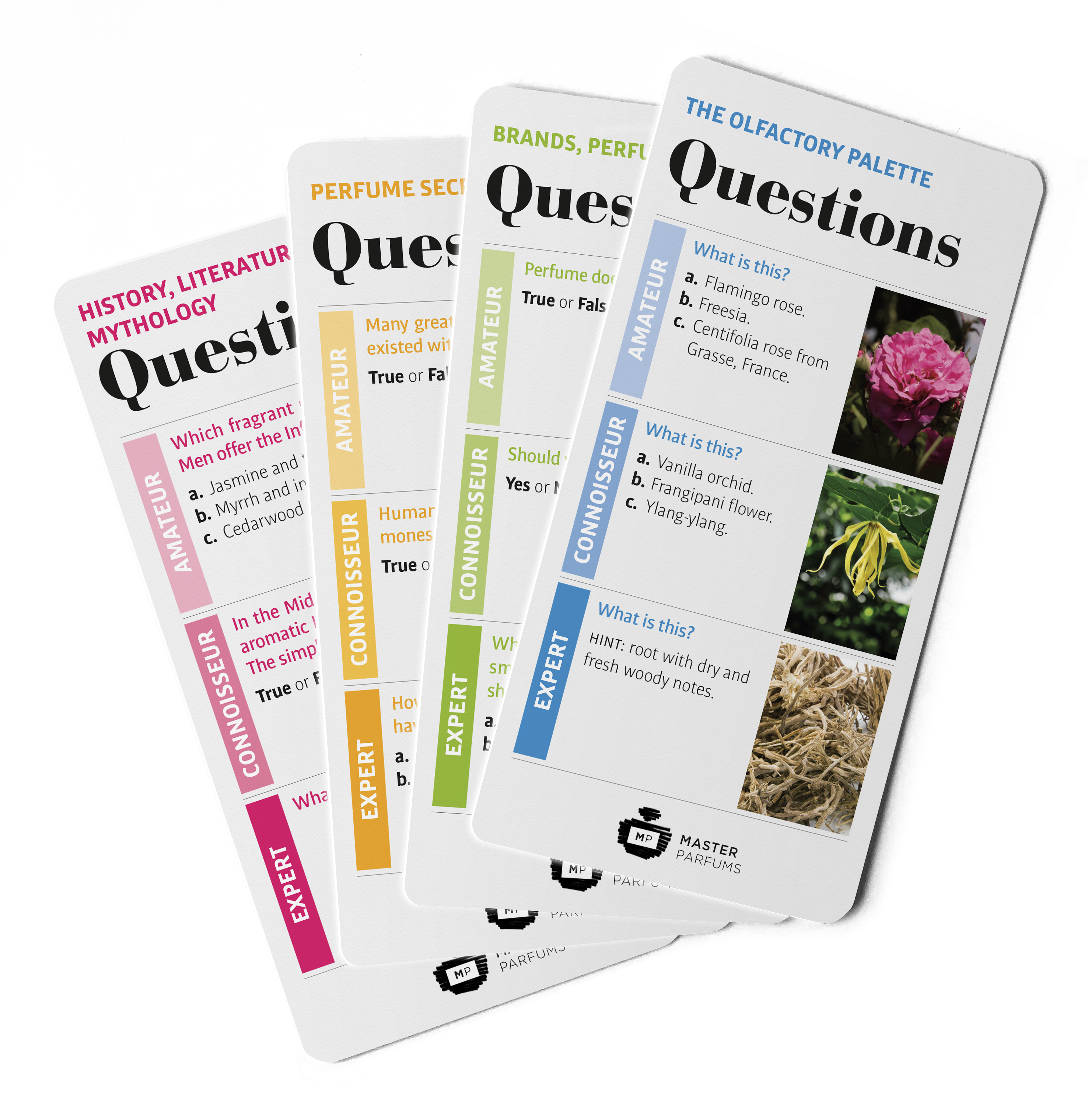
If the idea of a complementary perfume gift to tell her you love her—”JEU t’aime,” a playful nod to the game—tickles your fancy, the Pocket Quiz includes 120 cards with questions and answers to enrich your culture of the fifth sense while having fun. How about a game with your mum?
*: www.wikiparfum.com, https://www2.perfumist.fr
Collaborative article written by Hélène Sanchez & Anne-Laure Hennequin
The legendary perfume Opium by Yves Saint Laurent resonates like an ode to the emancipation of the woman of the late 1970s and heralded a new generation of perfumes throughout the decade of the 1980s. A provocative perfume in the image of its creator.
Yves Saint Laurent, Provocative Designer

Born in Oran, Algeria, in 1936, Yves Saint Laurent took an interest in couture fairly quickly. At 18, he arrived in Paris to take drawing courses at the Chambre Syndicale de la Haute Couture, where his talent made him famous in only 3 months. Christian Dior noticed him and appointed him a pattern designer. After the latter’s death, Saint Laurent continued the work of his mentor, thus taking over the direction of the House of Dior.
An undisputed genius, Yves Saint Laurent opened his own fashion house in 1962 with the help of his friend Pierre Bergé. Determined, the couturier then lived the apogee of his early hours, and the name Yves Saint Laurent became an essential of fashion.
A provocateur at heart, he broke the codes and made his know-how an artistic expression of feminism by launching a collection drawn from the men’s clothing world. The trouser suit now gave women the opportunity to wear trousers to work. The Saharienne jacket was diverted from the hunting wardrobe to make it an essential of his collection. Avant-garde, he dared to make the tuxedo a garment for women, cementing his aura in the world of fashion.
However, as early as the end of 1976, the press spoke of his excessive disappearance from the media, and magazines were already preparing retrospectives about him, as if he were soon going to die.
But Mr Saint Laurent was only writing his legend, and in response to this relentlessness, he launched with unprecedented success this narcotic juice with a transgressive name: Opium.
Opium by Yves Saint Laurent
Context of Its Release
In 1977, under the artistic direction of Chantal Roos, Yves Saint Laurent offered a modernised version of the oriental perfumes neglected since the 1940s. Opium was an olfactory and marketing coup advocating the emancipation of women, increasingly asserting their femininity.
The couturier wished to create a luxurious fragrance and imagined a bottle that went against the grain of what had been done until then.
For the bottle, Pierre Dinand innovated by slipping a glass flask into a sheath of amber plastic, inspired by the inrō cases that samurai used to store spices, medicinal herbs and opium.¹ He adorned it with a black silk tassel of Napoléon III inspiration, showcased in Yves Saint Laurent’s collection of the moment.

“It was a completely revolutionary object, a thousand miles from traditional glass bottles,” “It’s a period when Yves Saint Laurent is truly in the richest, most complete, most intense expression of his art,” notes Yann Andrea (International Marketing Director YSL Fragrances 2010–2014).
Opium concretised the fascination Yves Saint Laurent had with the Orient.
Sold on average 30% more expensively than its competitors, the perfume was such a success that French retailers quickly found themselves out of stock. It was the marketing tour de force aimed at reinforcing its prestige and its attractiveness.
In 1978, the advertising slogan was reworked for the American market. “Opium, pour celles qui s’adonnent à Yves Saint Laurent” (“Opium, for those who give themselves over to Yves Saint Laurent”) became tamer—some would say too prudish—”Opium, for those to whom Saint Laurent is a habit.”
Opium was immediately noticed, making the perfume the beginning of a myth. Indeed, the launch party took place on a boat moored in South Street harbour in Manhattan. Precisely where the ships coming from Asia loaded with opium arrived. The message was provocative, just like the couturier.
Opium, the Modernised Oriental
“If I chose Opium as the name for this perfume, it is because I intensely hoped that it could, through all its incandescent powers, release the divine fluids, the magnetic waves, the kiss-curls and the charms of seduction that give birth to mad love, love at first sight, fatal ecstasy…,” wrote Yves Saint Laurent. Transgressive, he wanted a sensual, hyper-opulent, extravagant, provocative, enigmatic and liberating perfume.
Olfactorily, Opium is largely inspired by Youth Dew (1953) by Estée Lauder (by Josephine Catapano) and the carnation-patchouli accords of Tabu (1932) by Dana (by Jean Carles). Its longevity is excellent; Opium opened the way to a lineage of sensual, sophisticated perfumes for glamorous femmes fatales, heralding an uninhibited, exuberant perfume industry for more than a decade.
Moreover, Estée Lauder replied to Yves Saint Laurent in 1978 (the year of Opium’s American launch) by creating Cinnabar (by Bernard Chant)… a revisited version of Youth Dew, very close to Opium.
Under the artistic direction of Jean Amic, Jean-Louis Sieuzac, Raymond Chaillan and Françoise Marin composed this dense, powerful perfume that nonetheless keeps an accuracy throughout its evolution.
It joins the oriental olfactory family, a powerful, heady spicy floral amber.
The Olfactory Notes of Opium
A fruity start of mandarin, peach and plum combines with aldehydes to give a certain brilliance and volume to this opulent heart.
The carnation accord studded with clove is the star of this composition. Dusted with cinnamon, it surrounds itself with rose, jasmine and ylang-ylang. These spicy floral facets nestle in an ambery, mysterious base adorned with myrrh, patchouli, vanilla, labdanum, cedar and sandalwood.
It is dense and captivating, addictive and enveloping. Musks and castoreum make this voluptuous, sensual fragrance wild.
It is a carnal perfume with much elegance. The carnation-patchouli accord is sublimated by a characterful, imposing ensemble.
However, the reformulations of the fragrance failed to keep the very essence of the original perfume, making it smoother and more conventional and perhaps less impactful, less provocative.
After Opium, the Story Continues with the Re-editions
No fewer than 25 flankers (reinterpretations) have come into being since the creation of Opium in 1977.
Variations on the concentration of the perfume—eau de toilette, eau de parfum, extrait or elixir—but also on their compositions have come into being; here are a few examples:
- Opium pour Homme (1995)
- Opium Fraîcheur d’Orient (1998)
- Opium Fleur de Shanghaï (2005)
- Opium Fleur Impériale (2006)
- Opium Légende de Chine (2007)
- Opium Elixir Voluptueux (2008)
Let us also note the creation in 2016 of Black Opium, nearly 40 years after the release of Opium, by 4 perfumers—Honorine Blanc, Marie Salamagne, Nathalie Lorson, Olivier Cresp—propelled to the rank of commercial blockbuster.
Black Opium represents, according to the brand, the new generation of Opium, provocative and rock & roll with a falsely relaxed style since it is perfectly mastered. Meaning to be rebellious and avant-garde in the image of the original Opium perfume, Black Opium—whose addiction is breathed in by the coffee note—is described as magnetic and sulphurous.
And you, do you prefer the initial version of Opium or its reinterpretation Black Opium, hewing to modern standards of what represents exuberance?
Watch our Master Parfums video on the question of the Opium perfume by Yves Saint Laurent.
References
- Les 111 parfums qu’il faut sentir avant de mourir, page 101. Y. Cervi
Banner photo credits: https://www.flickr.com/photos/wvfonseca/23827977442
Angel has become, over the years, an essential of modern perfumery, a captivating best-seller at the origin of a new lineage of olfactory category.
However, its fame was not achieved immediately. How did Thierry Mugler manage to make Angel one of the most prized perfumes in the world? What makes Angel so addictive and so particular?
Who Is Thierry Mugler?
Thierry Mugler, born on 21 December 1948 and died on 23 January 2022, is a French designer who marked the world of fashion in multiple ways: stylist, couturier, director, photographer and perfume creator.
As a child, he was a dreamer and a loner, tirelessly losing himself in his thoughts while watching the immensity of the starry sky… and one star in particular, blue, shone in his eyes more than the others and seemed to call him. So much so that he would make it his trademark, representing stars in all his artistic projects, and even tattooing on his body the famous, so characteristic Mugler star.
At fourteen, he joined the ballet of the Opéra du Rhin after 5 years of classical dance. From this experience he kept not only a developed talent for bodily expression, but also the sense of the aesthetics of the body that he would constantly want to showcase.
Then he took interior-design courses at the school of Decorative Arts in Strasbourg, which concretised his fervour for staging his fantastical shows.
Then came the moment when Thierry Mugler wanted to give an olfactory dimension to his world: the eau de parfum Angel was born.
Creation of the First Mugler Perfume
An Innovative Composition
Thierry Mugler’s ambitions at the beginning of the 1990s translated into the creation of a perfume, thanks to a famous, totally revolutionary and surprising formula for the time. He would say, “I want to make a fragrance so delicious that you’ll want to eat it.” A perfume that would disconcert at first, consumers being surprised by this gourmand fragrance of a new kind! A success that came into being thanks to a brilliantly conducted marketing method.
Indeed, he created the Cercle Mugler, a loyalty programme integrating customers into the privileged world of Angel. A programme offering advantages and gifts around the Angel perfume as purchases went on; loyalty was therefore rewarded with attentions reserved for members. Customers feeling favoured, pampered and completely under the charm of this new addictive fragrance talked about it around them… Word of mouth worked, and success finally established itself and inscribed Angel in the very restricted list of iconic perfumes.
This gourmand fragrance, which we owe to the great perfumer Olivier Cresp, is composed of sweet, addictive notes, with a base of vanilla and patchouli that is a classic oriental structure, but above all of an ingredient until then reserved for the food-flavouring sector: ethyl maltol. A compound that has a particular scent recalling the smell of funfairs with praline, candyfloss, caramel, which gives this particularity, this singularity to the perfume.
Olivier Cresp told L’Express: “I spent two hours talking with Thierry Mugler. He told me about the afternoon snacks he had at his grandmother’s, the madeleines he dipped in his chocolate, then the funfairs and the candyfloss.”
It took the perfumer nearly 600 trials to manage to develop the perfume as Thierry Mugler had dreamed it.
This completely broke the codes of the time and revolutionised the then still very classic perfume industry, so much so that a new olfactory category came into being thanks to Angel: that of gourmand perfumes.
Angel, a Unique Sensual Gourmand Perfume
Angel, a gourmand amber
The opening is juicy, a puff of citrus freshness. It is, according to Mugler, the celestial facet of the fragrance.
Then quickly come sweet, fruity notes carried by honeyed, milky, childlike, comforting accords. The alliance of praline, red fruits and passion fruit makes the whole gourmand—it is the delicious facet.
Finally, in the base notes, it is a ballet of sensual notes, ambered by vanilla and caramel, where cocoa, honey, heliotrope and patchouli blend. It is the voluptuous facet, giving the perfume this sensation of irresistible delight.
A dense, complex olfactory pyramid, which highlights the characteristics of a warm, sweet, childlike, sensual, mysterious and enveloping perfume.
A powerful perfume, recognisable among a thousand, like the Mugler fashion that strives to give woman the soul of a winner with a tender heart.
An olfactory comfort blanket in an era in search of reassurance—childlike, sexy on a skin you want to eat… and terribly addictive.
TEST YOUR PERFUME KNOWLEDGE
Angel holds no more secrets for you?
Iconic perfumes, great houses, raw materials, the history of perfumery…
Put your knowledge to the test with the Master Parfums Pocket Quizzes.
An Iconic Star-Shaped Bottle
Not only is the composition of its perfume particularly original, but its bottle is a jewel in itself, star-shaped of course, made with an innovative technique in thick glass. Three years of research were necessary to arrive at the creation of this iconic star bottle.
The avant-gardism was pushed even further, since he innovated by creating a refill system called the “Fontaine Mugler” (Mugler Fountain), which consists of fighting against waste.
Thus, each owner of an Angel perfume can refill their bottle and participate, in a certain way, in an ecological responsibility—natural today, but which at the time presented Mugler as a visionary.
A Perfume Rewarded on the International Scene
Particularly well-conducted communication and personalities having collaborated with Mugler to present Angel made the perfume even more desirable. An immense success that translated into Angel’s ranking in the top 3 of the best-selling perfumes in France, and this for more than 20 years. The fragrance also distinguished itself through the prizes received on the international scene:
- Hall of Fame Award of the FiFi Awards of the Fragrance Foundation (2007)
- Feminine Hall of Fame Award at the Canadian Fragrance Awards (2010).
Want to learn more about the iconic perfumes that marked French perfumery? Discover our Pocket Quiz perfume general-knowledge game!
Based on the Master Parfums video
YOU MAY ALSO LIKE …
Why can’t I smell my perfume anymore? We have all felt that impression of no longer smelling anything after testing several perfumes or wearing the same fragrance over and over. 👉 This phenomenon, called olfactory saturation (or a saturated nose), is completely normal: your brain gets used to the smells and stops perceiving them.
We have all experienced, one day, the sensation of “no longer smelling anything” after smelling several perfumes, or when we always wear the same fragrance. Our nose, assailed by many smells, becomes saturated. This phenomenon is common, and we explain why!
What Is Olfactory Saturation?
A little explanation of how our sense of smell works on our brain.
Smells are made up of a set of molecules perceptible only when they reach our nose.
A person can normally distinguish, on average, 3,000 different smells. Some well-trained noses can perceive up to 10,000 distinct nuances! This is the case for most experts in the field of perfume.
How Does the Nose Perceive Smells?
The molecules of volatile substances enter through the nostrils, until they come into contact with the olfactory cilia at the back of the nasal cavity. These capture the smell and transform it into information for the brain, which will recognise (or not) the smell.
If we have smelled it before through our past olfactory associations, then we can identify and analyse this smell. Otherwise, the information will be temporarily stored in our olfactory memory for future use.
There are generally fewer receptors than incoming molecules, so some molecules “escape” us, and consequently we do not smell certain nuances of the smell. This is why, for example, it is inadvisable to test several perfumes in a row, at the risk of seeing our sense of smell become saturated fairly quickly.
I Can No Longer Smell My Own Perfume

We have all had, at least once in our lives, that sensation of no longer smelling our own perfume at all—yet a perfume we particularly love, a perfume we wear regularly.
To make up for it, we overdose, cheerfully spraying all over our body or our clothes, in the hope of smelling it more, and for longer…
The result is often the same: we no longer smell our own perfume!
And the first thing that would come to mind would be that the perfume has oxidised, losing its most characteristic notes, and that it no longer performs as it did at the start…
Well, it is entirely possible that the perfume does not have a big projection and does not last long simply because its olfactory composition corresponds to so-called light perfumes, often green or hesperidic perfumes. Nothing serious in itself, since it has nothing to do with its quality or a potential degradation of the fragrance.
Never mind—we can perfume ourselves again during the day if the desire or need is felt.
In reality, it is not the perfume that has evolved, but rather our sense of smell and the information from our brain and, more precisely, from our olfactory memory. A smell that becomes common, habitual, and which, by extension, is recognised as “natural” by our memory, is therefore inhibited to allow our brain to concentrate better on other, less familiar ones.
This is the phenomenon of olfactory adaptation: naturally, we develop a habituation to our own smell. Our olfactory receptors become saturated, and so as not to exhaust themselves too much, they decide to stop smelling it by inhibiting it, in order to remain attentive to other smells that might warn of a danger. Let us not forget that smell is a primitive sense!
This capacity for adaptation works, moreover, for all the senses: someone who lives next to a train station no longer hears the trains. Someone used to seeing a tic in a person around them no longer sees it; when we put on a piece of jewellery, it can be bothersome when we have just put it on, and then we get used to it…
How to Remedy a Nose That Becomes Saturated
So how can we manage to feel this perfume we love so much that it had become our olfactory signature?
Why not take a break from time to time, change perfume, or not wear perfume for a few days?
Also remember to hydrate your skin well. Hydrated skin is a promise of better diffusion of the perfume.
When you perfume yourself, be careful not to spray on the chest, the famous triangle connecting the nose to the tips of the breasts. This could risk saturating your nose.
Choose instead pulse points (wrist, behind the ear, the knees) that will reveal the perfume when you move. The shoulders too.
Also beware of the conditions in which you apply your perfume: heat, sun exposure or application zones can influence your perception of smells. 👉 Discover our advice for wearing perfume in the sun and avoiding certain common mistakes.
You can perfume your clothes rather than your skin, or your hair (preferably by spraying onto your brush).
But the ideal way to escape habituation remains to be a little unfaithful to your perfume. You will rediscover it with great pleasure.
Myth and Reality: Coffee Beans

During olfactory walks, on a visit to a perfumery to discover new releases or plan a gift, for example, we sometimes have a sensation of loss of smell, headaches, a dry throat. Our body has had enough, and this is an entirely normal process.
Often, too often, we are offered coffee beans to smell to help us better perceive the perfumes that will follow. We are told that thanks to these little beans with their very characteristic and recognisable smell (more or less fresh), our nose will be “cleaned”…
But what is really going on?
This will only serve as a decoy for our brain, creating a “distraction” between the different fragrances smelled and this “new smell”—admittedly without alcohol, but a smell all the same!
In reality, this coffee smell does not desaturate our olfactory receptors at all.
The only power it will have is simply to be added to the list of smells inhaled, combining simply with other perfumes.
Guaranteed result: an exhausted nose, which will in no way have been cleansed!
So What Should We Do?
The best solution obviously remains to breathe fresh air for a few minutes, and as often as you feel the need. This technique allows a real reset of the olfactory receptors.
In the event that the situation does not allow you to go outside, the best thing is to smell your own skin—in the crook of the elbow, for example—free of any perfume.
As we have seen, the smell of one’s own skin is completely neutral to our brain; smelling it will also have a cancelling effect, a “reset” of the olfactory receptors.
PS: don’t block your nose—that won’t help either.
When we are used to often wearing the same perfume, it is common to no longer smell it a few hours after application. Fortunately, this does not mean it no longer has a scent! In this article, discover all about olfactory adaptation thanks to a new question drawn from the Master Parfums olfactory game.
Why Can’t I Smell My Perfume Anymore?
It is through a question from the “Brands, Perfumes, Tips” category of the Master Parfums game that we come across this expert-level question. It is a true or false: “Over time, you can stop smelling your perfume.”
So, what do you think—true or false?
Of course, the answer is “true.” It is even a very common sensation when you have been wearing a perfume for a long time. You then have the impression that it is like a second skin and that it is part of us. It becomes part of our personality, a little like an olfactory ambassador.
The Reasons for Olfactory Adaptation
Through habituation, the nose gets used to the smells that are part of our daily life. On the other hand, other people can indeed smell them.
It is the same with the smells of the house or the car. We always smell something at other people’s homes, but no longer at our own. On returning from a long period of holiday, that is when we notice the smell of our own home.
Olfactory adaptation develops through permanent stimulation with the same smell: the olfactory receptors get used to it and then classify it as commonplace. In the case of a perfume, the brain will end up associating it with your own body odours.
If the olfactory receptors mask familiar smells, it is in order to be able to stay alert to new smells that could put us in danger. Smell is indeed a primitive sense that was necessary for survival.
Finally, this capacity for adaptation exists for all the senses. For example, when we live next to a train station we no longer pay attention to the trains; when a loved one has a tic we end up no longer seeing it, just as we get used to a new piece of jewellery that can be bothersome at first.
Perfumes with a Fleeting Sillage
Sometimes, it is possible to no longer smell one’s perfume because of its fleeting sillage. This is the case, for example, with eaux de Cologne or hesperidic perfumes.
The latter reveal the intensity of their citrus notes during the first moments, before they fade quickly. The materials used to create these fresh, sparkling notes generally have low tenacity.
If your perfume belongs to these families, it is entirely normal that you no longer smell its scent a few hours after application.
However, to make up for this drawback, perfumers now dress these notes in musks that help to fix them. (We recommend you read our article on white musks.)
How to Smell Your Perfume Again?
There are a few solutions if you want to smell your perfume’s scent again. For example, you can take a break from time to time. To do this, you can alternate with another perfume, or quite simply stop wearing perfume for a while.
Also remember to hydrate your skin well, because well-hydrated skin is a promise of good diffusion of the perfume.
When you perfume yourself, be careful not to diffuse directly on the chest. This is what risks saturating your nose more quickly. Choose instead pulse points, such as the wrist, the crook of the elbow, behind the ears or the shoulders. That way, when you move, you will be able to smell your perfume again.
Finally, you can perfume your clothes rather than your skin, or your hair by spraying onto the brush.
What Is Anosmia?
Anosmia is a term that has become better known because of the Covid-19 pandemic. Indeed, this word means the loss of smell. This anosmia can be total or partial, permanent or temporary.
It is a disorder that can be present from birth or occur later. Anosmia occurs through alteration of the mucous membrane or when the olfactory nerve is affected. It can concern a single nostril or both.
The Causes of Anosmia
Anosmia can have several causes. It is important to consult a doctor in order to make a diagnosis.
Here is a non-exhaustive list of the possible causes of anosmia:
- Obstruction of the nasal passages: in the case of rhinitis, sinusitis or a deviation, for example.
- Damaged olfactory nerve: olfactory information is then no longer transmitted. This can come from tobacco consumption or the taking of certain medications, from liver problems, or from viruses such as flu or Covid-19.
Are There Treatments for Anosmia?
It all depends on the origin of the anosmia. If it is an inflammation, treatment with medication can help cure it.
In some cases, a surgical operation is necessary, notably if the anosmia is linked to the presence of a tumour.
It may unfortunately be possible that the sense of smell never returns to its full power following anosmia, whether partial or total.
In all cases, it is recommended to begin olfactory rehabilitation with a specialised speech therapist.
The scented pencils of the Master Parfums Olfactory Game-Book are, moreover, used and recommended by speech therapists as part of their post-anosmia olfactory therapy or to stimulate memory through smells in neurodegenerative diseases such as Alzheimer’s or Parkinson’s.
To discover even more about the fascinating world of perfumery, discover the Master Parfums game with family or friends.