Smells are part of our daily life. They can evoke memories, emotions and sensations. It is not surprising, over time, to recognise smells that made an impression on us and to associate them with particular moments of our life. But did you know that the recognition of a smell involves a complex process that takes place both in the nose and the brain? In this article, we are going to explore how our olfactory system works and discover how long our brain takes to recognise a smell.
What Is a Smell?
A smell is a sensation that is perceived when volatile molecules from a substance bind to the olfactory receptors in the nasal mucous membrane.
Smells are complex sensations that can be influenced by a multitude of factors. They can be divided into several components, notably quality, intensity and duration.
The quality of a smell represents the very nature of the smell: fruity, floral, woody, earthy, etc. This component is often associated with the chemical structure of the odorant molecules.
The intensity of a smell refers to its strength or its concentration. Smells can vary considerably in intensity, from very weak to very strong, and can also be modulated by factors such as the distance from the source of the smell and the duration of exposure.
There is also the duration of the olfactory sensation. Some smells can be short-lived, while others can persist for a long time. It is notably this concept that is used in perfumery in the composition of a perfume with the top note, heart note and base note.
It is important to note that the sense of smell is closely linked to emotions and memories. Smells can trigger emotional memories and associations particular to each individual.
How Does Our Brain Perceive and Recognise Smells?

Smells can have a great influence on our mood, our appetite and even our behaviour. A complex journey through the brain takes place to give meaning to smells.
Unlike the perception of colours, which involves three types of receptor cells located in the retina, the perception of smells relies on about 400 receptors present in the neurons at the back of the nasal cavity. Each receptor can recognise several molecules and each molecule can activate several receptors, thus creating many possible combinations.
For Jérôme Golebiowski, professor and co-director of the transdisciplinary research group Odorants-Odeurs-Olfaction at the Institute of Chemistry: “Perceiving a smell amounts to perceiving a musical chord produced on an organ with 400 keys: the olfactory system is thus formidably complex, since there is virtually an infinity of chords.”
Odorant Molecules
As we have seen, smells are made up of odorant molecules that float in the air.
These molecules are captured by our nose when we inhale, and bind to the olfactory receptors located in the nasal cavity. This is what is called orthonasal olfaction.
But odorant molecules can also come from what we eat or drink. The odorous products of foods and drinks pass through the back of the throat (pharynx) and rise up to the nasal cavity, where they are intercepted by the olfactory receptors. This is what is called retronasal olfaction. This is why, when we have a blocked nose, or when we suffer from anosmia, we cannot perceive the aromas of what we eat or drink.
The Interception of Smells
Right at the top of our nasal cavity (between the two eyes) is the olfactory epithelium, a thin membrane covered with mucus, also called the olfactory mucous membrane. It contains the olfactory neurons whose role is to:
- capture the odorant molecules thanks to their olfactory cilia (small filaments onto which the molecules attach)
- recognise the olfactory molecules, thanks to their olfactory receptors
- translate the chemical message of the odorant molecules into a nervous message comprehensible to the brain
- send these messages to the olfactory bulb in the brain
There are nearly 5 million olfactory neurons in the human olfactory mucous membrane!
The Transmission of Information
The nervous message is then sent to the olfactory bulb, which is located at the base of the brain, and which is responsible for transmitting olfactory information to the olfactory cortex, found in the temporal lobe: this is encoding, the creation of a kind of identity card for the smell.
The Processing of Information
The olfactory cortex processes the olfactory information and links it to our experiences and memories. It is part of the limbic system, the seat of our emotions and instinctive behaviours. This explains why certain smells can generate strong sensations in us, emotions—often unconscious, moreover—because they relate to specific moments of our life that we cannot immediately identify.
Conscious Recognition
It is when the information reaches the orbitofrontal cortex that we become aware of our sensations, analyse them and give them a name. It is this part of the brain that allows us to recognise and identify smells. In perfumers, this part of the brain is very often more developed than in the majority of us, owing to their intensive training in recognising smells.
In general, the olfactory sensation occurs almost instantly, because the nervous message is transmitted very quickly from the olfactory bulb to the olfactory cortex.
How Long Does the Recognition of a Smell Take?
The time the brain takes to recognise a smell depends on several factors, such as the concentration of the odorant molecule, the sensitivity of the olfactory receptors and the speed of transmission of the nervous information.
In general, the recognition of a smell occurs fairly quickly, in just a few milliseconds.
Indeed, the olfactory bulb is capable of recognising thousands of different odorant molecules and differentiating them from one another according to their structure; this recognition is extremely fast since it occurs almost instantly.
Once the olfactory message is processed by the olfactory bulb, it is transmitted to the olfactory cortex where it is analysed and interpreted. This analysis takes a little more time than the simple recognition of the smell, but the delay is of the order of only a thousandth of a second.
The same pattern occurs with the orbitofrontal cortex, which is responsible for decision-making and the analysis of sensory information; it processes the olfactory information according to our experiences and memories. It happens, however, that over time a familiar smell such as one’s own perfume is no longer “recognised” by our nose when we wear it, and that we no longer smell it.
The recognition of a smell is a relatively fast process that occurs in just a few milliseconds. However, the analysis and interpretation of olfactory information can take a little more time and depend on our experiences and memories.
By understanding how our olfactory system works, we can better appreciate the complexity of this fascinating sensation that is an integral part of our daily life. Furthermore, understanding how olfactory memory works can help perfumers, scientists and therapists to create perfumes, to study diseases and to treat mental disorders using smells (olfactotherapy).
If you want to learn more about the fascinating world of smells, discover our Pocket Quiz game, 120 questions about perfume and smells to learn while having fun, and stimulate your sense of smell with the scented pencils of the Olfactory Game-Book!

Collaborative article written by Elfa Jouini & Anne-Laure Hennequin
Raw materials are key ingredients in the composition of perfumes, whether natural—obtained by various extraction methods—or synthetic. The composer-perfumer selects them for their olfactory qualities and combines them to create unique, lasting fragrances.
Natural Plant Raw Materials
Natural raw materials in perfumery are ingredients obtained from plants.
Plants are the first source of the natural raw materials used in the composition of perfumes: flowers, stems, wood, fruits, leaves, roots, seeds… everything is usable, and the extraction methods vary.
The Different Extraction Processes for Natural Raw Materials
Various techniques are used to best capture the essence of each material.
- Distillation is the most common method for extracting essential oils from plants. Distillation uses steam to separate the oils from the plants. By decanting, one obtains on one side the essential oil or essence, and on the other plant water that can be used in cosmetics or for cooking (example: rose water, orange blossom water…).
- Cold expression, called “Pelatrice,” consists of cold-pressing fruit zests to extract the essential oil/essence. It is the most common method for extracting oil from citrus fruits. The so-called Sfuma Torchio expression presses whole fruits and makes it possible to obtain an essential oil/essence that is just as zesty but a little more gourmand.
- Enfleurage is an ancestral technique that consists of spreading flower petals on a plate of animal or plant fat that will absorb their odorant molecules. Once saturated with smell, it is filtered to obtain a pomade that can be used as is or else washed with alcohol and filtered to obtain a pure essence called an absolute. As this method is long and very costly, it is practically no longer used. It has been replaced by…
- Volatile solvent extraction. Solvents such as benzene, ethanol or hexane have, like fat, the property of absorbing odorous materials. Depending on the fragility of the ingredients, it can be done hot or cold. This technique is often used to extract raw materials that are difficult to process by distillation, such as flowers and leaves. The plants are placed in an extractor containing a solvent that circulates several times. Once saturated with smell, it is evaporated in order to obtain a highly fragrant paste, called a concrete (for flowers) or a resinoid (for dry materials such as roots or mosses). This paste is then melted and cleaned with alcohol to obtain one waxy phase and one alcoholic phase. The alcoholic phase is distilled to remove the alcohol, and one thus obtains an absolute.
- Infusion, another ancestral technique, consists of leaving plants to macerate in an oil or alcohol for a prolonged period in order to dissolve the odorous principles and recover a tincture. This method is often used to extract raw materials from roots, resins and woods.
- Headspace and Nature Print make it possible to capture the volatile smell of a material. Indeed, a flower cut to be distilled or extracted by solvent will not have the smell it can give off when it is still alive (the scent of a rose essence is very different from that of a fresh rose into which one might plunge one’s nose). This is what this technology sets out to reproduce. A glass bell is placed above the material, through which a gas current is passed. The gas impregnated with odorous material is absorbed by a carbon filter. This filter is analysed thanks to a chromatograph and a mass spectrometer, which will deliver the composition in odorant molecules. Once the list of molecules is identified, they can be reproduced in order to obtain an ACCORD reconstituting the smell of the fresh extracted material. For Nature Print, instead of a bell, a syringe is used to capture the odorous substances.
- Supercritical CO2 extraction, also called Softact, is the most recent technique. The principle is to replace volatile solvents with CO2. The latter has the particularity of transforming from the gaseous state to the “supercritical” state (dense like a liquid but fluid like a gas) when put under pressure (70 bars) and at a temperature of 30°C. It then has the same properties as a solvent without using high temperatures that can denature the materials. In addition to being ecological (the CO2 is recycled) and respectful of the material, this innovative process makes it possible to obtain extracts of exceptional quality and purity.
Each of these techniques has its advantages and disadvantages in terms of cost, quality and quantity of oil produced.
Raw Material Sourcers
The job of a sourcer in perfumery consists of finding and supplying quality raw materials for perfumers.
This involves establishing relationships with raw material suppliers, assessing the quality and stability of raw materials, negotiating prices and guaranteeing the regulatory compliance of raw materials. Sourcers must also be able to find rare and hard-to-find raw materials for perfumers.
Sourcers have a thorough knowledge of raw materials in perfumery, as well as of the processes of extraction and transformation of raw materials. They must also be familiar with quality and safety regulations for the raw materials used in perfumery.
A sourcer is able to work closely with perfumers to understand their raw-material needs and to help them find the most suitable ingredients for their project.
In summary, the job of a sourcer in perfumery is a key role for perfumers and perfume manufacturers.
Natural Animal Raw Materials
Raw materials of animal origin have been used for their odorous characteristics for hundreds of years. They are generally used as a fixative, found in the base notes of perfume compositions.
Animal musk comes from a sexual secretion produced by the male musk deer of the Himalayas during the rutting season. It is found in a pouch hidden under the animal’s belly. Generally obtained by killing the animal, the use of this raw material has been banned since 1979.
Civet adds an animalic, musky note to a perfume. It is obtained from the perianal gland of the animal, a small mammal, a kind of small wild cat, found in Africa (Ethiopia) and Asia. The production of this civet musk often involves confining civets in captivity and regularly harvesting their glands, which can cause pain and discomfort for the animals.
Castoreum is an oily, odorous secretion from the perianal glands of the beaver, serving it to mark its territory and waterproof its coat. Its smell, strong at first, can be soft, leathery and suave when treated. This highly prized raw material often involves hunting the beaver to obtain this substance, which causes, like musk and civet, ethical concerns.
Ambergris is used in perfumery to add a marine, animalic, ambery and tobacco note to a perfume. It is an intestinal concretion due to an irritation caused by the molluscs poorly digested by the animal. The whale naturally expels this substance through its digestive system. This raw material floats on the sea and, in contact with the sun and salt, dries and finally washes up on the beaches where this kind of waxy stone is collected. It is generally subjected to a cleaning and purification process to remove impurities and obtain a pure substance usable in perfumery. Owing to its rarity and the complexity of its formation, ambergris is precious and therefore very costly.
Beeswax, also used as a fixative, brings to the perfume its warm, round, honeyed notes, which can also exhale leather or tobacco facets.
Most of these raw materials are today controversial owing to ethical and environmental concerns. Synthetic alternatives are often used to replace these ingredients.
Synthetic Raw Materials

Synthetic products, for their part, are made in the laboratory from molecules of natural or synthetic origin. They are used to reinforce natural fragrances, give them relief, and to imitate natural aromas that are difficult to obtain.
The history of synthetic raw materials in perfumery dates back to the end of the 19th century, when, during the Industrial Revolution, the French scientists Paul Parquet and Georges Darzens began to synthesise odorant molecules in the laboratory. Before that, perfumers used exclusively natural raw materials to create fragrances. However, these raw materials were costly, rare and sometimes difficult to obtain in sufficient quantity.
The choice to create synthetic raw materials is also part of a dynamic of innovation. It is not only about reproducing already-existing natural smells, but also about creating new smells that make perfumes unique.
To cite a few examples, this is the case of aldehydes, which give a metallic, soapy smell to the perfume’s composition and make it possible to illuminate a bouquet. Ernest Beaux dared to use them for the first time in overdose in Chanel N°5, a feat that made the perfume unique and recognisable above all others.
Vanillin, used by Jacques Guerlain, an emblematic component of Shalimar and of his Guerlinade, gives gourmand vanilla scents.
Kenzo pour Homme, created by Christian Mathieu, has the characteristic of incorporating calone, giving that scent of marine, slightly aqueous freshness to the perfume.
Of course, one thinks of Angel by Mugler, created by Olivier Cresp, who had the wonderful idea of adding ethyl maltol to the perfume, with its addictive notes of candyfloss, caramel and praline.
Over time, synthetic raw materials have become increasingly popular in perfumery, since they offer greater stability and greater consistency in perfumes, as well as a more affordable cost compared to natural raw materials—even though some can sometimes be very expensive to develop.
They also make it possible to reproduce the scents of mute flowers (which do not give up their essence: e.g. lily of the valley, lilac, peony…), of materials that have become banned (animal materials and allergenic substances).
They also avoid the overexploitation of soils and remedy production problems caused by ecological disasters (fires, floods, drought…). And above all, they enrich the perfumer’s palette.
TEST YOUR NOSE
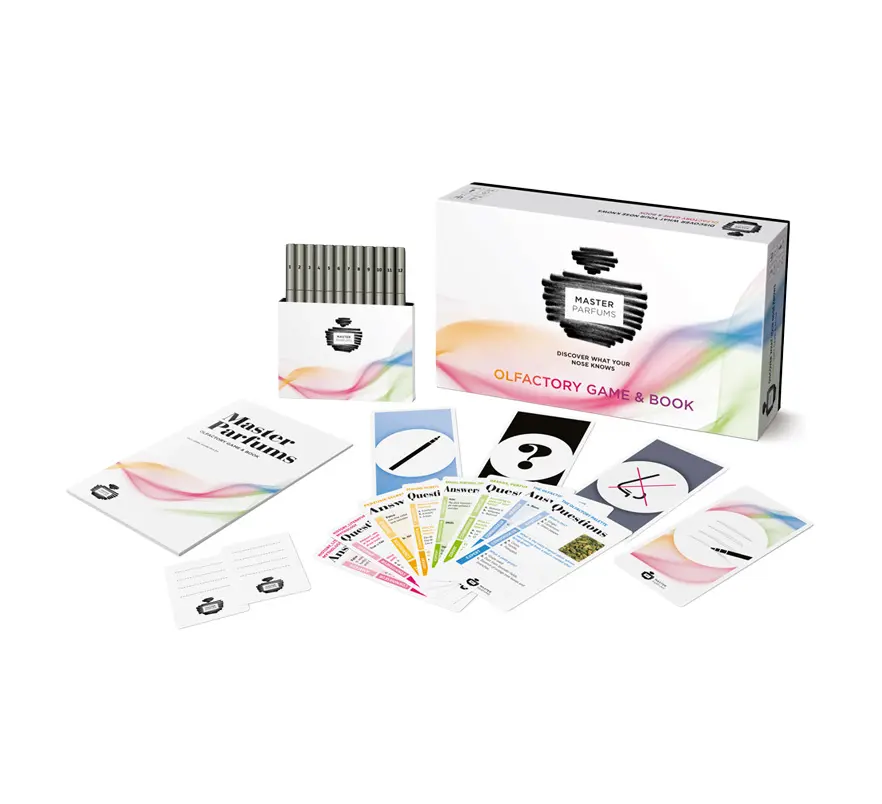
Will you be able to recognise raw materials? 👃
Woody, floral, spicy… Some smells seem familiar. But could you really identify them?
With the Master Parfums Olfactory Game, train your sense of smell, recognise raw materials and test your perfume culture.
IFRA Safety Standards
IFRA (the International Fragrance Association) is a global organisation that defines safety standards for raw materials in perfumery. IFRA establishes restrictions on the use of certain raw materials owing to their potential harmfulness to health or to the environment.
These restrictions can include limits on the quantity of raw material that can be used in a product, specific conditions of use, or a total ban on the use of certain raw materials. Perfumers must follow IFRA standards to guarantee the safety of their products and their regulatory compliance.
It is important to note that IFRA restrictions are not mandatory, but perfumers are encouraged to follow them to guarantee the safety of their products and their compliance with the regulations in force. Perfumers can also choose to follow stricter standards than those of IFRA to guarantee the safety of their products.
Natural or synthetic, each raw material adds a distinct note to the final perfume and can influence the fragrance according to the quantity used. Depending on trends, some raw materials are more prized than others. The advent of synthetic raw materials gives an infinity of possibilities for olfactory compositions, to our great delight!
YOU MAY ALSO LIKE …
The profession of composer-perfumer is above all that of an artist of great sensitivity, but not only. It is also a technician mastering the chemistry of the molecules that make up a fragrance.
It is the alliance between creativity, science and emotion in the service of a noble profession.
How does one become a perfumer? What is the necessary training path?
Master Parfums tells you all about it!
Artist and Technician of Fragrances
The composer-perfumer is an artist, a creator who designs fragrances both to develop skin perfumes and interior perfumes, food flavourings or household products.
They will first reflect on the structure of the perfume’s composition and on the choice of raw materials that will be used in it. The composer-perfumer masters the art of the symbiosis of the molecules that make up each raw material. This expertise is inevitably accompanied by a creative spirit whose sensitivity leads to a unique alchemy.
Note that the perfumer is commonly called a Nose. A rather simplistic and reductive term, since the profession does not boil down to a sensory function but rather to the symbiosis of multiple qualities and skills that are intrinsically inseparable. In fact, just like the musician’s ear, their nose is above all a tool of control and learning. To learn more about the composer-perfumer profession, don’t hesitate to take a look at our dedicated video!
The Skills of the Composer-Perfumer
A Developed Sense of Smell and an Outstanding Olfactory Memory
Having a developed sense of smell is an asset, and the ability to memorise smells is fundamental and indispensable to be a perfumer. There are hundreds of basic raw materials that a perfumer must know by heart, and therefore be able to identify by smelling them. The seasoned perfumer can recognise not only a raw material, but can also identify its origin, its place of production, and the type of equipment used for its extraction!
The greatest perfumers can memorise up to 3,000 smells! To become an expert, long years of experience and training are necessary; nevertheless, the perfumer must practise continually throughout their professional life to maintain their olfactory memory.
Intensive training of perfumers results in an increase in the brain areas linked to olfaction (piriform cortex and orbitofrontal cortex). With expertise, perfumers develop a high capacity to mentally manipulate smells. They can smell them mentally and imagine what different compositions might smell like. It is then the trials that will allow the perfumer to corroborate their intuition and refine their creation.
An Artistic Sense and Creativity
For a perfume to touch the client’s sensitivity, it is imperative to know how to develop an emotional intelligence in order to offer a relevant olfactory experience. Sometimes the objective is to create novelty, originality, to go and seek unusual or never-used raw materials making it possible to offer a unique perfume, while being universal.
The challenge is delicate, since the perfumer must not limit themselves to their personal tastes. Developing one’s artistic sense makes it possible to constantly seek new ideas, sometimes far from the perfumer’s preferences.
Becoming a perfumer is a profession that takes time, and patience is another indispensable asset. They must constantly keep watch from a socio-cultural point of view to ensure they always present fragrances in symbiosis with consumers’ expectations.
The Technical Skills of the Perfumer

In general, solid knowledge of chemistry is necessary to master and handle the molecules of the essences and other absolutes that make up the raw materials, whether natural or synthetic.
For perfumers who work in the creation houses (see paragraph below), knowing how to work in a team is also a necessary qualification. Indeed, in these companies, the perfumer does not develop the perfume alone in front of their perfume organ. A whole team composed of marketing, the evaluator, the assistants, gravitates around, and it is indispensable to be comfortable with this spirit of sharing. Many perfumes are also the fruit of the alliance of several perfumers.
Studies and Training to Become a Perfumer
There are very few perfumery schools leading strictly to this profession. A few creation houses have their own internal school (Givaudan, IFF, Firmenich) but the entries are limited and very selective.
One can also become a perfumer through training courses aimed at acquiring solid foundations in chemistry, creativity and marketing.
Besides fine-perfumery perfumers, these schools also train perfumers who will be specialised in functional perfumery (cosmetics, soaps, shower gels, shampoos, detergents), and food flavourings, as well as evaluators.
The ESP (École Supérieure du Parfum) in Paris and Grasse offers admissions in the first year post-baccalaureate on application, as well as in the second year after a two- or three-year degree in chemistry, biology, mathematics…).
The ISIPCA (Institut Supérieur International du Parfum, de la Cosmétique et de l’Aromatique), located in Versailles, offers various training courses around the perfumery professions, post-baccalaureate or higher.
The GIP (Grasse Institute of Perfumery) also offers various training courses in Grasse, and in several other cities around the world and online.
Other perfumery creation and training centres, such as Cinquième Sens, offer complete training courses over several modules.
The Perfumery Art School, created by the perfumer Isabelle Gellé, makes it possible to train online for the profession of independent perfumer, handling only natural raw materials. An artistic approach to perfumery, without the need for expertise in chemistry.
In addition to diplomas and training, experience remains fundamental. It is by practising continually that the perfumer manages to become a recognised expert in the very closed, selective world of perfumery.
Famous Perfumers and Creation Houses
Few are the perfumers who have the advantage of creating perfumes, sometimes entire collections, within the great houses themselves. We can cite Mathilde Laurent for Cartier, Christine Nagel, who took over from Jean-Claude Ellena for Hermès, Olivier Polge, who took over from his father Jacques Polge for Chanel, or Thierry Wasser for Guerlain, Francis Kurkdjian, who took over from François Demachy for Dior.
Most perfume creators are employees in companies that compose and produce natural and synthetic raw materials. It is these companies that, besides sourcing perfumery materials and creating new accords, provide perfume-composition services to the different brands: Givaudan (formerly Roure), IFF, Firmenich, Symrise, Mane, Robertet…
Today we also find companies or agencies dedicated solely to perfume creation, whose perfumers can express their talents for brands (often more confidential ones) such as, for example, Maelström, Flair, or Accord et Parfums.
Let us also note that the promotion of perfumers, who until then were considered shadow workers, was made possible and democratised thanks to Frédéric Malle who, by creating his perfume house Les Editions Frédéric Malle in 2000, not only offers a collection of perfumes of recognised quality, but even goes so far as to write the name of the perfumer on the bottle of the fragrances to give even more cachet to his collection. The recognition of the perfumer is henceforth official vis-à-vis the consumer. The young brand Essential Parfums also highlights the creators of its fragrances on its bottles and cases.
Furthermore, today more and more perfumers free themselves from the creation houses to become independent and offer their creation services directly to brands (often so-called niche brands, more confidential).
Others have even created their own brand where they can express their art without constraint: Jean-Claude Ellena and his daughter Céline, who had launched The Different Company; Akro by Olivier Cresp; Maison Jean-Michel Duriez; Parle-Moi de Parfum by Michel Almairac; Maison Francis Kurkdjian; Voyages Imaginaires by Isabelle Doyen and Camille Goutal; Pierre-Guillaume Parfums; Thierry Bernard and his perfumer friends for Parfumeurs du Monde…
Our Master Parfums olfactory game pays tribute to the great perfumers in a series of questions that plunge you into the heart of perfume history and culture! Discover it right here.
A Few Remarkable Perfumes and Their Creators
- Édouard Fléchier for Dior: Poison (1985)
- Calice Becker for Dior: J’adore (1999)
- Jean-Claude Ellena for Hermès: Terre (2006)
- Olivier Cresp for Mugler: Angel (1992)
- Alberto Morillas for Kenzo: Flower by Kenzo (2000)
- Cécile Zarokian for Amouage: Epic Woman (2009)
- Dominique Ropion for Editions de Parfums Frédéric Malle: Portrait of a Lady (2010)
- Maurice Roucel for Editions de Parfums Frédéric Malle: Musc Ravageur (2000)
- Bertrand Duchaufour for L’Artisan Parfumeur: Séville à l’Aube (2012)
- Isabelle Doyen for Naomi Goodsir: Nuit de Bakélite (2017)
- Patrice Revillard for Jacques Fath: L’Iris de Fath (2018)
- Philippe Paparella-Paris for Memo: Sintra (2020)
Electronic noses are increasingly present in the industry of the 21st century. Major advances in the world of artificial intelligence today make it possible to use electronic noses in the fields of health, safety and beauty. How do these intelligent machines work? How are they used in modern perfumery? Will perfumers eventually be replaced by electronic noses? Master Parfums tells you everything!
The Electronic Nose, a Futuristic Machine?
What Is an Electronic Nose?

The electronic nose is a biomimetic system designed to imitate the function of the human olfactory system. An electronic nose is a device used to detect and analyse smells and tastes, in addition to, or as a replacement for, the sense of smell of a human or an auxiliary dog (for example, for the detection of drugs or explosives).
Since the beginning of the 2010s, electronic sensor technology has undergone major developments, from both a technical and a commercial point of view. The English expression “electronic sensing” refers to the ability to reproduce the human senses thanks to a set of sensors and recognition systems.
How an Electronic Nose Works
The electronic nose imitates the process by which humans recognise smells. Once inhaled, the odorant molecules attach to a sensor, a little like olfactory receptors that analyse chemical fingerprints. This information is initially encoded as a unique reference. Then this code is sent to a database for analytical processing.
The architecture of an electronic nose depends on the use that will be made of it and the reasons for which it is designed. Generally speaking, it is created with a gas aspiration or inhalation sensor system, and an analytical and information-processing subsystem via algorithms.
In practice, most of these algorithms work by comparing descriptions of new data with descriptions of previously evaluated samples. This functionality requires a learning phase, before the development phase.
At the end of this learning phase, it will be possible to correctly classify and catalogue most of the smells that are presented.
These noses are widely used in the fields of food processing to check the freshness of foods, of defence to detect explosives for example, in the fields of the environment to recognise possible pollutants, and increasingly in medicine thanks to a process that analyses patients’ breath in search of possible diseases. For a few years now, they have also been used in the world of perfumery.
The Electronic Nose in Perfumery
Until now, the creation of perfumes was still very artisanal. How is the electronic nose used in perfumery, and will it eventually supplant humans?
The Electronic Nose
Obviously, all the technical qualities a human possesses are available via the machine. A few years ago, an AAP (Augmented Assistant Perfumer) named Philyra was born.
IBM Research conducted a study by collecting data concerning consumer tastes on the basis of several measures. Composed of nearly 2 million perfume formulas, the algorithm can create fragrances based on past successes.
Richard Goodwin, an IBM researcher, said: “This system behaves like an apprentice; in the same way that a human would learn from a master which combinations of ingredients work, the machine learns to create based on the formulas that work best.”
Algorithms are important accelerators of innovation, and the perfume industry needs them to evolve its offerings. Consumers want to be seduced by inventive, creative novelty.
Is a Perfume Made Entirely by Artificial Intelligence Possible?

Yes, technically it is achievable, but the electronic nose is not designed to replace perfumers and their evaluators. The final composition will be validated by the professional.
Electronic noses are an aid in this respect, a way to save time and energy wisely. Some ultra-high-performance electronic noses have a smell library of 99,000 molecules. (The human nose is said to be capable of deciphering 1,000 billion!)
But from an emotional point of view, it does not replace the hedonic, subjective evaluation particular to humans. Unlike the human nose, the electronic nose can precisely remember each odorant molecule for months or years. Our olfactory memory is not as high-performing.
For Claire Viola, vice-president of digital strategy at Symrise: “Creation will always need humans, because fragrances are developed from emotions, from intuitions. It is better to consider artificial intelligence as an assistant perfumer, a tool at the service of an ‘augmented’ professional.”
The aim of using an electronic nose is to be able to propose other viable formulations, and to use new raw materials, while being supervised and validated by a master perfumer.
The interest of artificial intelligence would therefore be to offer another point of view and to generate the use of new ingredients. AI can then offer wonderful opportunities, provided that the emotional aspect is respected.
As with beauty products, we wonder how long it is possible to keep our perfume. What are the factors that make our perfumes more fragile, and how can we prevent our perfumes from deteriorating over time? This is what we are going to see here.
What Is a Perfume Made Of?
To understand how sensitive a product a perfume is, you have to understand how and with what it is made.
The fragility of perfume lies as much in the composition as in its manufacturing process.
A perfumer chooses the raw materials that will go into the composition of a perfume, which is generally made up of the three following elements:
- An oily fragrant concentrate, which is the main scenting ingredient
- A base, usually alcohol (ethyl, or more recently, for perfumes wanting a more natural, plant-based alcohol, wheat or beet alcohol). Alcohol allows the diffusion of the perfume when it is sprayed: by evaporating, it carries the odorous substances with it to create the famous sillage. In the base, one also sometimes finds water and/or oil.
- A fixative, generally used in the base note.
- Various products can also participate in the elaboration of the perfume (anti-UV agents, colorants, or decolorants…).
Note that perfumes can be made from natural and/or synthetic raw materials (such as white musk).
These raw materials are delicate and remain sensitive.
To keep your perfume intact, a few important recommendations should be followed.
Want to learn more about the use of raw materials in perfumery? Discover our Pocket Quiz perfume-culture game, a fun general-knowledge game about perfume.
The Signs of a Perfume That Has Deteriorated
Perfumes sometimes have an indication of a use-by limit, like what you find on the boxes of beauty products, and sometimes this information is not noted. Whatever the case, this does not mean they can be kept indefinitely.
As for the change of colour, it is not a sign of expiry. When the colour of the perfume changes, it is entirely possible that this is the result of a natural maceration, of a chemical reaction between the different raw materials. Some become amber-tinged or darken over time, but this in no way alters the quality of the perfume.
Trust your sense of smell: if, despite a change of colour, the smell of the perfume remains intact, then there is no contraindication to using it. One will nevertheless be very careful not to spray it on light-coloured or delicate clothes, at the risk of staining them.
Another point to take into consideration: if a powerful smell of alcohol (reminiscent of vinegar, for example) takes hold of your nostrils, if the perfume gives off an acrid, irritating smell, or on the contrary if the perfume is no longer as fragrant as it was originally, it is a sign that the perfume has deteriorated.
Recommendations for Optimal Conservation
You should know that fragrances with a high concentration resist time better. Extraits and eaux de parfum, in which the concentration of base notes is predominant, will keep better and longer than fresh waters or eaux de toilette composed essentially of more volatile notes that are more sensitive to oxidation.
As we have seen, the molecules that make up a perfume are fragile. To prolong the shelf life, it is better to follow these few recommendations.
Avoid Direct Light
One might think it would be a shame not to display the magnificent bottle of one’s favourite perfume on a shelf, but in reality, it is better for it to be sheltered from light. Indeed, directly exposing the perfume to natural or artificial lighting (lamps can generate heat, another enemy of perfume) is one of the causes of the fragrance’s deterioration. Choose instead to keep it, as far as possible, in its original box, or in a drawer.
Beware of Temperature Variations

A perfume will not keep its initial freshness with overly fluctuating temperature changes. It is best to preserve it at a constant temperature, in a bedroom far from the window, for example.
Some collectors opt for a cool, dry cellar to store all their perfumed treasures. One can also opt for the bottom compartment of the refrigerator.
In the shop of Editions de Parfums Frédéric Malle, the perfumes are stored on shelves in a refrigerated place.
Banish Humid Places
And the worst place remains the bathroom! As with temperature variations, humidity is to be avoided. Prefer a room that you can ventilate at your convenience, or if possible use a dehumidifier.
Avoid Prolonged Contact with Air
Close the perfume well with its cap. In the event that you use a bottle with a screw closure—practical when you want to refill them with a refill—it is imperative to reseal the perfume bottle hermetically to prevent air from oxidising the fragrance and therefore altering it. Nor do you shake the bottle before perfuming yourself; this serves absolutely no purpose from an olfactory point of view—however, the air contained in the bottle can degrade the perfume more quickly.
Favour Frequent Cleaning
Roll-on bottles or table bottles with a wand are, moreover, exposed to possible contamination by bacteria during direct application on the skin. Remember to clean them regularly with alcohol.
By following these recommendations, the conservation of your perfumes will be optimised and you will be able to keep them for a very long time!
Have you ever heard of natural perfume? Do you know exactly what it is? Thanks to her Master Parfums olfactory game, Anne-Laure Hennequin unveils for us a few secrets or pieces of information about the precious world of perfume.
In this article, we talk to you about natural perfumes thanks to a card from the “Behind the Scenes of Perfume” category.
What Is a Natural Perfume?
Historically, the first perfumes were all natural (of plant or animal origin). It was from the Industrial Revolution of the late 19th century that the progress of science, and particularly of chemistry, made it possible to develop synthetic molecules at the origin of Modern Perfumery. A perfumery fleshed out with new scents, preservatives, perfumes with greater stability, as well as lower costs, making it possible to democratise their use.
With ecological awareness, these last few decades have seen natural perfumes flourish once again.
Today, according to the standards, a natural or natural-origin perfume must contain at least 95% natural ingredients.
There are also 100% natural perfumes—that is, they contain no synthetic product. If brands still choose to work with 100% natural materials, it is for their preservation properties and mainly out of ethical and ecological conviction.
Some perfumes can also use only materials from organic farming and be certified organic. (Which reduces the perfumer’s palette even further.)
The Difference Between “Natural” and “Natural-Origin”
These two designations can be confusing in the world of perfumery. According to the ISO 16128 standard, the term “natural” defines an ingredient that has not been modified, and that is used just as extracted from nature. For example, essential oils extracted by distillation. The alcohol used in the perfume will also be of natural origin (wheat alcohol, beet alcohol).
A natural-origin ingredient has undergone a transformation of its chemical structure after or during its extraction, and this for various reasons: either to improve its preservation, or to lighten a colour that is too dark, or to use only certain molecules making it possible, for example, to keep only the “fresh petal” effect of a flower, etc.
Let’s take the example of vanillin. A natural component of vanilla, vanillin appears in the form of white crystals on the pod during its natural fermentation. It is what brings its so characteristic, sweet facet. It is often used in food flavouring and in perfumery to bring a vanilla note. Yet it is only one component of vanilla, which, taken in its entirety, reveals a rich aromatic palette with multiple facets.
A distinction must be made between a synthetic vanillin (ethylvanillin, with characteristics close to vanillin, is derived from petrochemistry), and a natural-origin vanillin from the pod, whose price is naturally higher.
Today, “green chemistry” makes it possible to extract certain molecules from other natural sources with the aim of obtaining a less expensive product. And one can, for example, obtain vanillin from the fermentation of rice. The origin is still natural even if it does not come from the vanilla pod!
Should Preservatives Be Added to Natural Perfumes?
This expert-level card is built on the “true or false” principle: “Like any perfume, preservatives must be added to natural perfumes.” So, what do you think—true or false?
It’s false! Thierry Bernard, of the brand Parfumeurs du Monde, confirmed this answer.
Why Do Natural Perfumes Not Need Preservatives?
If natural perfumes do not need preservatives, it is because the essential oils they contain naturally have within them molecules that can serve as preservatives.
Consequently, if the blend is stable and balanced, it should not evolve. It is precisely this stability that is one of the greatest challenges for the creation of natural perfumes.
Indeed, the palette of raw materials that can be used is much more limited, because by definition it cannot be enriched with synthetic materials.
The Behind-the-Scenes of Natural Perfume Creation
The cost of raw materials limits the choice of ingredients for making natural perfumes.
One must also take into account the regulation of IFRA (the International Fragrance Association) regarding allergy risks. The complexity of the natural therefore consists of finding the right balance of a combination that is both harmonious and stable over time. Despite a more restricted palette, the creator of a natural perfume nonetheless benefits from a multitude of tonalities.
The Importance of the Raw Materials of a Natural Perfume
For the creation of a natural perfume, the quality of the raw materials is absolutely crucial. Everything is in the magic of the terroir. And terroir is not only the land and the climate—it is also the human element: producers chosen for the quality of their products and their ethics. Growers who pamper their plants, pick them and distil them with the greatest respect for nature.
It is this fair approach that led Thierry Bernard to turn to natural perfumes. This choice imposed itself over the course of his travels, his encounters and his human adventures. It is also the basis of the association “Parfumeurs sans Frontières,” which he created with his companions Stéphane Piquart, Michel Roudnitska, Olivier Behra, and Jérémie-Israel Deravin Rubinstein, and which works for a sustainable, supportive and responsible development of perfume materials.
Natural Perfumes: A Final Word
Natural perfumes are therefore made with a more limited range of scents than other perfumes. Their stability is certainly more difficult to obtain, but in the end their fragrance evolves even more according to the skin on which they are applied.
This is a very interesting point for consumers who appreciate standing out through their perfume.
In conclusion, working on a natural perfume requires very great expertise on the part of the perfumer, who must know how to handle to perfection a reduced palette of complex raw materials.
A few examples of natural perfume brands:
- Les Parfumeurs du Monde
- Voyages Imaginaires
- Voyages Parfumés
- Honoré des Prés
- Acorelle (certified organic)
- Le Couvent
- Ormaie
- Floratropia
- Florame (certified organic)
And to learn more about the fascinating world of perfumery, discover the Master Parfums olfactory game. Through 120 questions, it makes it possible to educate yourself while having fun and to discover astonishing information. The full version also makes it possible to create your own perfume sketch thanks to a combination of scented pens.