Among the most adored raw materials in perfumery, there is one capable of displaying, by turns, a comforting innocence and an unrivalled sensuality: make way for the bewitching vanilla, an ingredient of the moment, since it is in August that its harvest is in full swing. As you will see, vanilla has not always agreed to give up its coveted pods to perfumers… Master Parfums tells you all about it.
On the Trail of Vanilla
In the mythology of the Totonac people of the Americas, the princess Tzacopontziza, in the service of Tonoacayohua, goddess of the harvest and of food, must take a vow of chastity… but then she and prince Zkatan-Oxga fall in love! As the lovebirds flee to live out their love, they are caught and sacrificed. It is said that at the spot in the forest where their blood was spilled, a shrub grew, around which a vanilla vine wound itself, adorned with little star-shaped flowers…
Let us stay in Central America, where vanilla has its roots. Bourbon vanilla, the star variety we are going to discuss today, comes from Mexico. In the 15th century, the Aztecs made xocoatl—in Nahuatl xoco (bitter) and atl (water)—a drink based on cocoa beans and flavoured, you will have guessed, with vanilla. Yes, this is indeed the ancestor of our hot chocolate! While the Aztecs made the beverage, lacking the climatic conditions to grow vanilla themselves, they sourced it from their neighbours the Totonacs.

In 1519, when the Spaniards set foot in Mexico, the conquistador Hernán Cortés was welcomed by the emperor Moctezuma, who offered him this drink as a gesture of welcome. Won over, Cortés brought back to Spain not only the recipe but also the ingredients needed to make it. Love at first sight in Europe: hot chocolate became all the rage, and attention turned to the little pod with its rich aromas used to make it.
Fruits That Keep Us Waiting
In the 18th century, André Thouin, gardener to Louis XIV, tried to grow the very first vanilla plant in France… but not a single fruit in sight. Fond of the little pod, the Sun King exported vanilla to the island of Réunion (at the time a French colony called Île Bourbon) in the hope that the tropical climate would make the flower bear fruit… without success. Might the Totonacs have a well-kept secret?
In fact, the vanilla flower is hermaphroditic and cannot reproduce on its own. It needs a helping hand—in this case, that of a small bee, the melipona, found only in Mexico and the West Indies, which is not acclimatised to Île Bourbon. It seems to be a dead end… well, that was without reckoning on the genius of a young slave, Edmond Albius.
Edmond Albius’s Revolutionary Discovery
In 1841, a young slave from Réunion made a discovery that would upend the course of vanilla’s history. Though only 12 years old, Albius discovered that the Vanilla planifolia orchid could be pollinated by hand, and developed the technique: it consists of telling apart the male and female organs of the flower and pollinating them using a wooden spine, by tearing the membrane that separates them.
The technique, still used today, bore fruit and propelled Île Bourbon to the rank of leader in vanilla production… hence the name “Bourbon vanilla”! Madagascar has since taken over.
A Botanical and Aromatic Overview
The vanilla pod is the fruit of a climbing orchid vine that can reach 30 metres in height, the only orchid in the world capable of producing a fruit we can actually eat. Pompona, from Madagascar, from Tahiti… There are no fewer than 110 species of vanilla, but the darling of both cooking and perfumery is Vanilla planifolia, more commonly known as Bourbon vanilla. Its aroma is by far the richest, the most refined and the most persistent all at once.
In perfumery, Bourbon vanilla evokes warm, chocolatey and creamy notes, but it is not reducible to its gourmand side alone! It can also be tender and childlike, airy and powdery, at other times sensual and almost animalic, taking on woody, balsamic, spicy or leathery accents. Its presence can just as easily bring unctuousness and opulence to a fragrance as soften harsher, rawer notes.
Vanilla is a favourite ingredient of base notes, especially in amber-oriental perfumes, being capable of creating an unrivalled sillage there… but it makes its way no less into fragrances of all the other families and is also frequently worked as a central note.
The Transformation of Bourbon Vanilla

Bourbon vanilla pods are generally picked in the month of August, when they have reached the so-called “snake tail” stage: if about 1 cm of their tip has turned yellow, the pods can begin the process of conditioning them for use as a raw material.
- First comes scalding. It is by plunging the pods into boiling water for three minutes that the enzymes revealing their characteristic aroma are activated. Indeed, in their natural state, the pods are odourless!
- Next, it is the turn of sweating. The pods are placed in woollen blankets for three days, both so that they lose their water and retain their heat.
- Third step: drying for several weeks, in the sun and then in the shade, to prevent the appearance of nasty bacteria. It is here that they develop the lovely deep-brown colour we know them for.
- It is time to finish with maturing in a trunk: the pods are checked to ensure they are thoroughly dry and are placed in wooden or metal crates. They are regularly inspected to ensure they keep well, sorted according to their size and colour, and smoothed by hand to distribute their aromas, which continue to develop and intensify during this final step.
To incorporate vanilla into perfumery, the pods, cut into small pieces, used to be macerated in alcohol to obtain what was called a vanilla tincture. This technique has now fallen into disuse, and volatile solvent extraction is preferred, to draw a rich vanilla absolute from the pods.
But here is the catch: the long process to make the harvested pods usable can take almost a year, and it comes at a cost: 1,000 euros per kilo of pods. Fortunately, chemists and perfumers have a few solutions up their sleeve.
Synthetic Alternatives: Vanillin and Ethylvanillin
The main component of vanilla that gives it its much-loved scent is vanillin (and it is Bourbon vanilla that contains the most of it). In the 19th century, even though it was already known how to extract it from the pod, work began on synthesising it in order to enjoy its olfactory potential at lower cost and more quickly. Natural vanillin is certainly more aromatic and nuanced, but the synthetic version is far less expensive. Today, synthetic vanillin is the most manufactured aroma in the world!
The ethylvanillin molecule, also synthesised in the 19th century, is another alternative. Although it is more expensive than synthetic vanillin, it remains less costly than natural vanillin. More gourmand and food-like, it has a smell four times stronger than that of synthetic vanillin, which makes it possible to reduce the quantity used.
A Selection of Vanilla Perfumes
- Aimé Guerlain was the first to use synthetic vanillin, in the elusive Jicky (1889), a shower of aromatics in which the vanilla of the base notes marries to perfection with a note of lavender, coumarin and civet.
- With the ultra-sensual oriental Shalimar (1925), Guerlain inaugurated its Guerlinade: the house’s legendary iris-tinged, vanilla-scented perfume base is said to have been born after the Jicky formula was reworked and enhanced with a good dose of ethylvanillin!
- Caron orchestrated the meeting of vanilla and lavender in its aromatic classic Pour un Homme (1934).
- One could see in Habit Rouge (1965), Guerlain’s woody, spicy fragrance, a kind of masculine Shalimar.
- With the now essential women’s perfume Angel (1992) by Thierry Mugler, the union of vanilla and the ethyl maltol molecule recalls a delicious caramel melting over a powerful ball of patchouli.
- In Spiritueuse Double Vanille (2007) by Guerlain, an overdose of vanilla turns liqueur-like on contact with rum.
- For Essential Parfums, Olivier Pescheux created Divine Vanille (2019), where the presence of the beauty reveals itself as less gourmand, more mysterious, silky, tinged with the apricot and leathery accents of osmanthus.
- With Velvet Tonka (2021), BDK Parfums, the rising star of niche perfumery, works vanilla absolute in the style of a corne de gazelle (gazelle-horn pastry) alongside rose, almond and orange blossom.
Even today, the coat of arms of the island of Réunion bears a vanilla vine and a message in Latin brimming with hope: Florebo Quocumque Ferar, “I will flourish wherever I am carried.” And how! As we have seen, in perfumery vanilla is omnipresent today, and for good reason: the versatility of its rich olfactory palette is unmatched. Fancy discovering other flagship ingredients of perfumery? It’s possible with the Master Parfums game, which lets you learn more about these materials and, above all, smell them thanks to its scented pencils.
Have you ever wondered why, after smelling a perfume, that so-enticing bergamot note let you down after a few minutes? How is it that, over the hours, a fragrance can take such an olfactory turn? This is linked to the way the different notes of a composition coexist within what is called the olfactory pyramid—a pyramid into whose heart Master Parfums takes you today.
The Olfactory Pyramid: The Key to a Balanced Perfume
We owe the concept of the olfactory pyramid to Jean Carles, a renowned perfumer, a great teacher, and founder of the Roure perfumery school, which became Givaudan, the world leader in the manufacture of fragrances and aromas. This pyramid is a way of breaking down a perfume by distributing its ingredients into three different levels according to their persistence over time and their intensity: the top notes at the summit, the heart notes at its centre and the base notes at its base.
The olfactory pyramid corresponds, in fact, to the order in which the notes of a composition are revealed. A fragrance can bring together hundreds of ingredients! Fortunately for us, each raw material has its own rate of evaporation.
The lighter the molecules of a raw material, the more fleeting its scent will be—which does not, however, mean that it is discreet (e.g. citruses are very lively and bursting but, in return, very fleeting). Conversely, materials with heavier molecules will be present from the very moment you smell the perfume and will settle in durably, for several hours, or even several days. They will, moreover, help to ensure the longevity of the fragrance on the skin. One could use the allegory of the feather and the stone: the feather, very light, will fly off at the slightest gust of wind, while the heavier stone will stay anchored.
Let’s take a closer look at the different levels of the olfactory pyramid.
Top Notes: First Impressions
After spraying a perfume, the top notes are the first to come and tickle our nostrils. In referring to them, we often speak of the “opening” of the fragrance. The more a composition gives pride of place to its top notes, the fresher and livelier the fragrance will be… but also the more fleeting. It is thanks to these top notes that we will be drawn to the perfume.
The following facets are generally favoured as top notes:
- The hesperidic facet: neroli, bergamot, lemon, mandarin… Citruses jostle for an energising introduction: sparkling, joyful, tangy, refreshing;
- The aromatic facet, with notes such as rosemary, lavender, basil or anise: clean, energising, toning. This facet is often favoured in men’s perfumes, because these notes were used in the composition of aftershaves for their antiseptic and soothing properties.
- The aquatic facet (also called marine or iodised): here we find synthetic molecules such as calone and helional, but also natural notes derived, for example, from certain algae: invigorating, tonic, “salty,” sometimes even relaxing (fresh water);
- The clean facet, offering airy notes evoking pure air and freshly washed laundry (dihydromyrcenol, aldehydes…);
- The green facet, with, for example, the verdant character of blackcurrant bud or violet leaf: natural, vegetal, springlike;
- The cold spicy facet and the zing of ginger, cardamom or juniper berry: lively, exotic, biting.
If the top notes are intense, they take their leave after 15 to 30 minutes. No sooner arrived than eclipsed! Hence the importance of giving a fragrance time to express itself… which it does with the heart notes.
Heart Notes: The Main Theme
With the heart notes, the perfume tells us who it really is. It is these notes that define the sillage of a fragrance… so it is on them that the olfactory identity of a composition rests.
When recalling a perfume that made an impression on us, it is often its heart and base notes that come to mind.
Generally present in the heart notes…
- The cold spicy facet, halfway between the top notes and the heart notes, with the zing of ginger, cardamom or juniper berry: lively, exotic, biting;
- The spicy facet, this time showcasing warm spices such as pepper, saffron or nutmeg and cinnamon: warm, pungent, enveloping;
- The floral facet offers a bouquet of options: tender and romantic (rose, peony, neroli), springlike and innocent (lily of the valley, hyacinth, violet), heady and beguiling (white flowers such as jasmine, tuberose, orange blossom, narcissus…), spicy and exuberant (lily, carnation), solar and luminous (ylang-ylang, tiaré, frangipani…). It is very common to place floral notes at the centre of fragrances intended for a female audience; even though flowers such as rose or jasmine are, in the Middle East, much prized by the male audience.
- The fruity facet: colourful and gourmand, its notes can evoke distant lands or not… A whole host of fruits can bring the heart notes to life: orchard fruits (apple, pear, peach, fig, plum, quince…), tropical fruits (passion fruit, mango, pineapple, coconut…), water fruits (watermelon, melon…). One can also find a few flowers with fruity aromas, such as osmanthus, a small flower from China with apricot accents.
- The woody facet, on the border between the heart notes and the base notes, depending on the type of raw material. Here again, we distinguish different typicities: so-called “dry” woods (cedar, vetiver, pine), so-called “warm” woods (sandalwood, Cashmeran®…), smoky/leathery woods (guaiac, Lebanon cedar, oud…), powdery wood notes (iris, which by its olfactory richness can also be found in the floral or powdery facets), and undergrowth notes (patchouli, oakmoss…).
We can often already discern the contours of the heart notes a few minutes after spraying a perfume, but it is only after the top notes have flown off that we will fully appreciate them, and this for 3 to 6 hours, progressively rolling out the red carpet for the base notes.
Base Notes: An Olfactory Anchor
The base notes, the last to reveal themselves fully, form the base of the perfume, a foundation that will support all the fine company that came before them. Indeed, their role is not only to prolong the olfactory pleasure; it is also to reinforce the preceding notes. In short, the base notes are the guarantors of a fragrance’s depth. They can persist for days on the skin, the hair or the clothes… or even weeks! They are the soul of the perfume…
The facets that usually lend themselves to the game of base notes are…
- The mystical facet with its balsamic (resinous) notes of incense, myrrh or benzoin;
- The ambery facet and its warm notes of patchouli, amber, labdanum…
- The gourmand, sweet facet with, of course, the timeless vanilla, but also tonka bean, caramel, honey, and almond…
- The animalic facet: musk, civet, castoreum, as well as notes with leathery accents (birch, saffron…) or oud, are present here; note that most animalic notes today are, for the most part (those requiring the animal to be killed), synthetic reproductions.
- The powdery facet: make way for iris, violet, sometimes mimosa, padded with white musks.
In the same way that top notes in abundance confer lightness on a fragrance, when the base notes are dominant, the perfume will be all the more opulent.
The Olfactory Pyramid and You
As you will have understood, the olfactory pyramid makes it possible to ensure the balance of a fragrance by mastering its evolution over time. The best way to discover a perfume is to let it reveal itself on your skin: you will only better appreciate the story that the perfumer wanted to write.
Feel the urge to create your own olfactory pyramid? It’s possible with the Master Parfums game. It will allow you not only to learn all about the process of composing a perfume, but also to sketch out your own creation yourself thanks to its scented pencils. The ideal game for better understanding how this symphony of notes works!
Collaborative article written by Hélène Sanchez & Anne-Laure Hennequin
The cocottes were women of mysterious charm who occupied a singular place in French society. These renowned courtesans played a crucial role in the influential circles of the 19th century, being by turns admired and criticised. Besides their presence in the upmarket salons and their influence on political decisions, they were also linked to the flourishing perfume industry.
Let us see who these cocottes of 19th-century France are from a socio-cultural point of view, their relationship with perfumery and how the brand Les Cocottes de Paris celebrates their legacy.
The Cocottes: Who Are They?
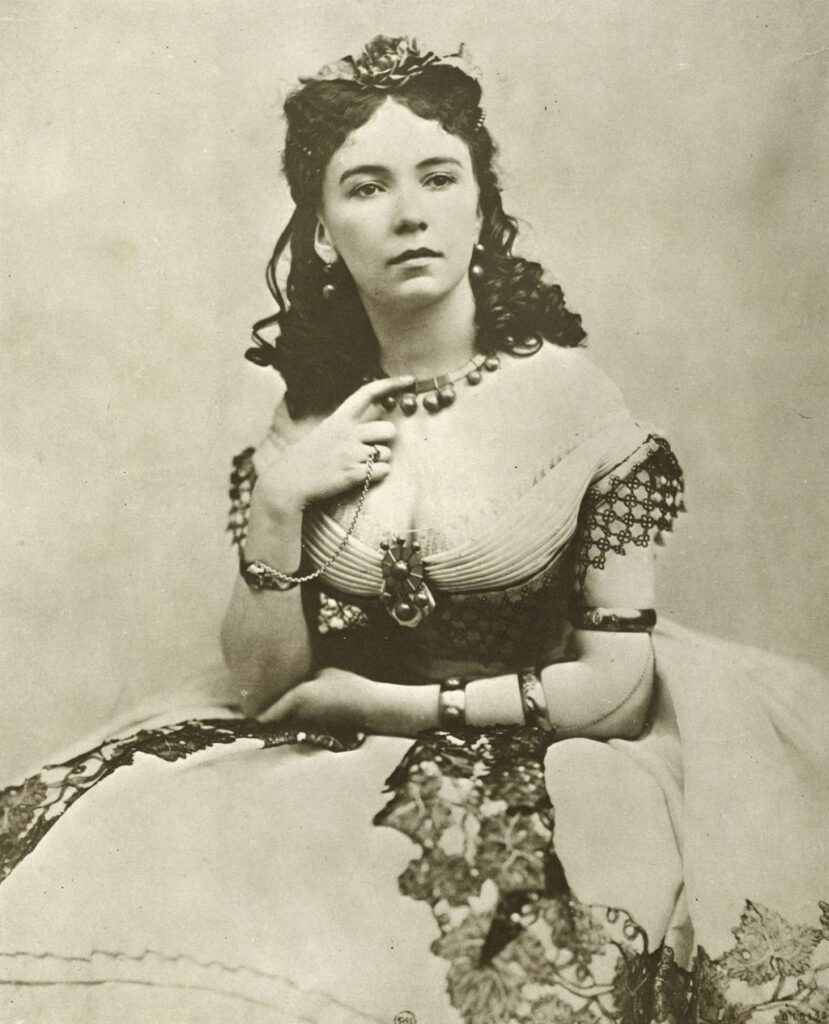
The demi-mondaines, the “does,” the scandalous women, the courtesans, or the cocottes: this is how the so-called women of easy virtue were nicknamed.
Women of great beauty, often from modest backgrounds, they engaged in prostitution in order to raise themselves into the highest spheres of society thanks to their charm, their intelligence and their talent as artists, singers or dancers, to seduce the influential men of the late 19th and early 20th centuries.
They were courted by powerful figures such as writers, artists, politicians, aristocrats and even crowned heads. But it was indeed they who chose their lovers!
Their charisma was not limited only to their ability to charm men—they were also important social actors. Some of them became the confidantes and advisers of powerful politicians, allowing them to have an indirect influence on the country’s decisions. However, this privileged position also aroused controversy and moral criticism, as they were often associated with behaviours interpreted as immoral.
Why Are They Called Cocottes?
The nickname “cocotte” has several possible origins.
It could come from the word “coquille” (shell), referring to their beauty and their outward charm.
The most likely origin would lie in the fact that they adorned themselves with luxurious outfits, and liked to add feathers to hats, fans, hairstyles, or even directly to their dresses and bodices. These feathers added a touch of lightness, elegance and theatricality to their clothes, in keeping with their status as free, independent women. Through these feathers, they came to be nicknamed cocottes.
Moreover, the term “cocotter” derives from it, since these women of easy morals perfumed themselves generously with opulent fragrances. This colloquial expression, somewhat old-fashioned and disparaging, refers to someone who has sprayed themselves with perfume excessively.
It is said that the wives of unfaithful men sometimes unmasked them by smelling this strong “cocotte” odour on them.
The Cocottes and the Link with the Perfumery of the Era
In the 19th century, the cocottes did not merely attract men through their charm and their brilliant wit—they were also recognised for their sartorial elegance. They sported clothes from Asia, such as shawls, fans and richly ornamented exotic dresses. These clothes, often imported from India and other Asian countries, were impregnated with perfumes emanating notably from dried patchouli leaves, a natural moth repellent, to protect them from insects during the long sea voyage from the East.
Patchouli, which is a plant whose essential oil gives off a powerful woody, earthy, intoxicating smell, quickly won over the cocottes, who adopted it as an olfactory signature, thus contributing to popularising its use in the perfumery of the era.
Patchouli was a symbol of exotic elegance and audacity, capturing the adventurous spirit of these mysterious women.
Besides patchouli, in their olfactory wardrobe one found fragrances with powerful, animalic musk notes. Musk evokes both passion and mystery, reinforcing their aura of enigmatic charmers.
Narcotic flowers such as tuberose, datura and narcissus also mark a turning point in the cocottes’ choice of perfumes—heady, captivating scents that become an olfactory hallmark of these women of character.
Amber, for its part, harmoniously completed this olfactory composition. With its warm, ambery, mellow notes, amber brought an opulent, magnetic, refined dimension to the fragrances.
They appropriated these unique, sensual perfumes to mark their presence and leave a memorable imprint in the minds of those they met.
The perfumery houses quickly took note of this trend and began to insert patchouli and other oriental notes into their creations. These perfumes were specially designed for the cocottes and the elegant women of high society who sought to distinguish themselves through unique, sensual fragrances at a time when eaux de cologne and floral eaux de toilette were prized for their romantic naturalness.
Thus, the close link between the cocottes and the perfume industry strengthened, shaping the evolution of olfactory tastes.
The Cocottes Honoured with the Les Cocottes de Paris Perfume Collection
Among the famous cocottes of the 19th century are emblematic figures.
These women left an indelible imprint on history and marked the society of their era.
Today, the brand Les Cocottes de Paris, created in 2015 by Anaïs Biguine, pays tribute to 5 of these legendary cocottes by offering perfumes dedicated to them. Each perfume is inspired by the personality and the unique character of these remarkable women, capturing their essence and their story in a bottle.
La Castiglione refers to Virginia Oldoïni, Countess of Castiglione, a woman described as the most beautiful of her century. Enigmatic, La Castiglione is a captivating, balmy woody amber perfume. Mugwort, cade, patchouli, ambergris and myrrh reflect the personality of one of the most desired cocottes.
Caroline Otero, a cabaret dancer and singer, is represented through La Belle Otero (the nickname she was given at the time). It is an aromatic, powdery, novelistic perfume in the image of this great courtesan. Absinthe, ginger and lavender adorn themselves with powdery, powerful notes between narcissus, musk and violet to become, thanks to sandalwood, infinitely sensual.
Mlle Cléo is Cléopâtre-Diane, known as Cléo, de Mérode. A muse and model, she posed for sculptors and painters. Of a delicate beauty, she is nonetheless an untamed cocotte.
Mlle Cléo is a fruity floral perfume where bergamot and lychee answer the delicate rose and the captivating ylang-ylang, and a falsely demure cotton flower.
Cora Pearl is a floral chypre evoking the demi-mondaine Emma Crouch. A proven seductress, she quickly grew rich thanks to her numerous carnal relationships with men of the high aristocracy. Cora Pearl is articulated around cardamom, violet and amber with a chypre accord of bergamot, jasmine, oakmoss and vetiver. It is a fragrance in which the nonchalant, seductive femininity of this cocotte is highlighted.
La Dame aux Camélias is the perfume reflecting the courtesan Marie Duplessis, who inspired Alexandre Dumas (fils) in the eponymous novel. She who added a white camellia to her neckline to signal her availability is represented by a powdery, musky floral fragrance. Violet, bergamot and grapefruit merge into a honeyed rose bouquet that stretches out into notes of ambergris and musk—gourmand, sensual and addictive.
The cocottes of the 19th century were much more than mere courtesans; they were influential, fascinating women who left an indelible mark on history.
Their close link with the flourishing perfume industry of the era helped to shape the world of perfumes as we know it today.
The legacy of the cocottes, although controversial, has continued to intrigue and inspire a great number of writers, and these singular women are forever engraved in French literature.
Banner photo credits: Loge im Sofiensaal, Josef Engelhart (1903). Vienna Museum, Austria. File licensed under the Creative Commons Attribution-Share Alike 3.0 Unported
If jewellers venturing into the world of perfumery seem self-evident to us today, the genesis of this practice is nonetheless not so distant.
While the very first to launch into this perfumed adventure was the jeweller Lacloche, in a bell-shaped bottle, the latter was very confidential and has today fallen into oblivion. On the other hand, First by Van Cleef & Arpels was in reality the very first jeweller’s perfume launched like a great perfume. Master Parfums takes you back to 1976 to discover this emblematic fragrance.
An Aftermath of Crisis
The year 1976 is a France gripped by a severe heatwave and, above all, in the aftermath of an oil shock in whose footsteps an economy in crisis followed. It is also the year when Place Vendôme saw a curious bud blossom: a product whose vocation was to play the role of a bridge between two worlds. On one side, there is the sparkling world of luxury. It is beautiful, it shines… and when it shines, it is expensive. On the other side, there is the French woman of the 1970s, whose purse and purchasing power had taken quite a hit. Never mind: on Place Vendôme, the jeweller Van Cleef & Arpels was preparing the reconciliation.
The House of Van Cleef & Arpels
The story of Van Cleef & Arpels begins in 1895 with the marriage of Alfred Van Cleef, son of a craftsman cutter of precious stones, and Estelle Arpels, daughter of a precious-stone merchant. The two lovebirds having always been immersed in the world of jewellery, it was quite naturally that Alfred partnered with his wife’s brothers to found, in 1906, the brand uniting their names. They established their quarters at number 22 Place Vendôme, a high place of Parisian elegance where the house is still found today.
Between 1926 and 1939, Van Cleef & Arpels affirmed its style when Renée Puissant, daughter of Alfred and Estelle, took over the artistic direction of the brand, accompanied by the designer René Sim Lacaze. It was during this period that emblematic pieces such as the Passe-Partout necklace or the precious Minaudière case were created. In 1933, the house patented the “serti mystérieux” (mystery setting), a technique of arranging precious stones without any metal claw being visible, a know-how that made its renown. The brand’s style, drawing on the aesthetics of the Belle Époque, became over the years increasingly prized by the high spheres of Paris.
In 1954, the house presented La Boutique, a collection of animal-shaped clips whose vocation was to offer creations at a more accessible price. Here was an initiative foreshadowing the events to come, because in 1976, Van Cleef & Arpels inaugurated what meant to be a luxury product within everyone’s reach, and surprise…: it is not a piece of jewellery!
First: The Shimmering Meeting Between Jewellery and the Fifth Sense
“I want it to smell like a jewel.” The tone is set by Claude Saujet, a veteran of the cosmetics company Orlane and at the head of the project, and from these words was born First (meaning “premier” in English), the very first fragrance of a jewellery house. A new type of adornment, more ephemeral, but no less sublime.
For the bottle of First, all in roundness, Jacques Llorente of the Ateliers Dinand found his inspiration in a Van Cleef & Arpels pendant. The curves of the cabochon and those of the bottle’s body echo each other, the latter revealing a gold-coloured juice. One must not forget that here, the jewel showcased is the amber liquid nestling at the heart of this Baccarat crystal case!
An Exuberant Composition

First belongs to the family of floral perfumes… and what a bouquet! To say that its fragrance is rich is almost an understatement, so much do the raw materials abound, almost overflow. Like a multifaceted diamond, First is an olfactory capsule brimming with more than 160 ingredients. It is Jean-Claude Ellena, then at the Givaudan perfumery school in Geneva, who signs this juice meaning to be the standard-bearer of luxury and with a devastating power of seduction. At only 28 years old, the man who would later be known as the composer of Hermès perfumes drew, according to him, “intuitively” on the spirit of the times.
The classicism of the aldehydes of a Chanel N°5 dresses itself in a crunchy opening of blackcurrant bud and mandarin. With anise and bergamot, these top notes breathe a green, crunchy air into a luxuriant bouquet. For First is above all a sumptuous floral heart of several varieties of rose and jasmine, of a creamy ylang-ylang, hyacinth, lily of the valley and narcissus. On the side of the base notes, an ambery, sensual, subtly animalic vanilla combines with the nobility of vetiver and sandalwood and with the enveloping warmth of musk and tonka bean.
Despite this avalanche of raw materials, First means to be an olfactory antidote to the ambient heaviness of the era: the propelling power of aldehydes combined with a coating of hedione, a molecule conferring transparency on floral accords, makes the bouquet airy. Jean-Claude Ellena delivers a perfume of overflowing sensuality, the embodiment of refinement and elegance. The perfumer would explain, moreover, that he used “everything that could express luxury.”
In the Wake of First
Since its release, First has never stopped reinventing itself through numerous re-editions: in a light alcohol-free water but also in an intense eau de parfum, by turns white, then black and gold for Christmas… The original fragrance has, for its part, definitively passed into posterity. A timeless floral explosion, then.
In 1976, its arrival on the olfactory landscape of the era left no one indifferent, and it took little time for other jewellers to follow in the footsteps of Van Cleef & Arpels and embark towards new perfumed adventures. We can notably cite Cartier with Must (1981), Boucheron and its eponymous Boucheron Femme (1988), or Chopard with Casmir (1992). Think of an essential jewellery brand, at random… There is a good chance that it has not only precious stones, but also a few liquid adornments to offer you. In short, if First was indeed the first, it was far from being the last.
The Pocket Quiz game is here to allow you to learn more about your favourite perfumes as well as the renowned brands of perfumery. So, what will be the next mythical fragrance you explore?
Banner photo credits: screenshot of the Van Cleef & Arpels website
That’s it, summer is here! For many, that means heading for the seaside. Should you be unable to kick back and wiggle your toes on a fine-sand beach, good news: perfumery is here to give you a helping hand. A multitude of raw materials are capable of recreating the sensation of skin warmed by the sun on a beach, and one in particular achieves it brilliantly: ylang-ylang, an unctuous and intoxicating flower that Master Parfums invites you to discover today.
A Flagship Flower in Southeast Asia

The ylang-ylang tree is native to Southeast Asia, mainly to the Moluccas archipelago in eastern Indonesia. There, “the flower of flowers” is scattered on the bed of newlyweds on their wedding night. In the Philippines, ylang-ylang flowers are woven together with sambac jasmine flowers to make garlands that adorn religious images. It is also used in “boori-boori” ointment: mixed with coconut, it yields a concoction meant to nourish the skin and hair. In short, it is hard to find a flower more appreciated than ylang-ylang in the region.
The 1960s saw the rise of its international use as its essential oil became increasingly prized. In aromatherapy, ylang-ylang is credited with anti-stress, antiseptic and sedative qualities. On the perfumery side, it is appreciated notably because it is the king of the solar note. For many, the solar note tickles our memories and takes us back to a very specific product that was all the rage on beaches in the 1930s: Garnier’s Ambre Solaire.
Ambre Solaire, a Summery Proustian Madeleine
Before the 20th century, white skin was the preserve of the rich, tanned skin being a sign of the hard outdoor labour of peasants. In the 1920s, it was Coco Chanel who reversed the trend. Her luxurious life led her to spend her weekends outdoors, on boats, colouring her skin brown. Tanned skin then became a sign of wealth and the good life. Legend has it that in 1927, seeing Coco Chanel return from one of these weekends at sea, her skin burnt by the sun, Jean Patou decided to create the first suntan oil, designed to protect from the sun while covering the skin with a veil of bronze colour, the “tan.” This was Huile de Chaldée, which Henri Almeras, the perfumer of the house of Patou, adorned with spicy floral notes and enriched with benzyl salicylate, a molecule discovered in 1908 and used as a sunscreen, capable of absorbing UV rays.
Riding the enthusiasm for this oil, Eugène Schueller, chemist and founder of L’Oréal, also sought to create a product that would protect against nasty sunburn while allowing a gentle tan. And so, in 1935, Ambre Solaire was born, a tanning oil that soon established itself as a beach-bag essential, especially from 1936 onward, the year of the first paid holidays offering the chance to treat oneself to a sunny seaside break.
At the time, the sunscreen used in Garnier’s product was none other than the famous benzyl salicylate, which gives Ambre Solaire its very distinctive olfactory signature!
Benzyl Salicylate
Benzyl salicylate gives off floral and spicy, slightly iodised wafts and readily lends solar light to the compositions into which it is incorporated. It is often paired with floral notes; in Ambre Solaire, these are rose and jasmine.
Over the years, it became apparent that benzyl salicylate was not as effective as had been believed. As research gradually developed better filters, L’Oréal removed it from its best-seller… and then Ambre Solaire’s sales plummeted. Indeed, the molecule’s scent had by then durably won over consumers. Without a moment’s hesitation, the company reworked the product’s formula to reintegrate the salicylate—a star, in the end, far more for its smell than for its anti-UV properties. Since then, benzyl salicylate has definitively set down its bags in the world of perfumery.
And ylang-ylang in all this? It turns out that the most decisive component in ylang-ylang’s smell is none other than… benzyl salicylate, which is naturally present in it! One then better understands why the flower is perfumers’ choice par excellence for bottling the rays of the sun (often hand in hand with carnation, tiaré and frangipani).
Ylang-Ylang: A Brief Botanical Overview
In Tagalog, the language of the Philippines, “ylang” means wilderness. It is therefore in reference to its natural habitat that we know the tree, which belongs to the Annonaceae family and whose Latin name is “Cananga odorata.” It can measure up to 30 metres tall in the wild under suitable climatic conditions. When it is cultivated, it is pruned so that its pretty fragrant flowers are more accessible at harvest, and its height then sits between 2 and 3 metres.
The flower’s long, tapered petals, forming clusters reminiscent of stars, give off a fragrance it would indeed be a great shame to do without. Creamy and spicy, a touch fruity, the ylang-ylang flower radiates, imbued with the light of benzyl salicylate. It is an extroverted, seductive flower with a facet that is sometimes almost animalic.
Ylang-Ylang in Perfumery
The first ylang-ylang distillation laboratory in the Philippines came into being around 1860. Shortly afterwards, the flower began to be cultivated on a larger scale and to find its way to French perfumers. Ylang-ylang production in the Philippines has, however, declined greatly since then, and its main producers today are the Comoros Islands and Madagascar.
Ylang-ylang flowers can be placed in stills to obtain a beautiful essential oil. We speak of “fractions” of essence—that is, extracts with different densities and olfactory properties. We distinguish the extra superior fraction, the extra, the first, the second and the third. The extra superior is richer and fruitier than its counterparts, and the further down the list we go, the less intense the fractions are… which in return makes them fresher. Only 40 to 50 kilos of flowers are needed to obtain a kilo of essential oil, and ylang-ylang flowers several times a year. This makes it a champion in terms of yield, and the perfumer’s material that produces the most essential oil.
One can also extract from ylang-ylang a magnificent absolute, headier than the essential oil and whose spicy notes are even more pronounced. It takes no fewer than two tonnes of flowers to obtain a kilo of absolute.
A Few Perfumes Built Around Ylang-Ylang
- There is, of course, the timeless N°5 (1921) by Chanel and its marriage of aldehydes and a sublime ylang-ylang absolute.
- In the emblematic L’Air du Temps (1948) by Nina Ricci, perfumery’s first floral-spicy, ylang-ylang nestles at the heart of a magnificent bouquet sublimated by benzyl salicylate.
- With Mayotte (2006) by Guerlain, tuberose, ylang-ylang and jasmine make up the heart of this reissue of the fragrance Mahora. A touch of frangipani and neroli opens the ball, all enveloped by a vanilla base.
- The luminous, balsamic Songes (2006) by Annick Goutal combines ylang-ylang with Bourbon vanilla. Other flowers bring the solar note to life: frangipani, tiaré and jasmine.
- In 2013, Olivier Pescheux created Eau Mohéli for Diptyque. In this floral eau de toilette with green and spicy accents, ginger and pink pepper meet a suave ylang-ylang.
- Over at Embruns d’Ylang (2019) by Guerlain, cinnamon and clove exalt ylang-ylang’s naturally spicy side while coconut milk and vanilla give the fragrance a touch of sunburn.
- With La Dompteuse Encagée (2021) by Serge Lutens, ylang-ylang rubs shoulders with an almondy facet supported by frangipani.
- In Infusion d’Ylang (2022) by Prada, the flower remains solar, but is nonetheless more veiled and transparent than usual. It is a green, fruity perfume, with an evocative accord of banana and jasmine.
A Potpourri of Other Summery Notes
Ylang-ylang is obviously not the only one with the power to whisk us off on holiday in a single sniff. We can also count on…
- Other white flowers: orange blossom, jasmine, tuberose, frangipani, tiaré… Ylang-ylang, incidentally, often calls to mind monoï, an oil obtained after macerating tiaré in coconut oil. These are the great favourites when it comes to working the solar sensation in perfumery.
- Hesperidics: bergamot, grapefruit, lemon, neroli… The zing of citrus has a knack for transporting us to the Mediterranean coast in the snap of a finger.
- Marine notes: also called aquatic notes, their iodised scent can be obtained through synthesis with molecules such as calone or helional, but there are also natural aquatic notes, derived, for example, from certain algae.
- Fruity notes: thanks to synthesis, the smells of exotic fruits such as coconut, mango, pineapple or banana make their way onto our skin… A change of scenery guaranteed.
Whatever your destination this summer, why not continue your olfactory journey with the Pocket Quiz version of the Master Parfums game? The Pocket Quiz is 120 questions about the world of perfumery in a pocket format that lets you take it with you wherever you go… even to the beach!
Other sources consulted:
L’Ylang-ylang en parfumerie – Cahiers des naturels NEZ-LMR