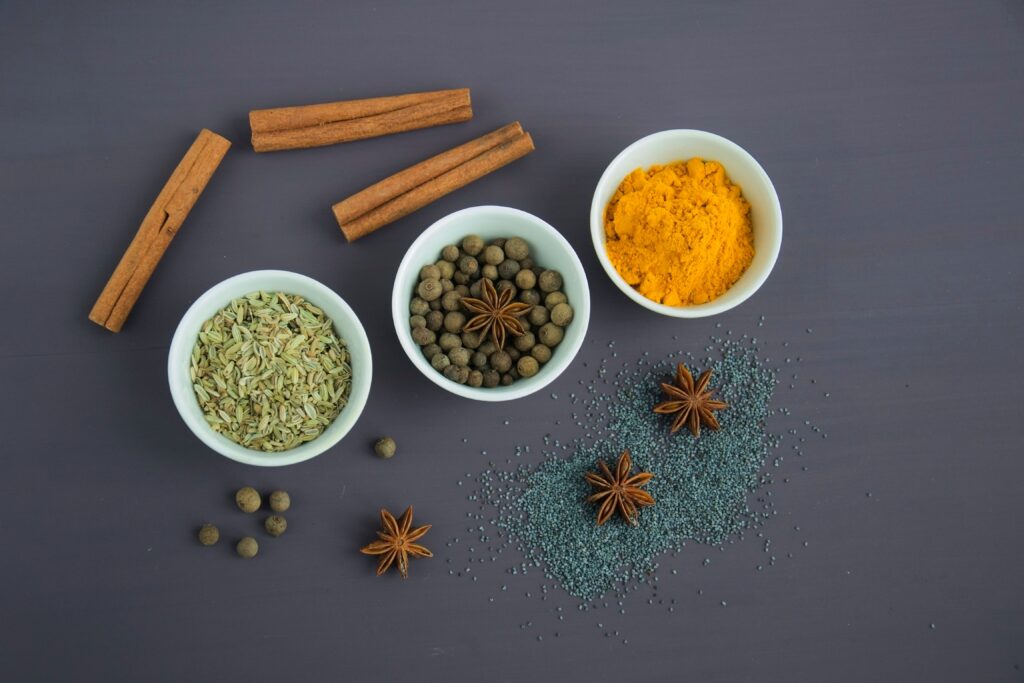
Perfumery is a delicate art that uses various ingredients to create unique, captivating aromas. Among these ingredients, warm spices hold a prime place, notably at the end of the year. These spices add a unique depth and warmth to perfumes, making them irresistible and giving an additional texture.
Distinctions Between Warm Spices and Cold Spices
Spices in perfumery are often distinguished by their sensory temperature, which influences the perception and the emotion evoked by a fragrance. Warm spices, such as cinnamon, nutmeg and clove, are characterised by their enveloping, deep smells. They tend to evoke a sensation of warmth and well-being, often associated with memories of cosy interiors and festive moments.
By contrast, cold spices, such as black pepper, cardamom or ginger, bring a sensation of freshness and vivacity. Their pungency offers a clarity and an energy that can revitalise and brighten a fragrant composition. These spices are frequently used in perfumes with lighter, airier profiles, conferring on them a distinct openness and luminosity.
Mastering the balance between these two types of spice can give rise to fragrant creations of remarkable complexity and depth, each family of spices playing a crucial role in the construction of a perfume’s olfactory identity.
Warm Spices Widely Used in Perfumery
Cinnamon: A Flagship Spice
Cinnamon is a key component in perfumery, appreciated for its ability to arouse sensations of warmth and comfort. This spice, obtained from the Cinnamomum tree, has been used for thousands of years for its captivating scent and its medicinal benefits. Historically, it enhanced incense and sacred oils as early as antiquity, revealing its richness and its depth in spiritual and ritual contexts.
Olfactorily, cinnamon offers a rich, complex profile, blending warm, sweet notes with woody touches and a hint of spice. Its versatility allows it to appear both as a top note and as a heart note, where it can play the leading or complementary role, adding depth and a spicy character to perfumes. It marries harmoniously with oriental, gourmand, and even fruity notes, to create enveloping, welcoming perfumes.
Cinnamon transcends its status as a spice in perfumery to become a true conveyor of emotions. Its use in perfumery is not limited to its sensory properties, but encompasses a deep emotional dimension, making it an olfactory signature that is at once timeless and profound.
Clove: Depth and Character
Clove is a spice that plays a significant role in the elaboration of perfumes thanks to its pungent aroma and its slightly bitter nuance. Used mainly in woody or spicy perfumes, it confers on fragrances a remarkable intensity and depth, as well as a pronounced character.
This ingredient, drawn from the clove tree, has a long history, spanning millennia in the fields of cooking and traditional medicine. In perfumery, its value lies in its ability to project a powerful and distinctly spicy scent.
The olfactory profile of clove is characterised by a penetrating, spicy robustness, enhanced by woody notes and a hint of bitterness, thus bringing an intriguing complexity to perfumes. It finds its place as a heart or base note, combining well with floral and fruity notes to enrich compositions with a rich spicy dimension.
Nutmeg: Subtle and Enveloping
Nutmeg, drawn from the nutmeg tree, has been a culinary and medicinal treasure since antiquity, revered for its distinctive taste and its curative properties. Its presence in perfumery, where it is celebrated for its subtle, comforting scent, testifies to its transition from a kitchen ingredient to an olfactory component rich in tradition and exoticism. Its taste is close to a pepper-cinnamon blend.
The scent of nutmeg is complex and multidimensional, offering a rich olfactory experience where spicy tonalities blend with sugary sweetness, all supported by a woody, musky base. This combination creates a refined subtlety in perfumes, where nutmeg brings a warm depth without ever eclipsing the other notes.
In perfumery, its versatility is showcased as a heart note, capable of complementing and embellishing a variety of aromatic profiles, from woody to floral to oriental. This adaptability makes nutmeg a favoured choice for perfume creators seeking to enrich their compositions with balance and elegance.
Allspice Berries: A Vibrant, Pungent Spice
Allspice berries, also known as Jamaica pepper or allspice, are native to the Caribbean and Central America. They are renowned for their unique scent that combines the characteristics of several spices such as cinnamon, clove and nutmeg. This blend offers a complex, spicy and woody olfactory profile with a slightly fruity nuance.
In perfumery, allspice berries are appreciated for their ability to bring a spicy, exotic touch to compositions. Their unique character makes them a fascinating choice for perfume creators seeking to infuse a touch of originality into their creations.
Pumpkin Spice: The Autumn Trend
Pumpkin Spice, known for its association with pumpkin pie in American cooking, has recently gained popularity in perfumery, where it is valued for its gourmand, warm qualities. This blend, composed of cinnamon, nutmeg, ginger, and sometimes clove and allspice, is appreciated for its rich, comforting scent that evokes autumn and its delights.
As an ingredient in candles and ambient perfumes, Pumpkin Spice is mainly used to enrich gourmand scents, adding a touch of softness and warmth. It harmonises particularly with sweet, creamy notes, contributing to a sensation of comforting, childlike indulgence.
Examples of Perfumes That Emphasise Warm Spices
Youth Dew by Estée Lauder (1953) Perfumer: Josephine Catapano Youth Dew is a spicy oriental fragrance for women that revolutionised the world of perfume with its bold blend of aldehydes, cinnamon and clove. It is a rich, complex scent, saturated with warm spices that confer on it a voluptuous, timeless sensation.
Opium by Yves Saint Laurent (1977) Perfumers: Jean Amic and Jean-Louis Sieuzac Opium is a timeless classic of spicy oriental perfumery. With its top notes of mandarin, plum, clove, coriander seed and pepper, it envelops in a mysterious, sensual veil. Warm spices are at the heart of this fragrance, giving it a charismatic, unforgettable aura.
Noir Épices by Frédéric Malle (2000) Perfumer: Michel Roudnitska Noir Épices is a modern, refined interpretation of traditional spices. It reinvents the theme with an ambery-spicy ambiance, making the spice not an accompaniment, but the star of the composition. The warm character of the spices creates an aura that is at once luxurious and mysterious.
901 by Bon Parfumeur (2017) Perfumer: Corinne Cachen This spicy ambery fragrance for women and men blends spicy notes of ginger, black pepper and nutmeg, with touches of almond and pimento at the heart, and a base of patchouli, vanilla and tonka bean, creating a rich, complex perfume that celebrates warm spices in all their splendour.
La Couche du Diable by Serge Lutens (2019) Perfumer: Christopher Sheldrake This woody ambery perfume emphasises cinnamon in its heart notes, creating an enigmatic, spicy warmth. Combined with oud, amber and woody notes in the base, the fragrance forms a rich, captivating sillage, typical of Serge Lutens’s warm spicy signature.
The Guardian Master – 5 – by Spiritum (2022) Perfumer: Philippe Paparella-Paris This fragrance fits perfectly into the theme of warm spices, with spicy bursts of nutmeg and cardamom that compose a woody bouquet enhanced by notes of pimento, pepper and turmeric, thus offering an explosion of warmth and pungency to a captivating, highly spiritual perfume.
“We live in an over-perfumed world, and yet the sense of smell remains the most underestimated, the most under-used, and also the most mysterious sense.” This is the observation made by Anne-Laure Hennequin – founder of the olfactory games brand Master Parfums. If you are only just discovering us, you could not have come at a better time: we propose to go back to the genesis of Master Parfums, retracing Anne-Laure’s journey before exploring the brand’s philosophy as well as each work in the collection.
And even if no one beats you at a game of Pocket Quiz, we bet that there are probably still a few grey areas for you regarding the history of Master Parfums – let us clear them up without further ado.
“I’ve Sniffed Everything Since I Was Tiny”: the Journey of an Enthusiast
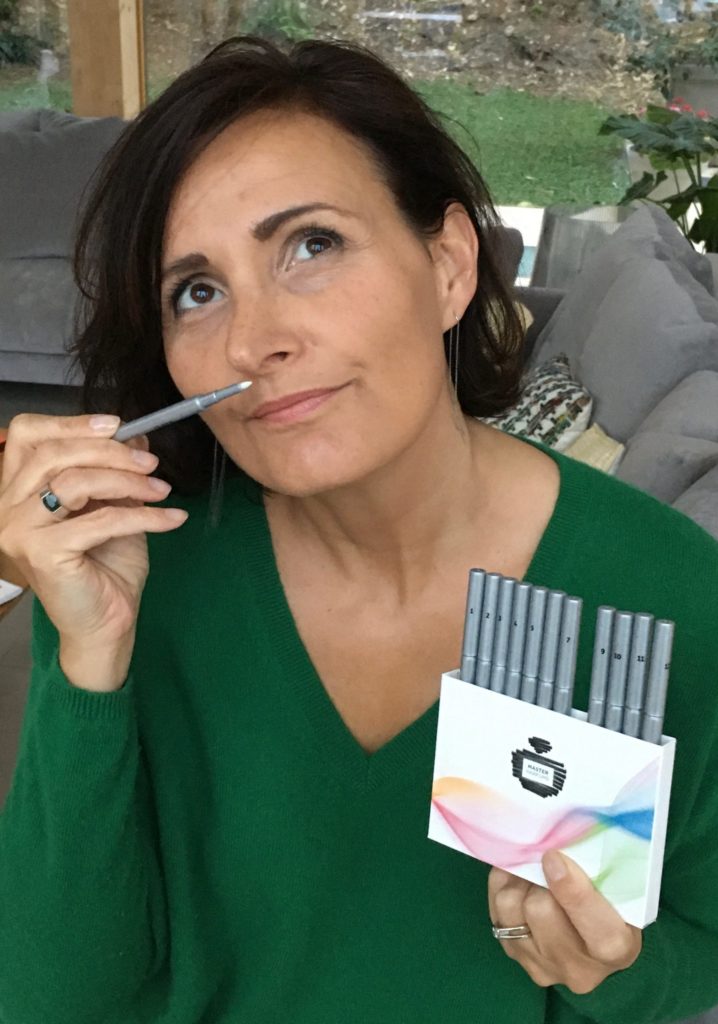
Anne-Laure Hennequin was hooked very early: her fascination with perfume and smells in general goes back to her childhood. “I’ve sniffed everything since I was tiny,” she explains. “Like many little girls, I amused myself by macerating flowers from the garden to create perfumes, not really memorable ones! My favourite game was one that let you compose perfumes. While I can picture the box very well, I can’t manage to remember the name. But it was well before Sentosphère! I remember my favourite creation, which was based on lilac and which I had poured into a little bottle of Cléa by Yves Rocher to give to my mum. I also, of course, had a collection of perfume samples and miniatures.” But at the time, Anne-Laure did not limit herself to admiring the pretty coloured juices in her pretty bottles—she was already amusing herself by smelling them blind and trying to recognise them, even organising contests with her aunt.
Not really scientific at heart, a career as a perfumer was not even to be considered at that time. When it came to higher education, she therefore chose the path of languages and, after a year in the United States, she joined a translation school. Her love for perfume did not leave her for all that—on the contrary: she did her end-of-studies internship at Clarins (which counted Angel and Elysium in its perfume catalogue), within the international training department. There, she translated the manual intended for training the teams. It was at that moment that she found her calling: that of transmission, and in this case, the transmission of a passion for the fifth sense and perfumed creation.
Anne-Laure then completed a course in perfume and cosmetics distribution, while working as a temporary beauty adviser at weekends. “Working for different brands each time, I was able to benefit from many training courses.” Then she held the position of trainer-presenter at Kenzo, first in France, then in the United States, for nearly ten years. Her mission? “To make the saleswomen understand the brand’s DNA and the new products.” Europe called, and it was in Barcelona that she settled to work for eleven years for Puig, beginning with training for Prada before extending her training to the entire group as international training director.
While Anne-Laure Hennequin was acquiring no fewer than twenty years of experience as a trainer for major perfume brands on an international scale, she realised that the means best suited to her educational objective was that of the game: she designed, with her team, training modules based on edutainment, a method combining education and entertainment—in a word, education through play. Because when one blends learning and play, one learns simply, quickly and effectively: directly involved and not just silent spectators of a teacher or tacit readers of a book, we retain much better what people are trying to transmit to us!
So, how did these edutainment modules end up giving rise to Master Parfums?
Master Parfums: Why?
Gaps in the Way of Training
In her professional life, Anne-Laure Hennequin had a front-row seat to an unfortunate observation: training courses favour knowledge of the new products, and the teaching of sales techniques serving these new products takes precedence over everything else. The brand image and the communication that carry a launch take up a great deal of space, to the detriment of olfactory culture. The result? The proliferation of “sleeping beauties”: olfactory creations that fall into oblivion under the weight of new products, gathering dust on the shelves instead of living on skins.
It is not only the saleswomen who are neglected: consumers are even more so, faced with a growing offering, but not necessarily with the expertise needed to find their way in this ocean of perfumed products. Yet Anne-Laure is convinced of it: once educated, one knows how to recognise quality, and this would allow many fragrances to be appreciated at their true value, and for us, to learn to honour and pamper our sense of smell.
An Olfactory Paradox
Beyond her professional journey, something else has struck Anne-Laure for a long time. On one side, everything is perfumed: hygiene and beauty products, supermarkets, shops, waiting rooms, the metro, food… Not a second of respite for our nostrils, our nose being solicited constantly, as if the world were a pomander.
On the other… The sense of smell is neglected! “Smell is the sense to which we give the least importance,” observes Anne-Laure. “Not only does school not bring us knowledge on this subject, but our sense of smell is not even tested, whereas we undergo tests from a very young age to check our sight, our hearing, or touch through manual activities. It is the most overlooked sense.” The Covid-19 health crisis, moreover, brought to light just how much the sense of smell is often taken for granted… Before, many people did not know that it was even possible to lose the sense of smell!
How to explain that our fifth sense is left abandoned, and above all, how to remedy it? This is where Master Parfums comes into play.
The Birth of Master Parfums
An idea then germinated in Anne-Laure’s mind: what if we could transmit the culture of perfume directly to consumers? “I felt myself invested with a mission: to simplify perfume education in order to promote its culture among everyone.”
The result? A concept of educational games within reach of complete beginners as well as enthusiasts and perfumery professionals: Master Parfums! It is time to restore the reputation of the fifth sense: not only does one learn about the fascinating world of perfume, one also puts one’s sense of smell and imagination into action. If you do not yet know the range of games, do get acquainted…
The Master Parfums Games Collection
The Master Parfums Pocket Quiz
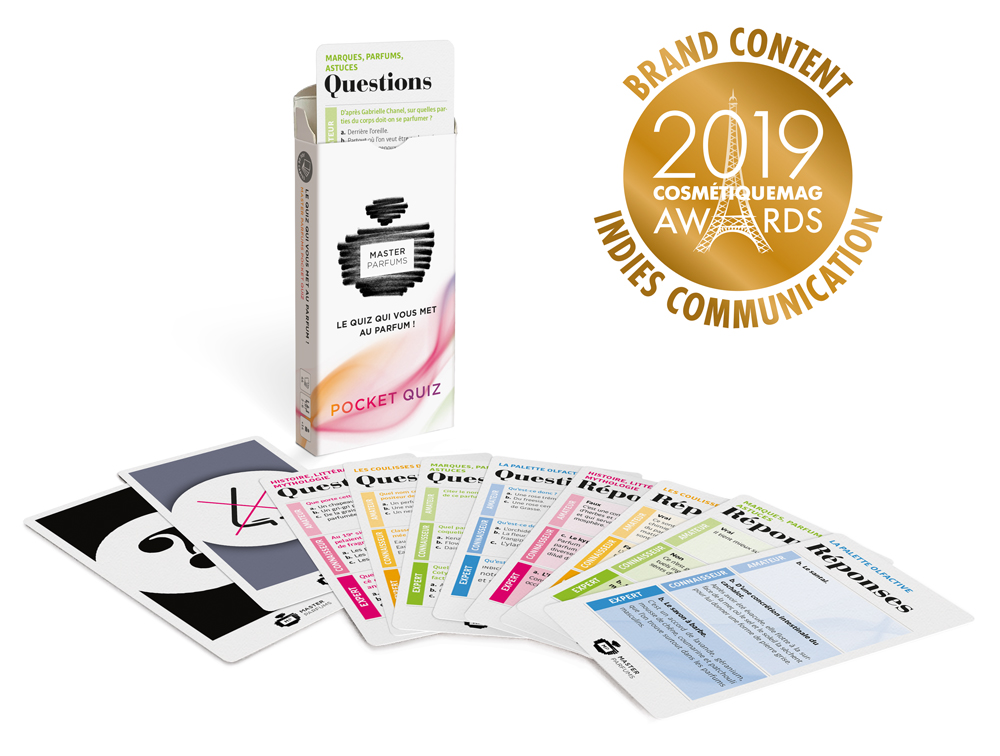
The adventure begins in 2018 with the Pocket Quiz, a perfume quiz in the form of a card game that can accompany you everywhere. A small format that is nonetheless incredibly rich! Its 120 questions are divided into four categories:
- The olfactory palette
- Brands, perfumes, tips
- History, literature, mythology
- Behind the scenes of perfume
With the questions ranging from amateur level to expert level, passing through connoisseur level, you can start a game whatever your knowledge of perfume! But to become the Master, you will need to climb the levels by answering 12 questions correctly (the 3 levels of the 4 categories), while avoiding, if possible, landing on the “anosmia” and “mystery” cards.
The Master Parfums Olfactory Game-Book
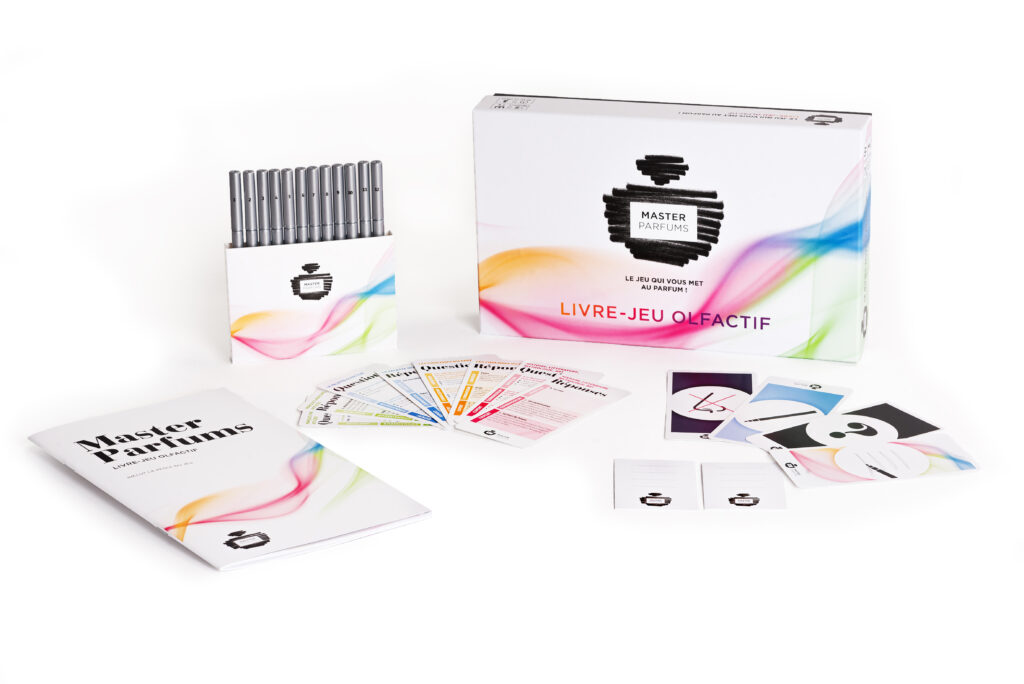
Talking about perfume is good, but it is even better to do it with an olfactory dimension! And so here comes a larger format: the Olfactory Game-Book. It contains an educational booklet and a new quiz, still with the same 4 categories and 3 levels of difficulty, but the 120 questions are different. If you own the Pocket Quiz, you can play with twice as many questions!
Another bonus: 40 olfactory challenges that rest on the little jewel of the Game-Book, its 12 scented pencils corresponding to the 12 olfactory facets most used in perfumery (hesperidic, aromatic, floral…). With these pencils, you can…
- Smell the notes and describe what they make you feel – this is the way to learn to speak (or speak better) about your olfactory emotions.
- Work on your olfactory memory by playing at recognising smells and explaining what they evoke for you, and why. Which pencil takes you back to an afternoon by the sea, a walk in the forest or your childhood snack time?
- Create a perfume from little briefs that will be given to you. The dream opportunity to momentarily bring to life that unique fragrance you have always dreamed of!
With its scented pencils, the Game-Book has even been recognised by speech therapists as a tool to aid olfactory rehabilitation!
Master Parfums then released the Pocket Quiz special Jovoy edition: it is the same concept as the first Pocket Quiz, the questions this time revolving around the niche brands present at Jovoy, the essential temple of niche perfumery on rue de Castiglione, in Paris.
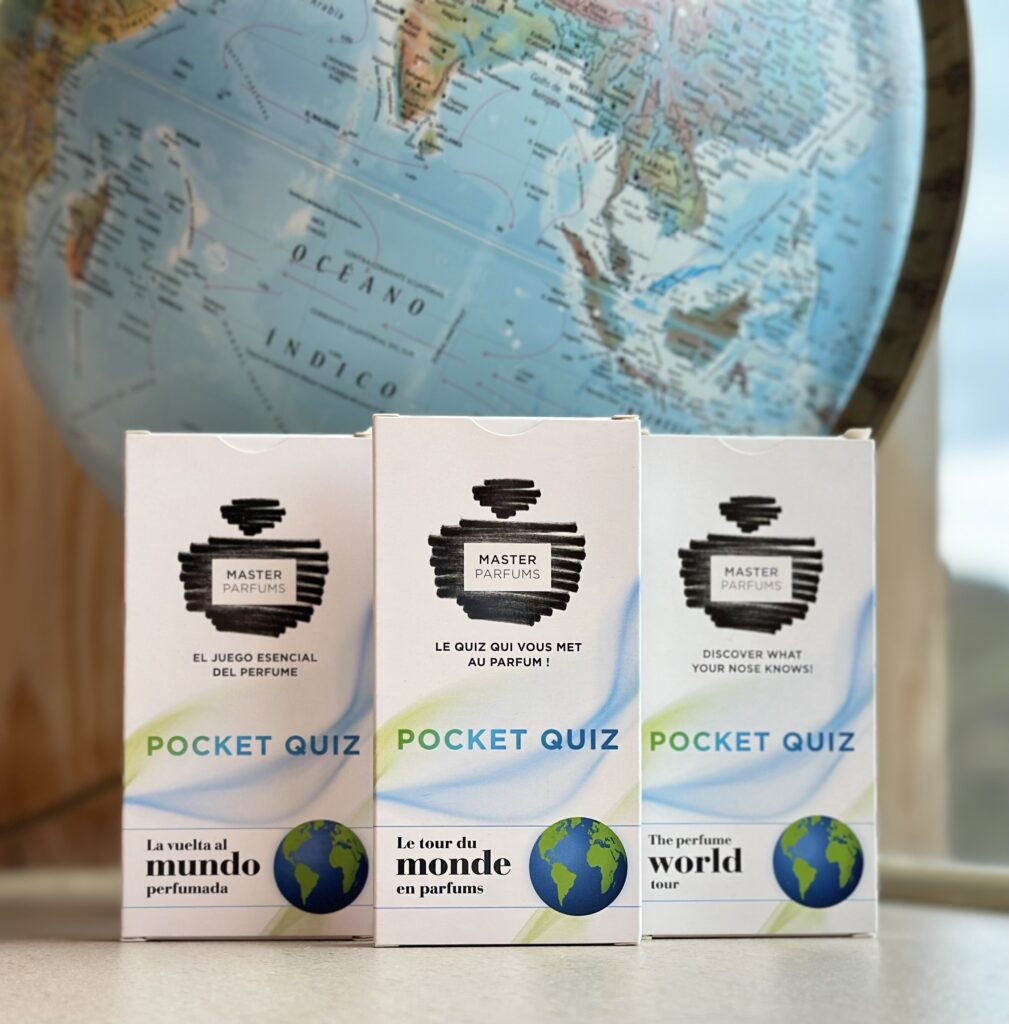
And the latest addition to the Master Parfums family, brand new and fresh, is the Pocket Quiz: Around the World in Perfumes. Here again, we take up the concept of the Pocket Quiz, with questions this time about the perfume cultures of the four corners of the world.
The 3 Pocket Quizzes can enrich the Olfactory Game-Book with new questions to enrich the games, the whole collection now bringing together 480 questions!
Beyond a playful learning experience stimulating knowledge and creativity, the Master Parfums games are also a way of (re)creating a bond, by sharing your passion with the people around you, or by initiating yourselves into the wonderful world of perfume, together. As the festive season approaches, why not take advantage of it?
Furthermore, Anne-Laure Hennequin is currently offering a new edition of her traditional Master Advent Quiz: one day, one question about perfume – it happens right here. If you get caught up in the game, that works out well, as we have just whispered a few gift ideas to you to slip under the Christmas trees…
The integration of AI into our lives is now an indisputable reality, and the perfumery sector, rich in traditions, also finds itself at a technological crossroads. From algorithms capable of defining olfactory profiles to tools for researching unprecedented combinations, AI is establishing itself as an agent of change. This article proposes to draw up an overview of these advances while opening the debate on the future impact of AI on the ancestral profession of the perfumer. Is artificial intelligence a revolution or the beginning of a replacement in the art of perfumery?
AI in Perfumery: a Portrait of Current Uses
Artificial Intelligence, commonly called AI, with its capacities for analysing and processing massive data, is revolutionising the search for new olfactory harmonies. It assists perfumers by proposing unexplored olfactory accords, optimises formulations according to consumer preferences and even anticipates olfactory trends. From the selection of essences to the prediction of their success on the market, AI proves to be a precious tool for perfumery houses.
This artificial intelligence is weaving a complex, rich web in the olfactory field, profoundly modifying the way perfumes are designed, produced and marketed. Today, its application extends across several main axes.
Creation and Formulation
Intelligent systems are now capable of analysing thousands of compounds and creating formulas that could have taken years to develop by traditional methods. AI can predict the interactions between molecules, suggest improvements to increase the stability and longevity of perfumes, and even generate less costly and more sustainable alternatives.
Personalisation
AI opens the door to unprecedented levels of personalisation. By analysing consumer data, from personal preferences to global consumption trends, it enables the creation of perfumes that respond to specific tastes, transforming perfume into a highly individual experience.
Trend Prediction
Algorithms can now detect patterns of consumer preferences and anticipate future olfactory trends. This allows perfumery brands to stay ahead of the market, developing fragrances that will capture consumers’ interest even before they know they desire them.
Production Optimisation
On the production side, AI helps to optimise supply chains and manage stocks more efficiently, reducing waste and improving the yield of precious ingredients.
Evaluation and Testing
AI is also used for the evaluation of perfumes, where sensors and smell machines can assess the quality of a perfume, its strength, its longevity and other important parameters, often more quickly and more objectively than human tests.
These current uses of AI in perfumery are only the tip of the iceberg. As the technology continues to progress, we can expect its role in the creation and distribution of perfumes to broaden, taking us towards unexplored, fascinating olfactory territories.
The Perfumer-AI Symbiosis: Collaboration or Competition?
Can AI replace the perfumer? The question is sensitive and opens up many avenues of reflection. While AI excels at managing data and detecting patterns, creativity and emotion remain the undisputed domain of the perfumer, who draws on their experience, their olfactory memory and their intuition to create perfumes that tell a story, evoke memories, arouse emotions—subtle nuances that escape AI.
In the contemporary olfactory arena, artificial intelligence has joined perfumers, giving rise to a passionate debate: are we witnessing an enriching collaboration or a competition for creative supremacy?
AI, with its ability to process voluminous, complex data, serves as a tool for perfumers to broaden their creative palette. It offers logistical support, suggesting combinations of molecules that even the most experienced perfumers might not consider. These suggestions can lead to unexpected discoveries, propelling perfume creation in bold new directions.
However, the rapid evolution of AI algorithms raises the question of their potential to surpass human capacities. With AI developing its own ‘intuition’ based on data patterns, perfumers might feel themselves in competition with a force that works 24/7, without rest or need for inspiration.
The symbiosis between perfumers and AI should not be seen as a competition, but rather as a cooperation. Perfumers bring their artistic sensitivity and their emotional understanding, while AI offers precision and innovation. Together, they can push back the frontiers of creativity, generating fragrances that are not only new, but also deeply resonant on an emotional level.
The roles within this symbiosis are clear: AI is a powerful research and development assistant, while the perfumer remains the final decision-maker, the soul behind the perfume, the one who gives the green light to transform a formula into a marketable fragrance.
It is essential to view this relationship while keeping in mind the ethical implications. Transparency about the use of AI in perfume creation is crucial to maintaining consumer trust. Moreover, the industry must consider the impact on employment and traditional artisanal skills. Finding a balance between technology and craftsmanship is imperative.
AI should not be perceived as a replacement, but rather as an additional tool in the perfumer’s arsenal. It is important that the perfume industry maintains a harmony between the efficiency of AI and the personal touch and expertise that only a perfumer can bring to a fragrance.
The future of AI in perfumery is not to replace the perfumer, but rather to become their most faithful ally, a tool harnessing their creative and analytical capacities.
Technological Avant-Garde and AI-Assisted Creation
Symrise¹ and Givaudan² show how AI can be used to innovate in the field of perfumery. These creation houses use AI to personalise experiences, optimise production processes, and push back the frontiers of creativity.
Symrise and IBM
Symrise, a world leader in flavours and fragrances, continues to push innovation in the industry, emphasising that AI represents the next great innovation since the introduction of synthetic materials into perfumery at the end of the 19th century.
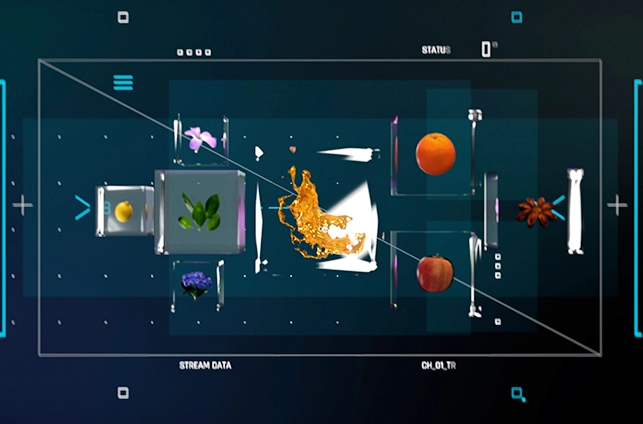
In collaboration with IBM, Symrise developed an AI perfumer assistant named Philyra that can generate perfumed compositions by analysing millions of formulas, raw materials and consumer preferences. This project makes it possible to quickly create adapted, personalised perfumes for specific markets. Philyra was used by the perfumer Dave Apel to create two distinct perfumes for the Brazilian brand Egeo by O Boticário, targeting Brazilian millennials. These creations were launched at the beginning of 2019.
By harnessing machine-learning algorithms, Symrise is able to analyse consumption trends and individual preferences to offer bespoke creations. Their approach combines data science with olfactory expertise, enabling the creation of unique perfumes that meet the specific expectations of each consumer.
Givaudan and Carto
Givaudan, another giant of the industry, integrates AI not only to analyse trends, but also to assist perfumers in the creative process. Their AI system can suggest innovative ingredient combinations, helping perfumers to explore new olfactory possibilities.
Givaudan launched Carto, an artificial-intelligence tool intended to revolutionise the perfumers’ creation process. This interactive platform is designed to maximise the olfactory performance of creations using a unique “Odour Value Map” and aims to integrate consumer understanding to refine creations. Carto encourages perfumers to explore new accords in a playful way with a touchscreen and an instant-sampling robot, which allows faster trial production than traditional methods. The system has been deployed in Givaudan’s creation centres and is being tested by perfumers for its integration into the creative process, showing promising results.
Calice Becker, perfumer and director of the Givaudan Perfumery School, emphasises that “Carto” helps perfumers to experiment more and with greater efficiency, while affirming that the human creative touch remains irreplaceable.
The perfume “She was an Anomaly” by Etat Libre d’Orange was born of an inspiration developed using Givaudan’s “Carto” artificial-intelligence tool. The AI made it possible to suggest an overdose of two ingredients: iris and white musk, with the rest of the formulation managed, considered and mastered by the perfumer Daniela Andrier. This process illustrates the integration of AI technology into the traditional art of perfume creation, marking a distinctive moment of innovation and singularity in the industry.
“This perfume is the fruit of the unexpected. I played with Carto, entrusting it with loved, familiar materials. Carto suggested an overdose of two ingredients. I took care of the rest.” – Daniela Andrier, perfumer (Givaudan)
The rise of artificial intelligence in perfumery symbolises a true revolution, redefining the frontiers of olfactory creation. These tools illustrate how AI can enrich the creative process, offering perfumers new perspectives to explore innovative, unexpected accords. This technology, complementing human intuition and all its expertise, opens the way to an era of unprecedented personalisation and innovation. However, it also raises ethical questions and challenges linked to the balance between tradition and technological progress.
As AI continues to develop, it will be fascinating to see how it shapes the future of perfumery, broadening the horizons of what we can create and feel through the sense of smell.